
Magnet Manufacturing Process
- Ethan
- Knowledge base
Magnets are made differently depending on their type. NdFeB, ferrite, and SmCo magnets are typically made using powder metallurgy, while Alnico magnets are usually made by casting.
Understanding these production processes helps you better understand the challenges that may arise during the magnet formation stage, as well as the potential costs involved. If you are a procurement specialist for magnetic materials, mastering the manufacturing principles behind magnets will provide you with valuable benchmarks for cost assessment.
Contents
Key Takeaways
- We can categorize magnets into three major categories: permanent magnets, temporary magnets, and electromagnets.
- Permanent magnets are mainly classified into neodymium magnets, ferrite, alnico magnets, and samarium-cobalt magnets.
- Neodymium magnets are primarily composed of the metallic elements neodymium, iron, and boron, with the typical compound being Nd₂Fe₁₄B.
- Ferrite magnets are made primarily from iron oxide and strontium carbonate, making them the most cost-effective option.
- Magnet manufacturing is primarily divided into two methods: powder metallurgy and casting.
What are Magnets?
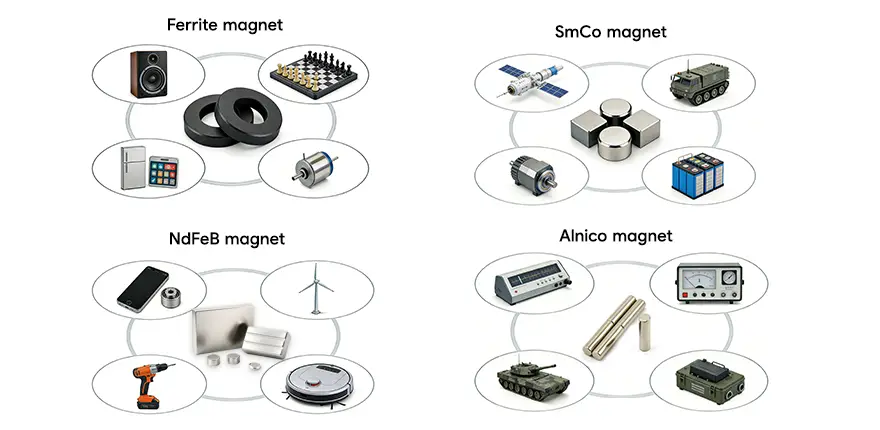
Magnets fall into three main types: permanent magnets, temporary magnets, and electromagnets. Permanent magnets are the most common. because they don’t need any power to stay magnetic. Common examples include refrigerator magnets, magnetic hooks, and the magnets found in loudspeakers. All fall under the category of permanent magnets. This article will focus specifically on several of the mainstream types of permanent magnets. If you are more interested in temporary magnets and electromagnets, we invite you to read our related blog posts: “Temporary Magnets vs. Permanent Magnets” and “What is an Electromagnet?“
Permanent magnets are primarily categorized into four common material types: NdFeB, Ferrite, Alnico, and SmCo. These four types differ a lot in magnetic strength, how well they resist corrosion, and what they’re usually used for. The following intuitive comparison table is provided to help you quickly understand the distinctions between them:
| Type | Magnetic Strength | Max Operating Temperature | Price | Typical Application Scenarios |
|---|---|---|---|---|
| NdFeB | Highest | 80–200°C | Relatively poor | Cell phone vibration motors, power tools, wind turbines |
| Ferrite | Lowest | 180–250°C | Good | Refrigerator magnets, speakers, low-end motors |
| Alnico | Medium | 500–550°C | Good | High-temperature sensors, instruments, military equipment |
| SmCo | High | 250–350°C | Excellent | Aerospace, high-temperature motors, military equipment |
Tip: Neodymium magnet is currently the most widely used magnet in civilian applications.
What materials are magnets made of?
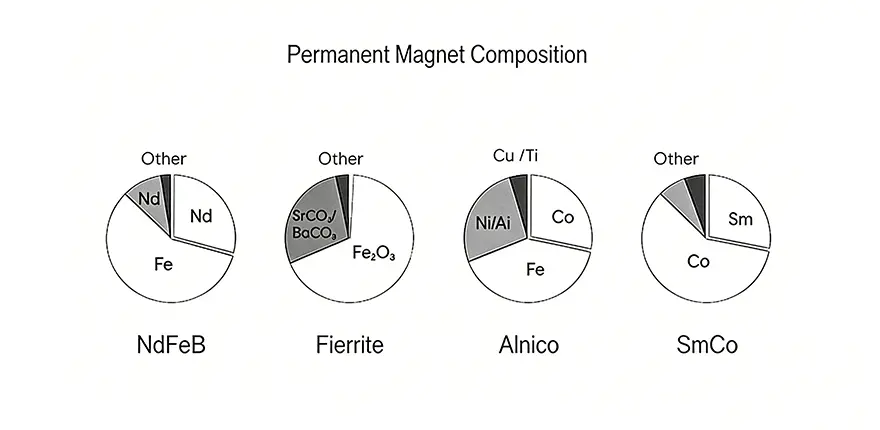
The composition and properties of magnets depend entirely on their type. Different types of permanent magnets use different raw materials, and they vary in magnetic strength, temperature resistance, corrosion resistance, and price, making them suitable for different applications:
- Ferrite: Primarily composed of iron oxide combined with strontium carbonate or barium carbonate. It offers good high-temperature resistance and excellent corrosion resistance, but has relatively weak magnetic strength.
- Neodymium: Primarily composed of neodymium, iron, and boron, with the typical compound being Nd₂Fe₁₄B. Currently, the strongest commercially available magnet is compact in size but has average temperature resistance and is prone to oxidation and rust.
- Alnico: Primarily composed of aluminum, nickel, cobalt, and iron, often containing small amounts of copper and titanium. It offers excellent high-temperature resistance and strong temperature stability, but has a lower magnetic energy product and weaker resistance to demagnetization.
- SmCo: Primarily composed of samarium and cobalt, it is divided into two types: SmCo₅ and Sm₂Co₁₇. It has the best heat resistance and very good corrosion resistance, but the material is relatively brittle and has poor machinability.
| Type | Composition | Price | Application Areas |
|---|---|---|---|
| Ferrite | Iron oxide, strontium carbonate, barium carbonate | Low | Speakers, refrigerator magnets, low-end motors |
| Neodymium (NdFeB) | Neodymium (Nd), Iron (Fe), Boron (B) | Medium | Cell phone vibration motors, wireless earphones, hard disk drives |
| Alnico | Aluminum (Al), Nickel (Ni), Cobalt (Co), Iron (Fe) | Medium-High | Precision instruments, sensors, flow meters |
| Samarium Cobalt (SmCo) | Samarium (Sm), Cobalt (Co) | High | Aerospace, defense & military, high-temperature motors |
Rare earth magnets are a class of powerful permanent magnets made with rare earth elements. The two main types are Neodymium and Samarium Cobalt magnets, both known for their exceptional strength. In contrast, magnets like ferrite and Alnico contain no rare earth elements and are considered conventional magnets. While not as strong as their rare earth counterparts, they are often chosen for their cost-effectiveness.
The Manufacturing Process of Magnets
There are many processes for manufacturing magnets, the most common of which is powder metallurgy. Neodymium, Ferrite, and SmCo magnets are generally produced using this method. The following outlines the powder metallurgy manufacturing process:
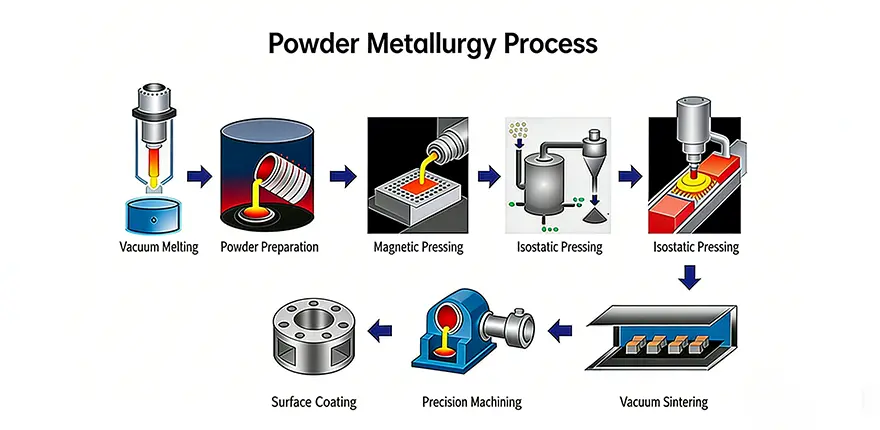
There are many processes for manufacturing magnets, the most common of which is powder metallurgy. Neodymium, Ferrite, and SmCo magnets are generally produced using this method. The following outlines the powder metallurgy manufacturing process:
- Raw Material Melting and Alloy Preparation: First, the appropriate raw materials are melted in a vacuum melting furnace. After melting, the alloy is fed into a mold and processed in a continuous casting machine to form alloy ingots or strips, laying the foundation for achieving high magnetic performance in subsequent steps.
- Powder Preparation: The melted alloy is processed into fine magnetic powder through mechanical crushing, hydrogen crushing, and air-jet milling. The alloy is crushed into fine powder with single-crystal or near-single-crystal dimensions to facilitate subsequent magnetic orientation.
- Pressing: In this process, the powder is placed into the die cavity of a press. An alignment magnetic field is applied. The magnetic field aligns the magnetic grains of the powder particles, forming an anisotropic magnet that enhances remanence and magnetic energy product.
- Isostatic Pressing: The powder is packed into a flexible container, which is then sealed and subjected to an alignment magnetic field. This produces a uniform, dense green compact, reducing density gradients and the risk of cracks.
- Vacuum Sintering: The material is loaded into a vacuum sintering furnace. During this process, the magnet is densified through particle diffusion and fusion. Mechanical strength and magnetic properties are improved through interparticle diffusion, liquid-phase sintering, or solid-phase sintering at high temperatures.
- Finishing: This includes surface grinding, slicing/cutting into smaller sizes, precision grinding, or drilling holes. This removes deformation or excess material caused by sintering shrinkage, ensuring the magnet meets the customer’s exact dimensional requirements, tolerances, and surface finish.
- Coating: Treating the magnet with coatings such as epoxy resin, electroplated nickel, or zinc plating to enhance corrosion resistance, weather resistance, and aesthetic appeal.
These are the primary manufacturing processes in powder metallurgy. Each step is crucial for the magnets. Otherwise, poor performance or failure to meet expectations may occur. This is the key to producing high-performance magnets. For Alnico production, the mainstream method is casting. The advantage of the casting process lies in its ability to achieve better magnetic properties and produce complex shapes. The following is the casting process flow:
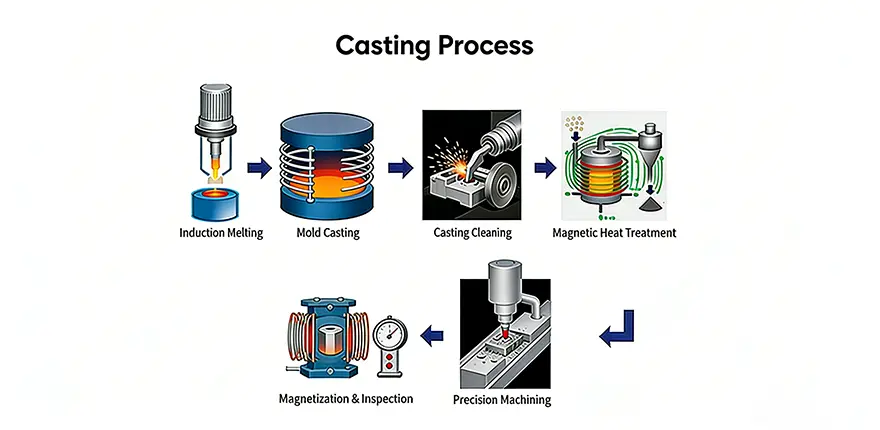
- Melting: The prepared raw materials are loaded into an induction furnace and heated to over 1750°C. This melts them into a uniform, high-quality liquid alloy, ready for the next step.
- Casting: Molten alloy is poured into a pre-formed mold. Within the mold, the liquid alloy cools slowly and solidifies, thereby acquiring the basic shape of the magnet.
- Fettling: After the casting cools, it is removed from the mold. Residual sand, runner gates, and flash are knocked off, and the surface is cleaned with a grinding wheel to prepare it for heat treatment.
- Heat Treatment: The casting is heated to a temperature above the solution treatment temperature to homogenize the alloy. It is then cooled at a controlled rate in a strong magnetic field, followed by multi-stage aging treatment to achieve high residual magnetism and high coercivity.
- Grinding: Methods such as grinding are used to achieve the final dimensions and tolerances. This ensures the magnet has precise dimensions, tolerances, and surface finish.
- Testing and Magnetization: First, each finished magnet is tested for its magnetic properties. Only those that pass are then placed in a specialized magnetizer, where a powerful pulsed magnetic field fully magnetizes them.
Through these steps, the casting process produces Alnico magnets with excellent magnetic properties and high-temperature resistance. This is also the primary reason why cast Alnico has long dominated the mainstream market share.
Tip: Alnico can also be produced via powder metallurgy, but the sintering process struggles to form the columnar crystal structure and optimal shape anisotropy required. Consequently, the magnetic properties of sintered Alnico are typically inferior to those of cast Alnico.
Some FAQs
What are permanent magnets?
Permanent magnets keep their magnetism for a very long time without needing any outside power or electricity, like neodymium or ferrite magnets.
Why is neodymium the most commonly used strong magnet today?
Neodymium magnets are the strongest ones you can buy right now for everyday use. They’re small, light, and give you the best bang for your buck.
Why do magnets have north and south poles?
Both are considered non-magnetic in engineering. Copper is typically diamagnetic, while aluminum is weakly paramagnetic.
Why do neodymium magnets rust easily?
Neodymium magnets have a lot of iron in them, so they rust quickly when exposed to moisture or air. That’s why most come with a protective coating to stop rust.
What does the maximum operating temperature of a magnet mean?
The maximum operating temperature is the highest heat level at which the magnet still works normally and keeps its full strength. Go above it, and the magnet permanently loses some of its magnetism.
For more insights, check these related blogs:
Does aluminum have magnetic properties?
Top 5 Permanent Magnet Manufacturers in China 2026
What’s the Difference Between Neo, NdFeB, and Neodymium Magnets?
Surface-Mounted vs. Interior Permanent Magnet Motors
The Comprehensive Guide to Rare Earth Magnets in 2026
Ready to upgrade your project? Browse our full product line at TOPMAG!🧲

I'm dedicated to popular science writing about magnets. My articles mainly focus on their principles, applications, and industry anecdotes. Our goal is to provide readers with valuable information, helping everyone better understand the charm and significance of magnets. At the same time, we're eager to hear your opinions on magnet-related needs. Feel free to follow and engage with us as we explore the endless possibilities of magnets together!