
Surface-Mounted vs. Interior Permanent Magnet Motors
- Ethan
- Knowledge base
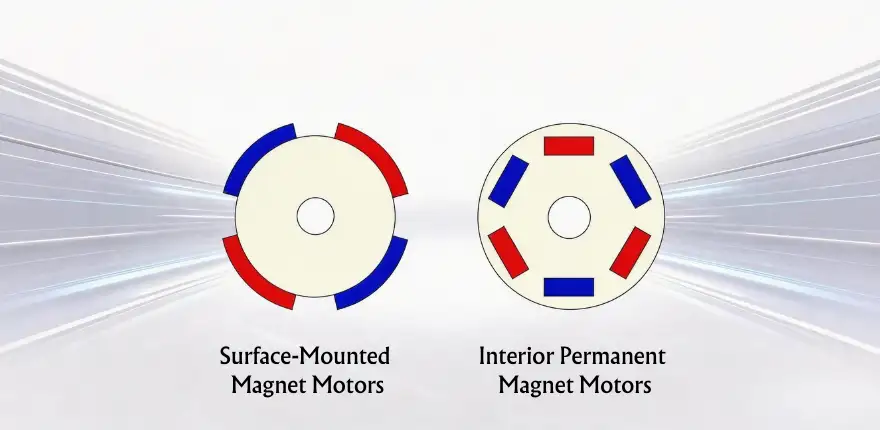
Permanent magnet synchronous motors (PMSMs) are currently the most mainstream motor type in new energy vehicles and high-efficiency industrial drives. Their core lies in using high-performance permanent magnets to directly generate a constant magnetic field on the rotor, achieving brushless, slip-free, and highly efficient synchronous operation. Based on the mounting position of the permanent magnets on the rotor and the magnetic circuit characteristics, PMSMs are mainly divided into two categories: surface permanent magnet synchronous motors (SPMs) and internal permanent magnet synchronous motors (IPMs).
- SPM motors have permanent magnets attached to the outer surface of the rotor core.
- SPM motors have a simple manufacturing process, but their magnetic circuit design is generally less sophisticated.
- SPM motors are suitable for low- to mid-range power applications.
- IPM motors embed the permanent magnets inside the rotor core.
- IPM motors have high mechanical strength and excellent magnetic circuit design.
- IPM magnet motors are suitable for high-speed, high-power applications.
Contents
Key Takeaways
- The basic structure of a PMSM includes a stator, rotor, air gap, and auxiliary components such as end caps and bearings.
- PMSMs are mainly divided into two categories: surface permanent magnet synchronous motors (SPMs) and internal permanent magnet synchronous motors (IPMs).
- The working principle of SPMs and IPMs is based on electromagnetic interaction and magnetic field synchronization.
- Surface permanent magnet motors (SPMs) directly attach permanent magnets in an arc shape to the outer surface of the rotor core. The manufacturing process is simple, and the cost is relatively low. They are suitable for low-to-medium speed servo motors, small-power brushless DC motors, and some older equipment.
- Internal permanent magnet motors (IPMs) embed permanent magnets inside the rotor core. They have high mechanical strength, the permanent magnets are naturally protected by the core, and they offer high speed and reliability, making them suitable for almost all mainstream new energy vehicle drive motors.
Development History of PMSM
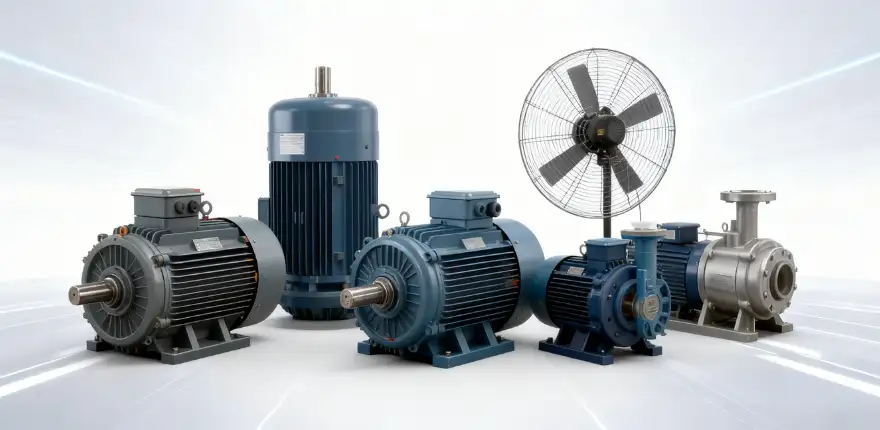
In the era of traditional motors, the mainstream was asynchronous motors and electrically excited synchronous motors. Nikola Tesla invented the three-phase asynchronous motor in 1887–1888, which subsequently dominated industrial applications. The rotor magnetic field of an asynchronous motor is generated by the induction of stator current in the rotor. It is simple in structure, low in manufacturing cost, and highly durable, but its efficiency is relatively low, its size is large, and its weight is heavy. These characteristics have long made it the preferred choice for general-purpose equipment such as industrial fans, pumps, and compressors.
The Rise of Surface Permanent Magnet motors
Major advances in rare-earth permanent magnet materials during the 1970s propelled permanent magnet synchronous motors into practical and widespread commercial use. Surface-mounted permanent magnet motors became the early mainstream type due to their simple manufacturing process, highly symmetrical magnetic circuit, and simpler vector control. However, at high speeds, the surface-mounted magnets are prone to detachment due to centrifugal forces, and can also suffer demagnetization, resulting in weak field weakening speed amplification and almost no reluctance torque generation. These shortcomings gradually limited their application in high-speed, high-power scenarios.
The Rise of Interior Permanent Magnet Motors
The concept of interior permanent magnet (IPM) motors dates back to the 1950s, but limited by the performance of permanent magnet materials at the time, they did not achieve large-scale adoption. The mature commercialization of NdFeB materials in the 1980s truly triggered its explosive development. After 2000, Toyota Prius extensively adopted IPM motors, fully demonstrating their comprehensive advantages such as wide speed range operation, high efficiency, excellent field weakening speed extension capability, high mechanical strength, good magnet protection, and relatively lower rare-earth material usage. This success directly promoted the rapid acceptance of IPMs in the new energy vehicle field. Currently, IPMs have become the absolute mainstream type in the electric vehicle drive motor field, and are also accelerating their penetration in the replacement of industrial high-efficiency variable frequency motors, while surface permanent magnet motors (SPMs) are gradually retreating to low-speed or specific power scenarios.
Basic Structure of Permanent Magnet Synchronous Motors
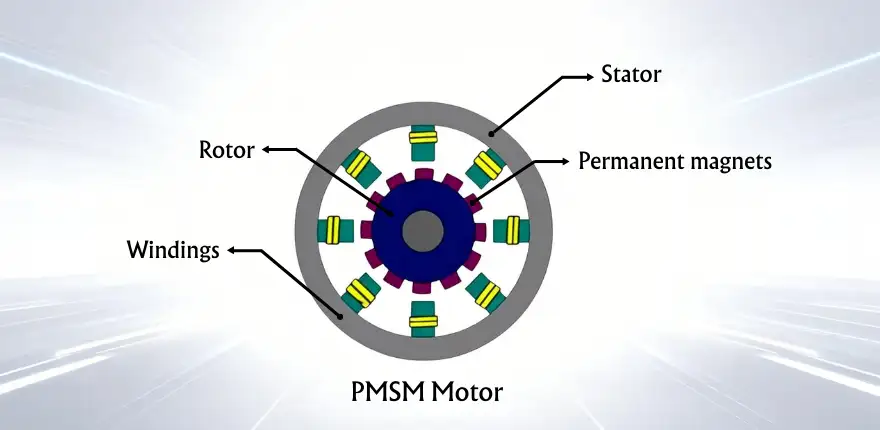
The basic structure of a PMSM consists of a stator, rotor, air gap, bearings, housing, and other auxiliary components. When three-phase alternating current is applied, these windings generate a rotating magnetic field.The rotor is equipped with permanent magnets, providing a constant magnetic field without the need for excitation current. The air gap is the main area for magnetic field interaction.
The operating principle relies on the interaction between the stator’s rotating magnetic field and the rotor’s permanent magnet field: these two magnetic fields are locked together, causing the rotor to rotate at a synchronous speed and generate electromagnetic torque. Compared with traditional asynchronous motors, PMSMs have no slippage, no excitation loss, and an efficiency typically reaching 94%–98%+, with higher power density and faster dynamic response. However, PMSMs must be equipped with a frequency converter and vector control (FOC) to achieve starting and speed regulation.
| Comparison Dimension | Permanent Magnet Synchronous Motor (PMSM) | Traditional Asynchronous Motor |
|---|---|---|
| Rotor Magnetic Field Source | Permanent magnets generate a constant magnetic field, no electricity required | The stator magnetic field induces current in the rotor, which then generates a magnetic field |
| Speed Relationship | Strictly synchronized, no slippage | With slippage |
| Efficiency | 94%–98%+ at full load | IE3 90%–93%, IE4 up to 95% |
| Power Density | High | Relatively low |
| Torque Characteristics | Wide constant torque range + strong field weakening for increased speed, strong low-speed burst power | Narrow constant torque range, rapid power drop at high speed |
| Control Method | Requires a frequency converter + FOC control | Direct grid connection available, simple control |
| Initial Cost | High | Low |
| Maintainability | Brushless, slip-ring-free, low maintenance, but requires demagnetization prevention | Simple structure, but bearings are prone to damage |
| Typical Applications | New energy vehicles, drones, high-efficiency wind turbines, robots | Traditional wind turbines, water pumps, compressors, and general equipment |
Permanent magnet synchronous motors completely outperform asynchronous motors in terms of efficiency, range, size, and power response, making them particularly suitable for the demands of new energy vehicles for long range and low energy consumption. Therefore, mainstream automakers have switched to PMSMs. Asynchronous motors, on the other hand, have retreated to cost-sensitive traditional industrial sectors.
Tip: PMSM motors typically cost 20%–40% more than equivalent asynchronous motors of the same power rating
Classification of Permanent Magnet Synchronous Motors
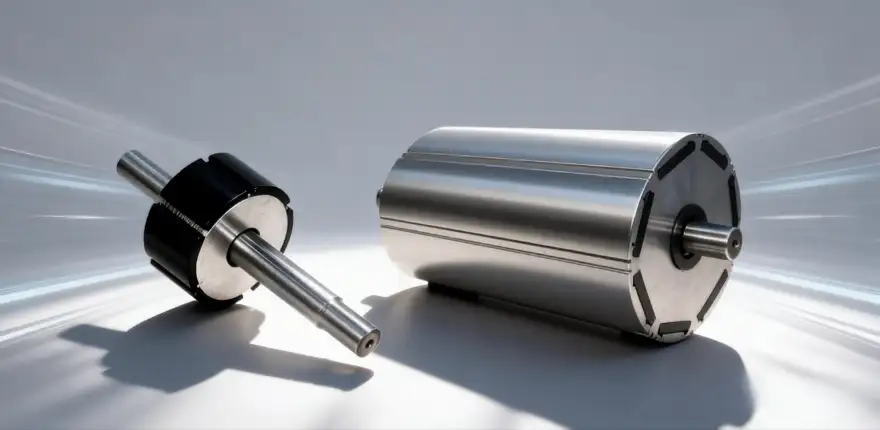
Permanent magnet synchronous motors (PMSMs) are mainly divided into two categories based on the mounting position of the permanent magnets on the rotor and the magnetic circuit characteristics: surface-mounted (SPM) and internal-mounted (IPM). This classification is the core structural division of PMSMs. SPMs and IPMs each have their own emphasis. The former emphasizes structural simplicity and ease of control, while the latter dominates in high-performance fields such as new energy vehicles.
Surface Permanent Magnet (SPM) motors have permanent magnets directly mounted on the outer surface of the rotor core in a tile-like shape. This design results in a simpler manufacturing process and a highly symmetrical magnetic circuit, which simplifies vector control. However, because the magnets are surface-mounted, the rotor has lower mechanical strength. They are prone to detachment due to centrifugal forces at high speeds. Furthermore, their field-weakening speed-enhancing capability is weak, and negligible reluctance torque. These limitations restrict their use in high-speed and high-power applications. SPM motors are typically suited to low- to medium-speed servo applications, low-power BLDC motors, legacy equipment, and scenarios where manufacturing simplicity and cost are prioritized.
An interior permanent magnet (IPM) motor places permanent magnets within the rotor laminations. Common rotor topologies include V-shaped, double-V, and I-shaped. This design imparts higher mechanical strength to the rotor, thereby improving demagnetization resistance and high-speed reliability. IPMs provide a wider constant-power speed range and generate, reducing the amount of rare-earth magnets used, improving overall efficiency, and achieving superior torque density. However, their more complex rotor design leads to more complex manufacturing processes and higher costs. Thanks to these combined advantages, IPM has become the preferred solution for almost all mainstream new energy vehicle drive motors and many high-efficiency industrial variable frequency motors.
| Dimensions | Surface Mount (SPM) | Internal Mount (IPM) |
|---|---|---|
| Magnet Location | Surface Mount on Rotor | Embedded Inside Rotor |
| Maximum Speed | Generally below 10,000 RPM | Easily 15,000–22,000 RPM+ |
| Field Weakening Speed Amplification Capability | Relatively weak | Strong |
| Torque Composition | Mainly Magnetic Torque | Magnetic Torque + Reluctance Torque (can be >30%) |
| Magnet Protection | Requires additional sheathing/bonding | Naturally protected by the iron core |
| Typical New Energy Vehicle Percentage | Less (<20%) | Over 80% (Mainstream, Absolutely Dominant) |
Tip: IPM motors typically cost 15%–30% more than SPM motors due to their more complex rotor design
Summary
Under the stringent requirements of new energy vehicles for high efficiency, lightweight, wide speed range, and low energy consumption, internal permanent magnet motors (IPM) have become the mainstream drive solution due to their comprehensive advantages, while surface permanent magnet motors (SPM) only retain a place in specific low-to-medium speed, cost-sensitive, or auxiliary motor scenarios. The dominance of IPMs will continue to solidify in the coming years, driving electrification towards higher efficiency and lower costs.
Some FAQs
What is a Permanent Magnet Synchronous Motor (PMSM)?
A permanent magnet synchronous motor is a highly efficient AC synchronous motor.
What are the fundamental differences between SPMs and IPMs?
SPMs are attached to the rotor surface, while IPMs are embedded inside the iron core. IPMs are superior to SPMs in all aspects, including mechanical strength, field weakening capability, reluctance torque utilization, rare earth efficiency, and demagnetization resistance.
Why do almost all new energy vehicles use interior permanent magnet motors?
IPMs easily achieve the wide constant torque and power ranges required by new energy vehicles through reluctance torque and excellent field weakening speed extension capabilities.
Will permanent magnet motors demagnetize?
Yes, but the risk is controllable, and the lifespan can reach 15–20 years under normal use.
How much more expensive is an IPM than an SPM?
IPM rotors are more complex to manufacture, resulting in an initial cost that is 10%–30% higher.
IPM rotors are more complex to manufacture, resulting in an initial cost that is 10%–30% higher.
Due to changes in international rare earth policies, research and development in the rare earth-free direction is accelerating, but IPM will still dominate in the short term.
For more insights, check these related blogs:
The Comprehensive Guide to Rare Earth Magnets in 2026
Comprehensive Overview of Permanent Magnets
Six Factors Affecting NdFeB Prices
Global Magnet Supplier TOPMAG: 2025 Canton Fair
5 Factors Affecting Neodymium Magnet Wholesale Prices
Ready to upgrade your project? Browse our full product line at TOPMAG!🧲

I'm dedicated to popular science writing about magnets. My articles mainly focus on their principles, applications, and industry anecdotes. Our goal is to provide readers with valuable information, helping everyone better understand the charm and significance of magnets. At the same time, we're eager to hear your opinions on magnet-related needs. Feel free to follow and engage with us as we explore the endless possibilities of magnets together!