
5 Factors Affecting Neodymium Magnet Wholesale Prices
- Ethan
- Knowledge base
The wholesale price of neodymium magnets hinges on five main factors: rare earth raw materials, magnet grade, supplier type, tolerance requirement, and order quantity. If your profession relates to procurement, you will need to understand what influences those costs.
- Rare earth raw material prices can fluctuate rapidly, directly dominating your budget.
- Magnet grade can significantly widen the unit price gap.
- Good supplier relationships can help you obtain more favorable prices.
- Choosing higher tolerance requirements may increase costs.
- Changes in the market and supply chain can alter your final payment price.
Contents
Key Takeaways
- Understand that there are five major factors affecting wholesale prices: the price of rare earth raw materials, magnet grade, supplier type, tolerance requirements, and order quantity.
- Conventional grades N35~N42 should be your first choice if you want to secure stable and low prices over the long term. They are well-performing grades, up to 30~80% cheaper than high performing grades.
- You will want to track the rare earth prices regularly. For example, the current price for Pr-Nd oxide is between $76,000 and $79,000 per ton, and that will also impact your total costs.
- Bulk order usually gives the best value. Usually, the larger order quantity, the lower the price-per-unit feature.
- Be very careful with shipping costs. Try to source from large-scale factories in China. They have good expertise in the logistics chain. Monitor fuel prices closely to control as much of the budget and risk.
Neodymium Magnet Raw Materials
Types of Neodymium Magnets
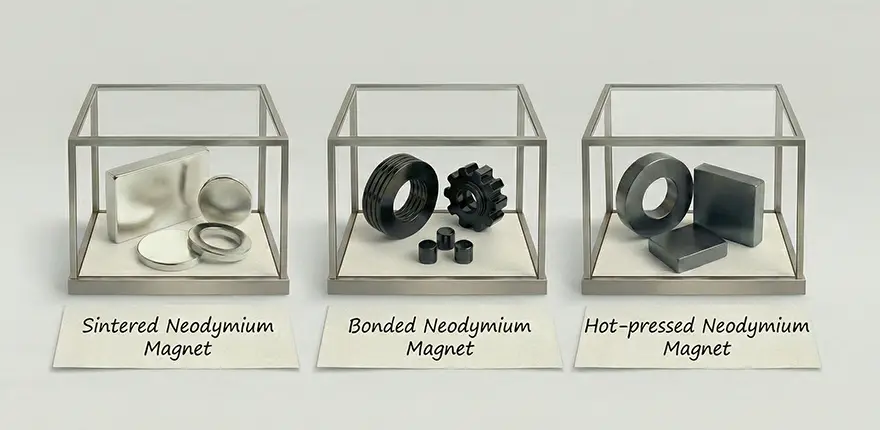
In selecting neodymium magnets, you should be aware of the kinds best suited for particular uses. Generally, manufacturers produce three kinds of neodymium magnets: sintered neodymium magnets, bonded neodymium magnets, and hot pressed neodymium magnets. Each comes with different advantages, magnetic performance, and uses.
The table below lists the main types of neodymium magnets commonly used:
| Magnet Type | Manufacturing Process Description | Common Uses |
|---|---|---|
| Sintered NdFeB | Produced by high-temperature sintering using powder metallurgy | Electric vehicle motors, wind power generators, industrial high-performance motors |
| Bonded NdFeB | Magnetic powder mixed with resin polymer and injection molded | Micro motors, small sensors, office automation equipment |
| Hot-pressed NdFeB | Produced using high-temperature and high-pressure deformation process | Automotive EPS motors, high-performance micro motors, sensors |
You will notice that sintered neodymium magnets and hot-pressed neodymium magnets are the most common types for high performance neodymium magnets, especially suitable for applications requiring strong magnetic force and high temperature resistance. Although bonded NdFeB has lower magnetic strength than the other two, it is very suitable for complex shapes, multi-pole magnetization, and large-volume precision production.
Material Properties and Costs
You certainly hope the chosen magnets can provide sufficient magnetic force, durability, and cost effectiveness. Neodymium magnets have extremely strong magnetic performance, which helps achieve high efficiency and high power output in space-limited applications. In addition, although the price of neodymium magnets is higher than that of ferrite, in large volume purchases, by selecting appropriate grades, overall cost control can still be achieved.
Ferrite magnets are robust with good heat resistance, suitable for high-temperature or outdoor environment applications. However, ferrite has a weaker magnetic force and usually requires a larger volume to achieve the same effect.
The following briefly introduces the two main magnet materials:
| Property | Ferrite Magnet | Neodymium Magnet |
|---|---|---|
| Magnetic Strength | Lower | Extremely high |
| Impact Resistance | Higher | Lower |
| Corrosion Resistance | Excellent | General |
| Outdoor Suitability | Excellent | General |
| Cost | Lower than neodymium | Higher than ferrite |
| Heat Resistance | High | Limited |
You should also check market prices. In the global market, finished neodymium magnet prices range from a few dollars to twenty dollars per kilogram in different regions. The figure below shows the price differences of neodymium magnets across various regions.
When choosing the right material, a balance must be struck between magnetic force requirements, working environment, and budget. This helps you purchase suitable neodymium magnets at the most favorable price.
Pr-Nd Costs and Rare Earth Prices
Pr-Nd Price Fluctuations
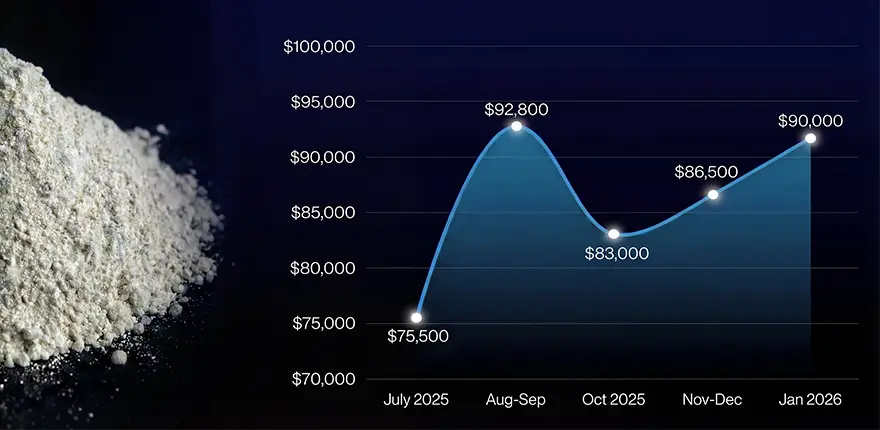
Neodymium magnet raw material prices fluctuate greatly. Many factors can cause Pr-Nd prices to rise or fall. You need to closely monitor these changes because they will directly affect your procurement expenditure.
The table below lists the main reasons affecting Pr-Nd price fluctuations:
| Factor | Description |
|---|---|
| Upstream Assets and Raw Materials | Costs of rare earth mining, separation, and refining are influenced by mineral resources and refining processes, directly dominating Pr-Nd prices. |
| Inventory | Oversupply can easily lead to price discounts, while supply tightening stimulates strong downstream stocking, thereby driving prices higher. |
| Industry Trends | If capacity expansion fails to keep pace with demand growth, Pr-Nd prices are prone to rise. |
| Labor and Production | Changes in labor costs and production efficiency will indirectly affect Pr-Nd production costs and market prices. |
| Capacity Adjustments | The industry's overall ability to meet market demand directly determines supply levels and influences price trends. |
| Policies and Geopolitical Events | China's rare earth mining quotas, export controls, and other policies, as well as geopolitical events, may significantly increase or decrease supply, causing dramatic fluctuations in Pr-Nd prices. |
Before purchasing neodymium magnets, please check the following items. If the rare-earth supply is insufficient or demand is great, prices will rise. Planning orders in advance can help avoid suddenly paying higher prices.
Rare Earth Market Impact
Rare earth prices are crucial to Pr-Nd costs. Most neodymium magnets are made using rare earth elements, and these raw materials mainly come from rare earth mining, separation, and refining. When rare earth prices rise, the cost of producing high-performance magnets also increases, which means the wholesale price of every neodymium magnet will rise.
- Changes in rare earth prices affect more than just raw material costs.
- When Pr-Nd prices rise, neodymium magnet prices usually also rise.
- Rising rare earth prices increase the cost of recycled magnets or substitute materials, so magnet prices everywhere may rise.
Tip: Closely monitor rare earth price trends. If rare earth prices rise, communicate with suppliers. You may need to lock in Pr-Nd or magnet prices in advance.
Tooling and Design Complexity
Standard vs. Custom Molds
When choosing the production method for neodymium magnets, you must decide between standard molds and custom molds. This choice will affect your costs and delivery cycle.
Standard molds have lower costs, faster delivery, and require no special design. These molds are suitable for the production of conventional shapes, as manufacturers usually have ready-made mold inventory and can proceed directly with wire cutting.
Custom molds have higher initial costs but offer more design options. This type of mold is best suited for large volume production or special products, allowing you to request precise shapes and complex features, especially suitable for complex shaped magnets in bonded NdFeB or hot-pressed processes.
Tip: If you want to test the market or reduce costs, start with standard molds. If you need a unique appearance, complex irregular shapes, or special functions, custom molds are more suitable for your brand.
Design Intricacy and Cost
The design of neodymium magnets affects price. Simple shapes have lower manufacturing costs, while complex designs require more work and higher investment.
- Special shape designs help meet different application scenarios, but require molds, invisibly increasing costs.
- High-precision tolerances make magnets more suitable for precision assembly, but increase product rejection rates, thereby raising prices.
- Injection-molded integrated designs allow magnets to bond directly with metal parts. This design makes motors appear more integrated, but production costs are higher.
Custom mold costs range from $1,000 to $5,000. Simple standard molds may start at $1,000. If you need molds with multiple cavities or complex multi-pole orientation, prices may exceed $5,000. Generally, when producing 100,000 or more magnets, the cost per magnet will be lower.
| Cost Factor | Description |
|---|---|
| Initial Mold Investment | Upfront cost depends on design, size, and process type. |
| Maintenance and Repairs | You pay to keep the mold in good condition over the long term. |
| Economies of Scale | Large-volume orders can significantly reduce the cost per magnet. |
| Small-Batch Production | Small-batch production has higher unit prices because setup costs are spread over fewer products. |
Note: Before starting, please plan your design and order quantity first. This helps you control costs and achieve the best cost-performance ratio.
Order Volume and Scale
Economies of Scale
Buying more neodymium magnets at once results in a lower price per magnet. This is because factories can spread fixed costs across more units. The larger the output, the lower the average price per magnet. In addition, manufacturers can obtain more favorable prices when purchasing rare earth raw materials in bulk. Therefore, large one-time orders can help you save money.
Tip: Planning a large purchase? Check with suppliers to see if they provide discounts for a volume order. Usually, unit prices decrease as order quantity increases.
Manufacturers usually set a minimum order quantity, called MOQ. You must purchase at least this quantity to enjoy wholesale prices. MOQ helps factories produce more efficiently and maintain low prices. Knowing the MOQ allows one to plan purchase quantities and required funds accordingly. It gives the buyer more confidence in negotiating with suppliers.
Here are some minimum order quantity examples from different companies:
| Manufacturer | Minimum Order Quantity |
|---|---|
| TOPMAG | 100 pieces |
| SuperMagnetMan | 50 pieces |
| totalElement | 10 pieces |
| K&J Magnetics | 10 pieces |
| Stanford Magnets | 10 pieces |
Understanding the Minimum Order Quantity will prevent excess purchases and save money. You can also use it to secure better pricing. Always ask about the minimum order quantity whenever you place an order. This will help in controlling your inventory and your costs.
Note: If you plan your order scale in advance, you can obtain the most favorable prices and ensure smooth business operations.
Logistics and Transportation
Shipping Costs

When purchasing neodymium magnets, transportation costs account for a large portion of the total cost. These costs include shipping fees, warehousing fees, and insurance fees, etc. You should consider the transportation distance of the magnets, as well as the packaging method.
- Shipping costs derive from the total order weight, volume, and protective packaging of the magnets.
- If you hold the container or pallet before delivery, you will need to pay warehousing fees.
- Insurance can protect your goods from magnetic interference, collision damage, or loss.
- Good packaging and careful handling help prevent collision breakage and reduce insurance costs.
Distance and Fuel Prices
The distance between the supplier and you will affect your transportation costs. If the supplier is farther away, you will need to pay higher sea or air freight. Fuel prices fluctuate sharply. When fuel costs rise, freight companies will increase charges. These increased costs will ultimately be reflected in your bill.
Fuel price changes will affect your supply chain. Shipping companies will adjust prices to maintain profits. You may see additional fuel surcharges (BAF) on your bill. When transportation costs rise, the landed cost per magnet will also increase. Due to rising transportation costs, you will also need to pay more for warehousing fees and potential tariffs.
- When fuel prices rise, shipping companies need to increase expenditures.
- These costs will ultimately be passed on to you in the form of higher freight.
- Rising transportation costs will change your inventory and pricing plans.
You can save on freight through some clever methods:
- Only place production orders when needed to avoid additional storage space.
- Using professional anti-shock packaging and container LCL can reduce waste and save money.
- Sturdy packaging and magnetic shielding help prevent returns and losses.
- Larger orders allow trucks or containers to load more goods, thereby reducing the transportation cost per magnet.
Note : Keep a close eye on fuel prices and shipping dynamics. Orders should be planned rationally, and suppliers near major ports should be chosen for cost savings.
Understanding these five factors allows the buyer to compare different suppliers and achieve better prices: raw material cost of rare earth, magnet grade, tooling, order quantity, and logistics cost, all of which go into making the total price.
The table below explains how each factor helps you negotiate with suppliers:
| Factor | How It Helps You Negotiate |
|---|---|
| Raw Materials | Closely monitor changes in Pr-Nd and heavy rare earth prices |
| Magnet Grade | Choosing appropriate grade can avoid unnecessary performance premiums |
| Tooling | Choosing standard shapes can save costs |
| Order Volume | Large purchases can apply for tiered discounts |
| Logistics | Choosing suppliers near ports can save freight |
Some silly mistakes include focusing exclusively on low prices and other freight charges, neglecting magnetic shielding packaging rejected by air, and so on.
Informed decisions continue to be based upon all current market news regarding rare earths.
Some FAQs
Which type of neodymium magnet is most suitable for your application?
Most neodymium magnet purchasers should choose sintered NdFeB, which has the highest magnetic performance and is suitable for applications requiring a strong magnetic force.
How to reduce the price of each magnet?
The price becomes attractive as quantities increase. Use standard shapes rather than complex custom irregular shapes. Choose source factories rather than traders to save on middle margins. Always compare prices from other suppliers before making a purchase.
Why do rare earth prices fluctuate so frequently?
Rare earth prices depend on China’s rare earth mining, supply-demand relationship, geopolitical events, and explosive downstream demand. You should follow global market news to plan procurement.
What is the Minimum Order Quantity (MOQ)?
MOQ is a quantity set as a condition by the supplier for efficient production and reduced setup costs. If you reach the minimum order quantity, the supplier offers wholesale prices and tiered discounts.
How does transportation distance affect your costs?
Transportation costs go up with an increase in distance. Fuel prices, air freight, and sea freight accumulate quickly. Choosing large Chinese coastal factories closer to you can significantly save logistics costs.
For more insights, check these related blogs:
TOPMAG cordially invites you to the 138th Canton Fair!
Top 5 Permanent Magnet Manufacturers in India 2026
2025 India Magnetic Materials Supply Chain and Production
Ready to upgrade your project? Browse our full product line at TOPMAG!🧲

I'm dedicated to popular science writing about magnets. My articles mainly focus on their principles, applications, and industry anecdotes. Our goal is to provide readers with valuable information, helping everyone better understand the charm and significance of magnets. At the same time, we're eager to hear your opinions on magnet-related needs. Feel free to follow and engage with us as we explore the endless possibilities of magnets together!