
 Electromagnetic energy refers to the energy stored in electromagnetic fields, which is actually composed of two parts: electric field energy and magnetic field energy. The formation of electromagnetic energy is typically caused by the accelerated motion of charged particles: stationary charges produce electrostatic fields, currents produce magnetic fields, and the two couple through electromagnetic induction to form changing electromagnetic fields. Electromagnetic signals utilize the Lorentz force produced by the electromagnetic field on charged particles to do work, transforming energy into other forms. Electromagnetic energy can propagate in the form of electromagnetic waves, with a constant speed in a vacuum.
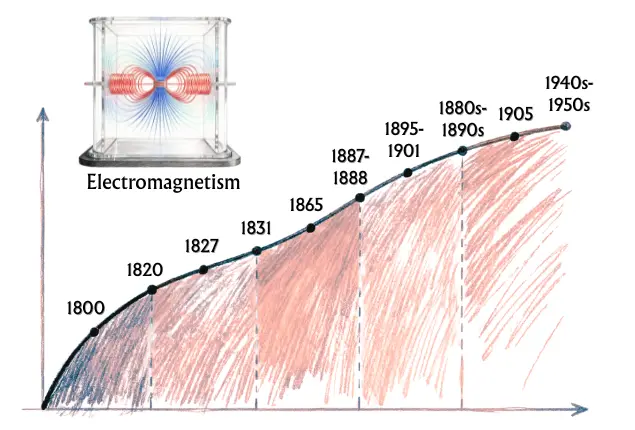 In 1800, Italian physicist Alessandro Volta invented the first battery. Batteries quickly gained widespread attention, and scientists actively applied them to various experiments. Oersted was the first to discover the magnetic effect of electric current, which meant that there was a very close relationship between electricity and magnetism. Inspired by Ohm’s law, Michael Faraday used a battery-powered electromagnet, winding a coil around it, to repeatedly test and prove that a changing magnetic field could generate an electric current, the phenomenon of electromagnetic induction. Ohm used batteries to build circuits with wires of varying lengths, measuring the relationship between current and voltage. Through countless experiments, he derived Ohm’s law.
In 1873, James Clerk Maxwell proposed Maxwell’s equations, unifying the relationship between electric and magnetic fields and laying the theoretical foundation for the development of technologies such as radio and radar.
In 1887, Hertz experimentally confirmed the existence of electromagnetic waves predicted by Maxwell. Shortly after, Marconi invented wireless telegraphy, and Tesla popularized alternating current transmission technology.
At the beginning of the 20th century, Einstein’s special theory of relativity unified electromagnetism with spacetime, explaining the principle of the constancy of the speed of light. In the 1950s, Richard Feynman and others established quantum electrodynamics.
 The development of electromagnetism has had a profound impact on human civilization. Faraday’s law of electromagnetic induction accelerated the invention of the generator, paving the way for humanity’s transition from the steam age to the electrical age. Edison and Tesla’s power systems enabled large-scale power generation and long-distance transmission, allowing the power industry to develop rapidly, with global electricity coverage exceeding 90%.
The further development of electromagnetic waves ushered in a new era of wireless communication. Since the 1950s, radio broadcasting, television, and satellite communications have facilitated the global flow of information, and electromagnetic technology is the foundation for the development of the Internet, 5G, and the Internet of Things. According to World Bank data, electromagnetic technology contributes more than 10% to global GDP.
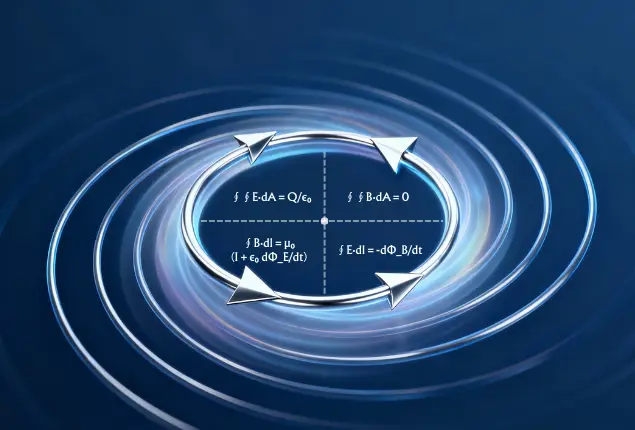
Maxwell’s First Equation: Gauss’s Law
Maxwell’s Second Equation: Gauss’s Law for Magnetism
Maxwell’s Third Equation: Ampère-Maxwell Law
Maxwell’s Fourth Equation: Maxwell-Faraday Equation
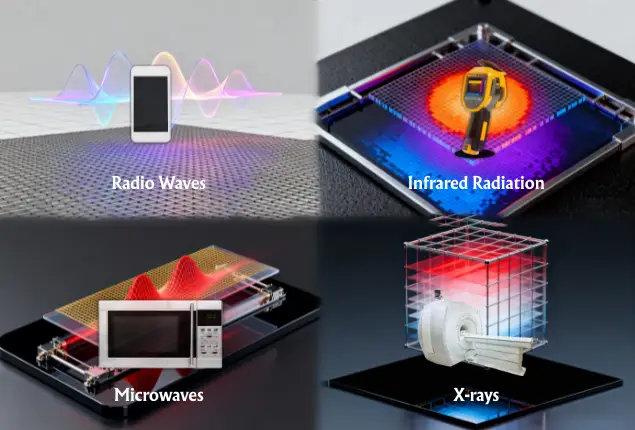 Radio Waves: Used for broadcasting, mobile communication, and GPS navigation.
Infrared Radiation: For thermal imaging, remote controls, and night vision devices.
Microwaves: Heating food in microwave ovens, radar detection, and satellite communication.
X-rays: For medical imaging and material detection.
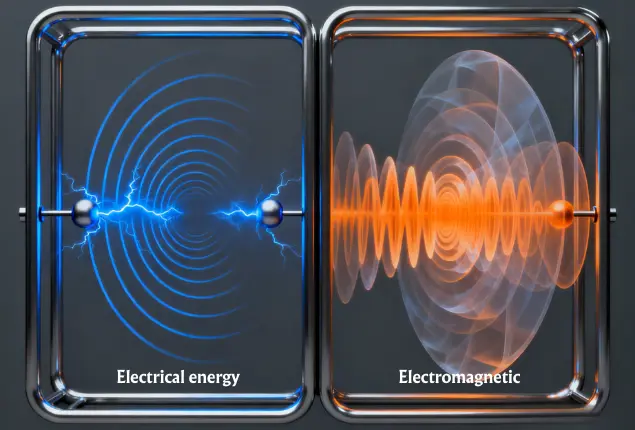 Electrical energy specifically refers to the energy stored in electrostatic fields, mainly originating from the charge separation of relatively stationary or low-speed moving charged particles. It focuses on the static aspect of the electric field and does not involve the dynamic effects of the magnetic field.
Electromagnetic energy is a broader category that includes electrical energy, magnetic field energy produced by moving charged particles, and the energy of particles that inherently possess magnetic dipoles. The electricity in our homes is essentially a special case: it is the interaction between dynamic electric and magnetic fields, rather than purely electrostatic.
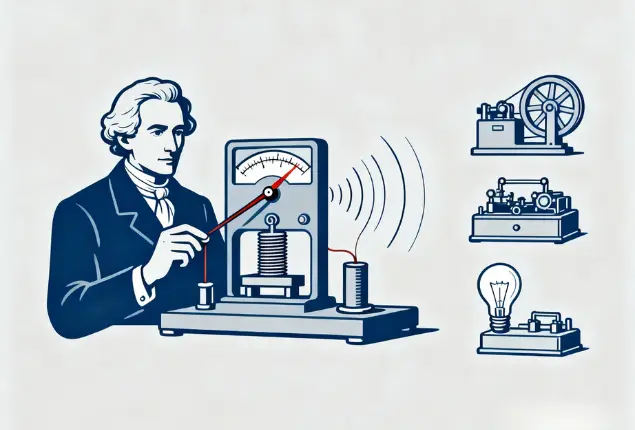 The discovery of electromagnetism marked humanity’s entry into the electrical age. This revolution greatly optimized production methods and improved people’s quality of life. The discovery and application of electromagnetic waves ushered in a new era of wireless communication, promoting global information flow and cultural exchange.
