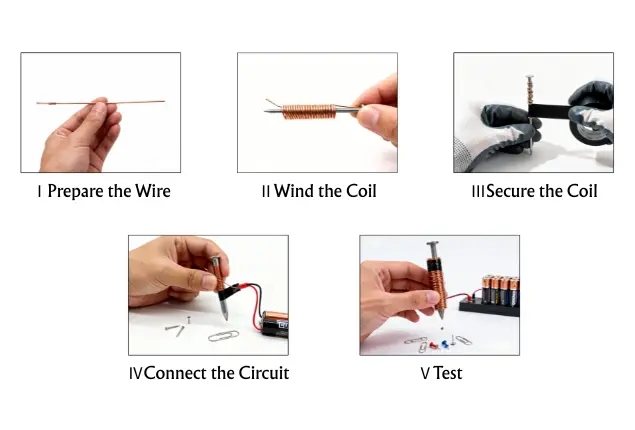
Permanent magnets are something everyone is familiar with. They are magnets that come with their own permanent magnetic field. An electromagnet, on the other hand, is a temporary magnetic field generated by electric current, most commonly seen in maglev systems. It produces a temporary magnetic field through current and can control the magnetic field strength by adjusting the current intensity. In theory, it is the magnet with the highest magnetic performance among all magnets today. Next, we will systematically introduce the basic knowledge of electromagnets, hoping to bring help to your life and studies.
 An electromagnet is actually a magnetic field generated by an electric current. It is usually composed of three simple parts: a solenoid, an iron core, and a power source. The biggest difference from permanent magnets is that the magnetic field strength and polarity of an electromagnet can be adjusted, and the magnetic field disappears after power is cut off. Need a stable, permanent magnetic field? Contact us for customized permanent magnet solutions.
 The working principle of an electromagnet primarily relies on two important physical phenomena: The magnetic effect of electric current. Any energized wire will produce a magnetic field around it. Magnetization of ferromagnetic materials: When an electric current passes through a solenoid, a ring-shaped magnetic field is generated around the conductor. Metal materials like iron, cobalt, and nickel will be strongly magnetized under the influence of an external magnetic field, thereby strengthening the magnetic field. However, with just a solenoid, the magnetic field is weak and may not even attract small metals. When an iron core is inserted, the solenoid’s magnetic field immediately magnetizes the core, aligning billions of tiny “magnetic domains” inside it neatly. The core itself becomes a strong magnet, superimposing with the original field to produce hundreds of times the enhancement.
 As a device that uses electric current to produce a controllable magnetic field, electromagnets come in a wide variety of types, classified based on different design needs and application scenarios. The main classification methods include structural form, current method, and material type. Below, we will classify them according to structural form.
1.Solenoid Electromagnet: Formed by tightly winding a cylindrical coil with a straight soft magnetic core embedded inside. The coil is helically wound; when current flows, it generates an axial magnetic field. The core can slide along the axis, enabling piston-like motion.Common applications: door locks, electromagnetic pumps, automotive fuel injectors.
2.Toroidal Electromagnet: The coil is evenly wound around a toroidal iron core made of laminated high-permeability materials, forming a closed magnetic circuit. There are no obvious poles, and the magnetic field circulates along the ring interior. Common applications: Transformers, induction heaters, audio transformers.
3.U-Shaped & E-Shaped Electromagnets: The iron core is U-shaped or E-shaped, with coils wound around the legs to form a closed magnetic yoke. The U-shape is simple and bilaterally symmetric. The E-shape is more complex, allowing independent control of magnetic fields in each leg via multiple coils. The core has a large cross-section, with multi-layer enameled copper wire windings. Common applications: Electromagnetic cranes, speakers, electromagnetic relays.
 The core characteristic of electromagnets is generating a temporary magnetic field when energized to attract metal objects, which rapidly disappears after power is cut off. This controllability makes them widely used in industry, transportation, household appliances, and power sectors.
1.Steel Industry: Used for metal handling and processing, such as electromagnetic cranes, electromagnetic chucks, and electromagnetic stirrers.
2.Petrochemical Industry: Applied in fluid control and heating processes, including solenoid valves, electromagnetic pumps, and electromagnetic heaters. They help achieve automation and explosion-proof designs.
3.Power Systems: Electromagnets are core components in power transmission and control, including electromagnetic relays, as well as transformers, circuit breakers, contactors, and generator excitation systems.
4.Transportation: Provides braking and transmission functions, such as electromagnetic brakes and electromagnetic clutches. Commonly used in electric vehicles and rail systems for precise control.
5.Household Appliances: Integrated into everyday heating and control devices, like induction cookers and electromagnetic water heaters. These applications are energy-efficient, environmentally friendly, and easy to integrate into smart homes.
 To increase the magnetic force of an electromagnet, optimization can be done from multiple aspects. Below are several common and effective strategies. In practice, consider heat effects, safety, and cost factors comprehensively.
1.Increase Current Intensity: The greater the current, the stronger the magnetic field around the current-carrying conductor. Common methods to increase current include raising the voltage. However, in high-current industrial applications, directly and drastically increasing the voltage is a dangerous method because it causes the coil’s heating power to increase exponentially, creating high-voltage safety hazards. Currently, commonly used precise current control methods include constant current source drivers, pulse width modulation, and reducing loop resistance. Common applications include electromagnetic cranes and electromagnetic locks.
2.Increase Number of Turns: The more windings, the stronger the electromagnet’s magnetic force. However, more turns aren’t always better—excessive turns increase resistance and volume, leading to local overheating. Common applications: Relays, solenoid valves.
3.Use Ferromagnetic Materials: Ferromagnetic materials become magnetized when energized, enhancing the magnetic field. The characteristic of soft magnetic materials is producing a temporary magnetic field during energization, which disappears after power is cut off. Common applications: Motor stators, transformers.
4.Adjust Iron Core Shape and Size: Its goal is to concentrate the electromagnetic field within the working area to enhance the magnetic force. The principle is to optimize the closed magnetic circuit to reduce magnetic resistance. Common applications include electromagnetic door locks and magnetic separators.
5.Use High-Permeability Materials: If the core can be replaced with high-permeability materials like Permalloy or silicon steel sheets, the magnetic force can be significantly improved, though such materials are relatively expensive. Common applications: High-precision instruments, MRI auxiliary magnets.
6.Increase Potential Difference: By raising the potential difference of the power source connected to the electromagnet, its magnetic force can be increased. Common applications: Electromagnetic brakes, speakers.
7.Cooling System Assistance: This is an emerging advanced method. Due to sustained current causing thermal saturation, water cooling or air cooling can prevent system overheating and downtime, making it suitable for high-power scenarios. Common applications: Industrial electromagnetic chucks, particle accelerators.
 Electromagnets and permanent magnets are two common types of magnets. The former generates a magnetic field through electrical energy, while the latter relies on the material’s inherent magnetization properties. The most obvious difference is that an electromagnet’s magnetic field completely depends on external current to exist, whereas a permanent magnet’s field comes from the permanent alignment of magnetic domains within the material and can maintain the field even without external energy.
 Instantaneous opening/closing of magnetic field: The electromagnet generates a magnetic field immediately after being energized and disappears immediately after the power is turned off, without any physical intervention.
Precise Control of Magnetic Field Strength: By adjusting current magnitude or voltage, the magnetic field can be continuously varied from 0 to the maximum value with high precision and fast response.
Reversible Pole Direction: Simply reversing the current direction switches the N/S pole positions, enabling dynamic polarity control.
Easy Integration and Customization: The coil + core structure makes it simple to embed into circuits or mechanical systems.
Can Produce Magnetic Field Strengths Far Beyond Permanent Magnets’ Limits: For scientific equipment with strict magnetic field strength requirements, electromagnets are particularly important.
Relatively Unaffected by Ambient Temperature: High temperatures may demagnetize permanent magnets, but electromagnets are not impacted by such factors.