
Does lead have magnetic properties?
- Ethan
- Knowledge base

Lead is non-magnetic. Lead, atomic number 82, is a classic example of a heavy metal. Many people incorrectly think that lead, like iron, cobalt, and nickel, is attracted to magnets, but this is not the case at all. Lead is diamagnetic, a characteristic shared by most heavy metals. It does not possess strong magnetic properties like ferromagnetic elements. This is because its electrons all exist in pairs. There are no unpaired electrons. This electron configuration results in lead atoms having no net magnetic moment, thus preventing them from exhibiting the magnetization response of ferromagnets.
When lead is placed in an external magnetic field, the orbital motion of the electrons within the lead is induced, generating a magnetic field that opposes the applied field. This opposite magnetic field causes a very slight repulsive force towards the magnet. However, this repulsive effect is extremely small and imperceptible in everyday life.
Contents
Key Takeaways
- Lead is a diamagnetic material that repels external magnetic fields.
- The magnetic susceptibility (χ) of lead at room temperature is -1.8 × 10⁻⁵.
- Lead becomes a superconductor at -266°C, with a magnetic susceptibility approaching -1.
- The electron configuration of a lead atom is [Xe] 4f¹⁴ 5d¹⁰ 6s² 6p².
- The diamagnetic applications of lead are mainly focused on shielding magnetic fields.
- Lead exposure poses a threat to human health.
Classification of Magnetic Materials
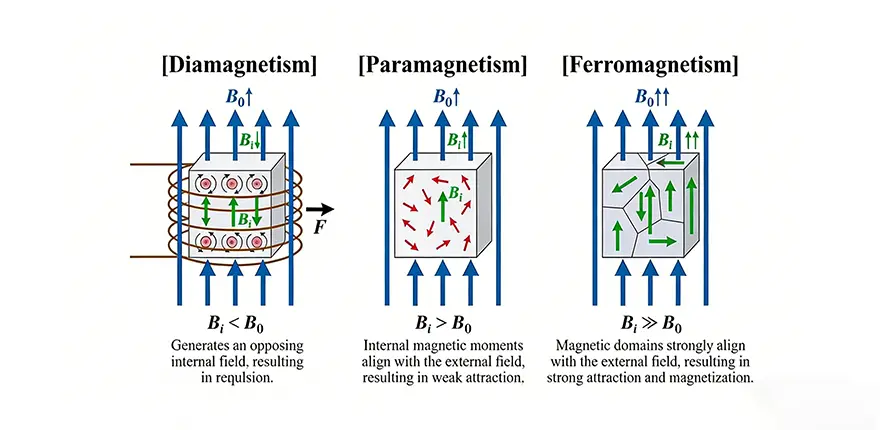
Magnetic materials are categorized based on how they respond to a magnetic field, generally falling into three basic categories: diamagnetic, paramagnetic, and ferromagnetic. The essential differences in these three behaviors stem from electron spin and orbital motion within the atoms, as well as the way atoms interact.
Diamagnetic Materials
In diamagnetic materials, all electrons exist in pairs, meaning the atoms are not magnetic. Under the influence of a magnetic field, the orbital motion of these electrons changes slightly, generating a weak magnetic field opposite to the direction of the external magnetic field. Such materials include copper, gold, silver, lead, and bismuth.
Paramagnetic Materials
In paramagnetic materials, the atoms have some unpaired electrons, so each atom has a small net magnetic moment. When placed in a magnetic field, the spins of the unpaired electrons partially align with the direction of the magnetic field, producing a weak attractive force. Typical examples include aluminum, platinum, oxygen (O₂), and certain transition metal salts.
Ferromagnetic materials
These materials have a large number of unpaired electrons in their atoms, and strong exchange interactions exist between adjacent atoms, causing the magnetic moments of a large number of atoms to spontaneously align in parallel, forming magnetic domains. Under an applied magnetic field, domain wall movement and domain rotation occur very easily, resulting in a sharp increase in magnetization and generating extremely strong attractive forces. After the external magnetic field is removed, some magnetization can be retained. Typical examples include iron, cobalt, nickel, and certain rare earth compounds.
| Material Classification | Magnetization Response | Typical Examples |
|---|---|---|
| Diamagnetic materials | Weak (repulsion) | Copper, Silver, Lead |
| Paramagnetic materials | Weak (attraction) | Aluminum, Platinum |
| Ferromagnetic materials | Strong | Iron, Cobalt, Nickel |
The type of magnetic material can also be visually distinguished by its magnetic susceptibility, χ. This is a dimensionless physical quantity that describes how easily a material is magnetized in an external magnetic field.
- When χ > 0, the material is attractive to the magnetic field, exhibiting weak magnetic properties. The larger the value of χ, the stronger the attraction.
- When χ < 0, the material repels the magnetic field. The larger the value of |χ|, the stronger the repulsion. However, most diamagnetic materials have very small χ values, and the repulsive effect is so weak that it is almost imperceptible in daily life.
The magnetic susceptibility of lead is approximately -1.8 × 10⁻⁵. This value clearly indicates that lead is a diamagnetic material. This is why lead is not attracted to magnets under everyday conditions.
The following table compares the magnetic behavior of lead with other common metals.
| Metal | Magnetic Behavior | Magnetic Susceptibility χ (×10⁻⁵ SI) |
|---|---|---|
| Lead | Diamagnetic | ≈ -1.8 |
| Iron | Ferromagnetic | ~10⁴ ~ 10⁶ |
| Aluminum | Paramagnetic | ≈ +2.2 |
| Copper | Diamagnetic | ≈ -1.0 |
The magnetic susceptibility (χ) can be used to determine whether a material is magnetic visually. Lead and copper have small negative χ values, meaning they’re essentially non-magnetic, while iron has a very large χ, making it strongly magnetic. This is why only a few metals, namely iron, cobalt, and nickel, can be magnetized.
Tip: Only ferromagnetic materials possess magnetism.
Physical properties of lead

Lead’s magnetic properties are affected by temperature. At room temperature, lead is a typical diamagnetic material, exhibiting extremely weak repulsion to external magnetic fields. When the temperature drops to -266°C, lead transitions to a superconducting state. It completely repels external magnetic fields, and its magnetic susceptibility approaches -1. This resembles the classic characteristic of traditional Type-I superconductors.
| Temperature Condition | Magnetic Response Characteristic | Magnetic Susceptibility (χ) |
|---|---|---|
| Room temperature ≈ 20°C | Weak repulsion | ≈ -1.8 × 10⁻⁵ |
| Low temperature ≈ -266°C | Strong repulsion | ≈ -1 |
Although lead exhibits superconducting behavior only at extremely low temperatures, it has played a crucial role in the history of superconducting physics, helping scientists verify theories at the elemental level and laying the foundation for modern superconducting technology.
Electron configuration of lead
The electron configuration of a lead atom is [Xe] 4f¹⁴ 5d¹⁰ 6s² 6p². In this configuration, the outermost valence electrons are distributed in the 6s and 6p subshells. The 6s subshell is fully filled with two electrons, with two paired electrons, while the 6p subshell contains only two electrons. According to Hund’s rule, these two electrons will occupy different p orbitals with the same spin direction; they are two unpaired electrons. This means that an isolated lead atom has a certain net spin magnetic moment and exhibits paramagnetic characteristics. Once it enters the solid metallic state, the delocalization and pairing of electrons transform it completely into a diamagnetic material.
According to the Pauli exclusion principle, the electrons do not form strong exchange interactions like those in iron, cobalt, and nickel. The lead atom only exhibits a weak repulsive effect from external magnetic fields, which is the microscopic reason why lead is not magnetic.
Tip: Diamagnetic materials exhibit a weak repulsive effect from external magnetic fields.
Applications of lead

Because lead is diamagnetic, it is not attracted to external magnetic fields and even shows a weak repulsion. This property makes lead very useful for shielding sensitive electronics from magnetic interference, which is essential in environments where magnetic fields need to be blocked. Consequently, lead finds application in the following key areas:
- MRI-related auxiliary facilities;
- Precision scientific instruments and laboratory equipment;
- Casings for sensitive electronic equipment.
Moreover, lead is most commonly used because it is excellent at blocking radiation. Radiation shielding mainly works because high-energy photons interact with matter. When they enter lead, they undergo processes such as the photoelectric effect and Compton scattering. In these processes, most of the photon’s energy gets absorbed by electrons in the lead atoms, which greatly reduces the radiation strength/intensity. Lead’s high atomic number and high density are key characteristics that enable it to effectively block ionizing radiation. Radiologists wear lead aprons, goggles, and other personal protective equipment. This device utilizes the high density of lead to effectively block X-rays and gamma rays, thereby reducing the radiation exposure risk for medical personnel. Specific applications include:
- X-ray machines, CT scanners, and fluoroscopy equipment;
- Nuclear medicine equipment;
- Interventional radiology equipment.
In composite materials, lead is often combined with other substances to create lead-containing glass, lead-containing rubber, or lead-based composite shielding materials. These composite forms are particularly useful in the aerospace field: they maintain excellent radiation protection performance while being lighter and effectively shielding against cosmic rays, solar particle radiation, and high-energy electrons. Specific applications include:
- Satellite and spacecraft outer shells;
- Deep space probes;
- Critical components of manned spacecraft.
Health Effects of Lead Exposure
The widespread use of lead greatly benefits our daily lives and industrial production. However, lead itself is also a very dangerous substance with extremely high toxicity. Once it enters the human body through improper handling, dust inhalation, drinking water contamination, or old paint peeling, it can cause serious and often irreversible damage to health. Lead is a cumulative poison that can accumulate in bones, teeth, brain, kidneys, and other sites over a long period. Even low levels of exposure have no safe threshold. The main health effects of lead exposure include:
- Nervous system damage: Lead is most harmful to the central and peripheral nervous systems, especially to children and fetuses. Lead exposure in children can cause permanent brain damage, manifesting as decreased IQ, learning disabilities, hearing loss, and delayed language development.
- Heart and blood vessel issues: Being exposed to lead raises your chances of getting high blood pressure, heart disease, and other cardiovascular problems.
- Kidney and bone health: Lead interferes with calcium metabolism, accumulates in bones, reduces bone density, and may increase the risk of osteoporosis.
- Other systemic effects: These include anemia, reproductive toxicity, immune system damage, and digestive symptoms.
- Children are particularly vulnerable: Children absorb lead much more readily than adults; even very low doses of exposure can cause developmental delays, growth retardation, and long-term cognitive impairment.
Lead’s toxicity has been proven, and many countries have phased out its use in common consumer products such as gasoline, paint, and pipes. Nevertheless, lead remains indispensable in certain industrial applications. We must ensure, through scientific safeguards and strict regulations, that the use of lead benefits society without harming public health.
Some FAQs
Does pencil lead contain lead?
No, pencil lead does not contain metallic lead. It is mainly made of a mixture of graphite and clay. Graphite is harmless to both children and adults.
Are all metals attractive to magnets?
No. Lead is actually diamagnetic and is hardly attracted by magnets.
Does temperature affect the magnetism of lead?
At room temperature, it is weakly diamagnetic. When the temperature drops below about 7.2 K, lead transitions to a superconducting state, exhibiting perfect diamagnetic properties. This is important in low-temperature physics research.
Why is lead suitable for magnetic field shielding?
Lead’s non-magnetic nature and high density make it advantageous in environments where magnetic interference needs to be avoided.
Is lead harmful to health?
Lead is extremely toxic and is a cumulative poison that can cause nerve damage, cardiovascular disease, kidney damage, and other health problems.
For more insights, check these related blogs:
Does aluminum have magnetic properties?
Does copper have magnetic properties?
Top 5 Permanent Magnet Manufacturers in China 2026
What’s the Difference Between Neo, NdFeB, and Neodymium Magnets?
Surface-Mounted vs. Interior Permanent Magnet Motors
Ready to upgrade your project? Browse our full product line at TOPMAG!🧲

I'm dedicated to popular science writing about magnets. My articles mainly focus on their principles, applications, and industry anecdotes. Our goal is to provide readers with valuable information, helping everyone better understand the charm and significance of magnets. At the same time, we're eager to hear your opinions on magnet-related needs. Feel free to follow and engage with us as we explore the endless possibilities of magnets together!