
Does aluminum have magnetic properties?
- Ethan
- Knowledge base
In daily life, we often use magnets to test various metals. Iron will stick firmly, while aluminum won’t budge. Why is this? Aluminum is a non-magnetic material, meaning it is weakly attracted to magnets. Only ferromagnetic materials, like iron (Fe), nickel (Ni), and cobalt (Co), have a strong attraction to magnets. To dive deeper into why metals behave differently, explore “Diamagnetic, Paramagnetic, and Ferromagnetic Materials“.
Simply calling aluminum a non-magnetic metal is sufficient for everyday understanding. However, more strictly speaking, aluminum is actually a paramagnetic metal. When the magnetic field is strong enough, aluminum has a weak attraction to the magnetic field, while diamagnetic metals like copper only repel magnetic fields.
Contents
Key Takeaways
- Aluminum is a paramagnetic material. It only generates a strong repulsive force when the magnetic field changes rapidly.
- The magnetic susceptibility (χ) of aluminum at room temperature is +2.2 × 10⁻⁵.
- The magnetic susceptibility of aluminum is largely unaffected by external factors.
- The classic experiment involving aluminum and a magnet provides a direct visual demonstration of eddy current phenomena.
- Non-magnetic applications of aluminum are mostly in high-end fields.
- Aluminum-based functional materials not only possess the properties of aluminum but can also have additional properties added through formulation design.
At Rest: Weak Paramagnetic Attraction
Aluminum is a weakly paramagnetic material. This means that it will produce extremely weak co-directional magnetization in an applied magnetic field, theoretically allowing it to be slightly attracted by a magnet.
In Motion: Strong Dynamic Repulsion
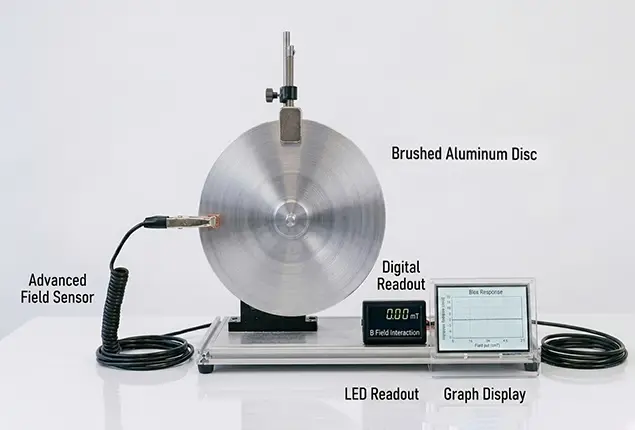
Aluminum exhibits the opposite magnetic behavior, which is extremely important in engineering: when the magnetic field changes rapidly, aluminum produces a strong repulsive force. This is because aluminum is an excellent conductor of electricity. When a magnet moves fast near aluminum, Faraday’s Law creates swirling eddy currents inside it. These currents then generate their own magnetic field that fights the magnet’s motion (Lenz’s Law), pushing it away. Crucially, this “push” isn’t due to the atomic magnetism we discussed earlier, but rather a macroscopic induction effect. The atomic magnetic moments of aluminum itself do not play a dominant role here. But it has an excellent ability to conduct electricity.
Three Types of Magnetism
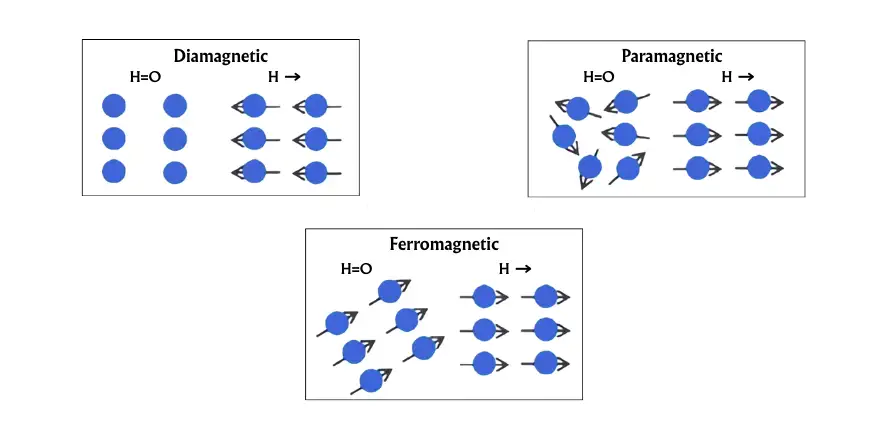
The magnetic properties of metallic materials can be broadly classified into three types: ferromagnetism, paramagnetism, and diamagnetism. Their different properties depend on the electronic microstructure of their respective materials. Based on the magnitude and behavior of magnetic susceptibility, materials are roughly divided into three types of magnetism:
- Ferromagnetism: Has more unpaired electrons, with strong electron spin coupling, forming large-scale magnetic domains that generate extremely strong collective magnetic fields. Even after the external magnetic field is removed, some magnetism is retained.
- Paramagnetic: Has unpaired electrons, which only weakly align in the presence of an external magnetic field and disappear immediately after the field is removed.
- Diamagnetism: All electrons are paired, and the electron orbitals induce opposite magnetic moments in an external magnetic field, resulting in weak repulsion.
At room temperature, the magnetic susceptibility χ is +2.2 × 10⁻⁵, meaning that it will produce extremely weak co-directional magnetization in an external magnetic field, and therefore, theoretically, it would be slightly attracted by a magnet. However, this attraction is millions of times weaker than that of ferromagnetic materials, and no attraction effect can be felt in the face of a common refrigerator magnet. The phenomenon of magnets attracting things, which we clearly experience, almost entirely comes from ferromagnetic materials.
The Microscopic Origin of Magnetism
Aluminum is classified as a paramagnetic material. But why is it strictly paramagnetic, and what evidence backs this up? The answer lies in the microscopic electronic structure of the aluminum atom. Below, we delve into the origin of the atomic magnetic moment of aluminum from a quantum mechanical perspective and its fundamental differences from ferromagnetic materials such as iron, cobalt, and nickel.
Magnetics essentially originates from the magnetic field generated by moving electric charges. According to classical electromagnetism, any closed path of current will generate a magnetic field. In most atoms, the spin magnetic moment and orbital magnetic moment cancel each other out, so the atom has no overall magnetic moment. However, an atom with one or more unpaired electrons has a spin magnetic moment that cannot completely cancel out, thus giving the atom a net magnetic moment. This is the microscopic basis of both paramagnetism and ferromagnetism. Let’s apply this to aluminum (atomic number 13). Its ground-state electron configuration is written as: 1s² 2s² 2p⁶ 3s² 3p¹. Notice the single unpaired electron in the 3p orbital. This lone 3p electron is the reason aluminum is paramagnetic. It gives each aluminum atom a tiny, permanent magnetic moment. Numerous authoritative institutions and laboratories have repeatedly verified that, at room temperature, the magnetic susceptibility of aluminum, χ ≈ +2.2 × 10⁻⁵, conforms to paramagnetic characteristics.
You might wonder, since both ferromagnetism and paramagnetism involve unpaired electrons, why is aluminum classified as a paramagnetic material? The key difference lies in a quantum mechanical effect called the exchange interaction of unpaired electrons. You can simply understand it as follows: aluminum has only one unpaired electron, thus it is a weakly paramagnetic material, while materials like iron have multiple unpaired electrons, thus they are diamagnetic materials.
Analysis of Non-Magnetic Influencing Factors
Understanding aluminum’s paramagnetic nature at the atomic level allows us to see how this property translates into real-world applications. Aluminum, together with its excellent conductivity, makes it essential in applications such as precision instruments, electromagnetic shielding, eddy current damping components, magnetic levitation technology, and non-contact metal sorting equipment. But how stable is this paramagnetism in real-world use? For applications requiring precise electromagnetic control, even minor changes in external factors can cause a sudden increase or decrease in magnetic response, which could be critical for applications requiring precise electromagnetic control. Below, we analyze the impact of common factors such as temperature, alloying, and surface treatment on the paramagnetic behavior of aluminum to help engineers and material users better assess the risks.
Effects of temperature
The magnetic susceptibility (χ) of paramagnetic materials. This relationship is described by Curie’s law: χ ≈ C / T, where C is the Curie constant, and T is the absolute temperature in kelvin. This means the paramagnetic response weakens as temperature increases. Higher temperatures increased thermal motion, which more vigorously disrupts the alignment of unpaired electron spins with the external magnetic field, reducing the net magnetization. For pure aluminum at room temperature, the paramagnetic susceptibility is approximately +2.2 × 10⁻⁵. Even if heated from room temperature to several hundred °C, the decrease in susceptibility is tiny and can usually be ignored in engineering applications. In other words, temperature has only a minor effect on aluminum’s paramagnetism and doesn’t change its core material properties.
Effects of alloying
Pure aluminum is a typical paramagnetic material. However, commercially available aluminum alloys often contain trace impurities or intentionally added elements, with iron being the most common ferromagnetic impurity. Iron has extremely low solid solubility in aluminum and mostly forms brittle intermetallic compounds, such as Al-Fe-Si or Al-Fe. These compounds can create local magnetic moments, especially when the iron content exceeds about 0.1–0.2%. This slightly raises the alloy’s overall magnetic susceptibility. Therefore, in MRI-compatible parts, precision sensors, or high-purity electronics, high-purity aluminum is essential to prevent magnetic interference from trace iron, which also mainly damages mechanical properties.
Effects of surface treatment
The Influence of Surface Treatment: Aluminum naturally forms a dense, amorphous aluminum oxide film in air. This natural oxide layer is the core reason for aluminum’s corrosion resistance. It prevents further oxidation and has excellent chemical stability. Al₂O₃ is a typical diamagnetic material, with a magnetic response even weaker than that of aluminum. Neither the natural oxide layer nor an artificial anodized layer significantly affects the bulk magnetism of the aluminum underneath. Surface treatment has virtually no effect on the paramagnetism of aluminum. The natural oxide layer, in fact, is non-magnetic and serves primarily as a protective coating.
Classic Experiments with Aluminum and Magnets

Experiment 1: Magnetic Adsorption Test.
- Materials needed: An empty aluminum can, several iron paperclips, and a common permanent magnet.
- Procedure: Approach the aluminum can from different directions and observe whether the can exhibits attraction or repulsion.
- What happens: The aluminum can remains completely still, showing no attraction or repulsion, no matter how you move the magnet around it.
- Why: Aluminum is not inherently magnetic. Unlike iron or steel, its internal structure doesn’t have the tiny magnetic zones that would allow it to be attracted to a static magnet.
Experiment 2: Free Fall Test
- Materials needed: An aluminum tube approximately 30-60 cm long, a small 2×2 mm neodymium magnet, and a small 2×2 mm wooden block.
- Procedure: Allow the magnet and the wooden block to fall freely from above the aluminum tube and observe their trajectories.
- You will see: The wooden block falls rapidly within the aluminum tube at near-free-fall speed, accelerating increasingly faster until it almost instantly falls out of the bottom. The small magnetic block, during its descent, noticeably slowed down and moved smoothly and slowly through the entire tube.
- Why: The moving magnet creates a changing magnetic field. This induces swirling electrical currents in the aluminum. By Lenz’s law, these currents create their own magnetic field that opposes the magnet’s fall, acting like an invisible electromagnetic brake. The wooden block creates no such currents, so it falls freely.
Through these two experiments, you can personally experience the wonders of electromagnetism. If you have the opportunity to record videos for scientific demonstrations, these phenomena will often amaze your friends.
Nonmagnetic Applications of Aluminum
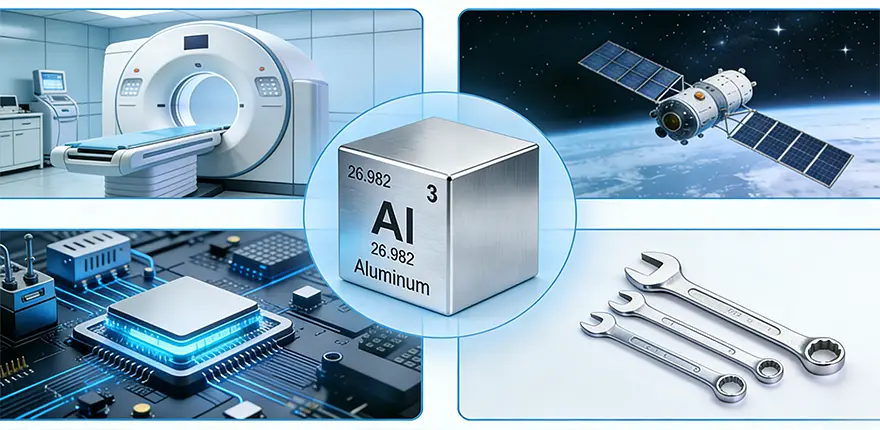
As a typical paramagnetic material, aluminum exhibits an extremely weak response in static magnetic fields. This nonmagnetic property, combined with its lightweight, high conductivity, corrosion resistance, and ease of processing, makes aluminum highly valuable in many fields where magnetic interference is zero-tolerance.
Medical Imaging
MRI scanners have extremely high internal magnetic field strengths and zero tolerance for the magnetic response of materials. Aluminum provides lightweight, high-strength, nonmagnetic structural support, ensuring it does not undergo significant magnetization and avoids missile effects and magnetic field distortion.
Aerospace and Defense
Aircraft, satellites, and missile systems are highly sensitive to magnetic interference. Magnetic materials can affect navigation accuracy. Aluminum’s nonmagnetic nature avoids interference with magnetic sensors while providing an excellent weight-to-strength ratio.
Electronics and Semiconductor Manufacturing
Semiconductor cleanrooms and precision electronics are extremely sensitive to magnetic contaminants, even weak magnetic fields can disrupt the read/write process. Aluminum’s nonmagnetic nature ensures zero magnetic contamination and does not introduce magnetic field interference.
Precision Instruments and Laboratory Equipment
Aluminum serves as a nonmagnetic support structure, maintaining system stability.
Other special scenarios
Tools for explosive environments, using aluminum as the body of the safety tool to prevent magnetic detonation of sensitive devices or ignition of flammable gases by sparks.
How to Choose the Right Nonmagnetic Material?
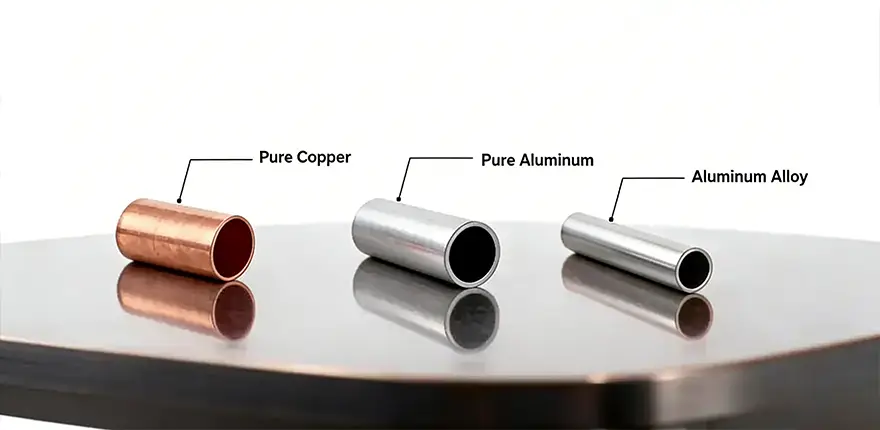
While aluminum’s nonmagnetic properties are excellent, it’s not the first choice for every project. The optimal choice depends on a balance between performance, cost, weight, corrosion resistance, processability, and environmental factors. To make a systematic decision, ask yourself the following questions:
What are the core performance requirements?
If you need something both light and affordable, aluminum is a top pick. It’s about one-third the weight of steel, so using it can make things much lighter.
Are cost and weight the main limiting factors?
When cost is the core requirement, aluminum is the overwhelming choice. Aluminum is significantly cheaper than copper and has lower processing costs.
Do your application's mechanical performance requirements exceed the limits of pure aluminum?
If higher strength, hardness, and fatigue resistance than pure aluminum are required, aluminum alloys should be chosen. Aluminum alloys retain the key advantages of aluminum. They are ideal for demanding applications such as aircraft fuselage skin, wing spars, automotive chassis reinforcements, MRI stretcher frames, and non-magnetic precision supports.
| Material Type | Advantages | Disadvantages | Applications |
|---|---|---|---|
| Pure Copper | Extremely high electrical and thermal conductivity | High material cost | Eddy current damping plates, precision motor windings, MRI-compatible coils |
| Pure Aluminum | Excellent conductivity-to-weight ratio | Low cost | Automotive heat sinks, electronic chassis, aerospace non-magnetic supports |
| Aluminum Alloy | Significantly enhanced mechanical strength and hardness | Lower electrical and thermal conductivity than pure aluminum | Pipe components, corrosion-resistant structural parts, enhanced eddy current damping components |
The Future of Aluminum-Based Functional Materials
Natural aluminum and its alloys are widely used in many fields such as aircraft, automobiles, electronic products, and medical devices due to their lightweight and excellent thermal and electrical conductivity. However, the relentless push in electronics for higher frequency, greater intelligence, and lighter weight in electronic devices, relying solely on aluminum’s natural properties, is no longer sufficient to meet the multifunctional integration requirements of next-generation applications. The emergence of aluminum-based functional materials aims to overcome this bottleneck. Researchers have moved beyond simply using aluminum’s inherent traits to actively reinventing it through the embedding of functional particles and microstructural engineering. This grants them unprecedented control over the material, unlocking dramatic performance gains.
EMI Absorption Composite Materials: formed by uniformly dispersing and embedding micron-sized ferromagnetic particles into the aluminum matrix. This preserves aluminum’s intrinsic advantages. This composite achieves high-efficiency EMI absorption by leveraging the magnetic and dielectric losses generated by the embedded particles. This mechanism makes it especially well-suited for high-frequency applications, particularly in the X-band and beyond. These properties open up promising future applications.
High-Performance Lightweight Conductors: Carbon nanotubes, graphene, and other nanomaterials are embedded to improve the conductivity, mechanical strength, and thermal conductivity of aluminum. This material combines near-pure-aluminum conductivity with significantly higher strength and a stronger eddy current effect.
Intelligent Magnetic Response Materials: Through precise control of the type, size, concentration, and distribution of embedded particles, programmable control of magnetic properties can be achieved. The aluminum matrix provides the structural basis, while the particles impart intelligence. External stimuli can dynamically alter the response, potentially leading to the fabrication of multifunctional components in the future.
Aluminum-based functional materials not only possess the properties of aluminum but can also have additional properties added through formulation design.
Some FAQs
Does aluminum have magnetism?
Aluminum is not ferromagnetic, ordinary magnets cannot attract aluminum objects.
Why is aluminum not attracted to magnets, while iron, nickel, and cobalt are?
This is because of the different magnetic classifications of the materials: iron, nickel, and cobalt are ferromagnetic materials, while aluminum is a paramagnetic material.
Why does aluminum slow down in a magnet experiment?
This happens not because aluminum acts like a magnet, but because of a principle called electromagnetic induction. When you move a magnet past the aluminum, the moving magnetic field causes electricity to swirl inside the metal.
Will temperature changes change the magnetic properties of aluminum?
No. While paramagnetism in general weakens slightly as temperature rises, aluminum’s magnetic susceptibility changes so little that it’s practically negligible.
Can aluminum alloys become magnetic by adding elements?
This is very rare. In commercial aluminum alloys, iron content is typically kept below 0.1–0.7%, which preserves their paramagnetic nature.
Will surface oxidation of aluminum affect its non-magnetic properties?
No. Aluminum oxide is a diamagnetic material with a weaker magnetic response than aluminum.
For more insights, check these related blogs:
Does copper have magnetic properties?
Top 5 Permanent Magnet Manufacturers in China 2026
What’s the Difference Between Neo, NdFeB, and Neodymium Magnets?
Surface-Mounted vs. Interior Permanent Magnet Motors
The Comprehensive Guide to Rare Earth Magnets in 2026
Ready to upgrade your project? Browse our full product line at TOPMAG!🧲

I'm dedicated to popular science writing about magnets. My articles mainly focus on their principles, applications, and industry anecdotes. Our goal is to provide readers with valuable information, helping everyone better understand the charm and significance of magnets. At the same time, we're eager to hear your opinions on magnet-related needs. Feel free to follow and engage with us as we explore the endless possibilities of magnets together!