
A Comprehensive Guide to Rare Earth Magnets
- Ethan
- Knowledge base
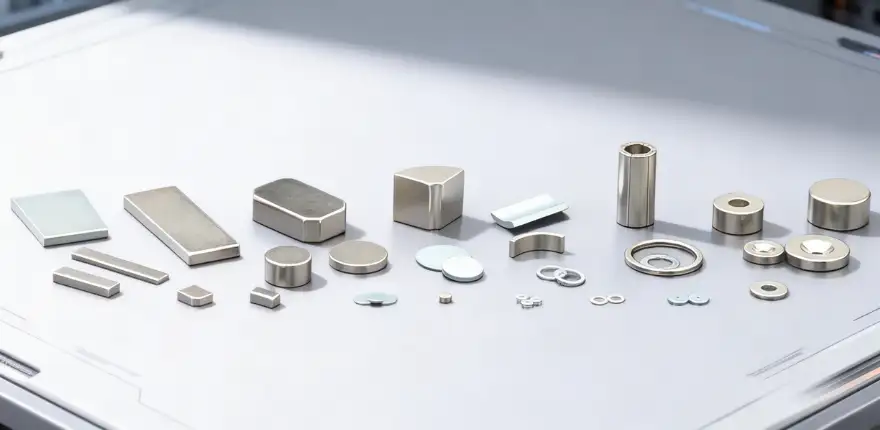
Rare earth magnets are superior-performance permanent magnets based on rare earth elements. Currently, rare earth magnets are primarily consist of two types: neodymium magnets and samarium-cobalt magnets. Selecting the appropriate rare earth magnet material is an essential consideration in magnetic application design. With their excellent magnetic properties and relatively reasonable price, rare earth magnets have become indispensable core components in many high-tech and industrial fields.
Contents
Key Takeaways
- The scarcity of rare earth magnets primarily stems from the difficulty and scarcity of separating the elements.
- Rare earth magnets include NdFeB and SmCo magnets.
- Neodymium magnets are currently the strongest permanent magnet materials on the market.
- Electric vehicles are currently the fastest-growing sector for rare earth demand.
- The SmCo magnet is the preferred material for extreme environment applications.
What Are Rare Earth Magnets?

Rare earth magnets are ultra-strong permanent magnets made from alloys of rare earth elements. They are currently the strongest permanent magnet materials known to humanity. They began to be practically used in the 1970s–1980s and now dominate almost all modern devices that require miniaturization and high magnetic force.
| Type | Main Advantages | Main Disadvantages |
|---|---|---|
| Neodymium Magnets (NdFeB) | Currently the strongest, best cost-performance | Poor temperature resistance, easily oxidized, very brittle |
| Samarium-Cobalt (SmCo) | Excellent high-temperature resistance, good corrosion resistance | Extremely expensive, slightly weaker magnetic force than NdFeB |
Are Rare Earth Magnets Really Rare?
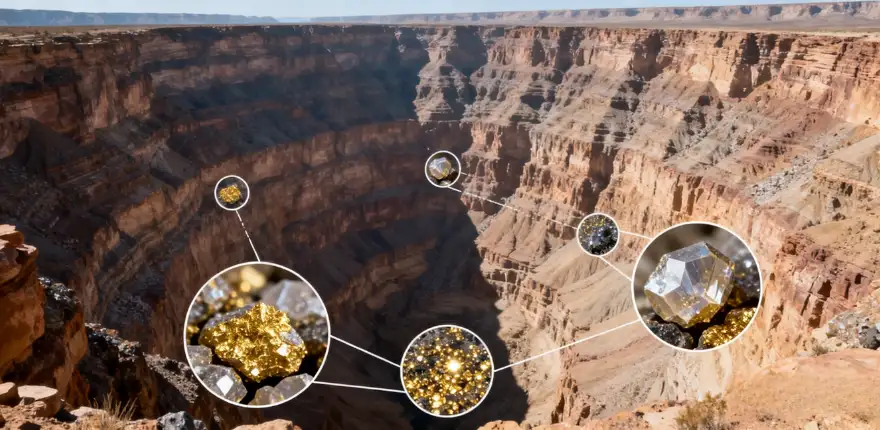
Although they are called rare earth magnets, rare earth elements are actually not scarce in the Earth’s crust. They are far more common than most people think. The most common rare earth elements (such as neodymium) have average crustal abundances similar to or even higher than those of commonly used metals like copper, zinc, nickel, and lead. Even the “rarest” stable rare earth element (such as thulium) has an abundance dozens to hundreds of times higher than gold. Below is a comparison of the average crustal abundance of selected rare earth elements versus gold (unit: ppm):
| Element | Average Crustal Abundance (ppm) |
|---|---|
| Cerium (Ce) | ≈60–68 |
| Neodymium (Nd) | ≈28–38 |
| Lanthanum (La) | ≈30–39 |
| Yttrium (Y) | ≈20–33 |
| Dysprosium (Dy) | ≈4–6 |
| Thulium (Tm) | ≈0.5 |
| Gold (Au) | ≈0.001–0.004 |
Rare earth elements have extremely similar chemical properties and almost always coexist in the same minerals. Separating them into high-purity individual elements requires hundreds or even thousands of solvent extraction steps. The entire process is extremely complex, time-consuming, energy-intensive, and generates large amounts of acidic wastewater and radioactive tailings. Environmental treatment costs are very high, and technical barriers are enormous. The term rare earth magnets mainly refers to the scarcity and difficulty of the separation stage, not the scarcity of the raw resource itself.
Tip: Currently, 70%–90% of global rare earth refining and separation capacity is concentrated in China.
What Makes Rare Earth Magnets Special?
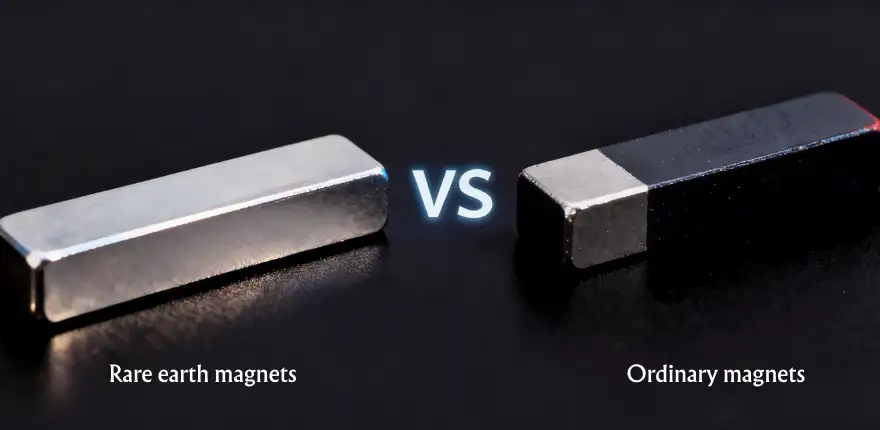
Rare earth magnets are vastly different from ordinary magnets. They essentially belong to two different eras. Rare earth magnets have almost completely replaced ordinary magnets in modern devices.
- Maximum energy product (BH)max: For the same volume, rare earth magnets can deliver 10–20 times the pulling force of ordinary magnets.
- Resistance to demagnetization: Extremely high intrinsic coercivity (Hci), making them resistant to external magnetic fields, vibration, and temperature changes.
- Ultra-high remanence and saturation magnetization: They produce much stronger magnetic fields in the same size.
| Parameter | NdFeB | Ferrite | SmCo |
|---|---|---|---|
| Remanence Br | 1.0–1.5 T | 0.2–0.4 T | 0.9–1.2 T |
| Maximum energy product (BH)max | 35–52 MGOe | 3–4.5 MGOe | 20–32 MGOe |
| Coercivity | 12–30 kOe | 2–4 kOe | 20–35 kOe |
| Temperature resistance | Low | High | High |
| Appearance | Silver-white metallic luster | Black | Silver-gray |
| Density | ≈7.4–7.6 g/cm³ | ≈4.8–5.1 g/cm³ | ≈8.2–8.4 g/cm³ |
| Brittleness | Medium | High | Low |
| Price | Medium | Low | High |
Rare earth magnets are special because the addition of rare earth elements dramatically outperforms ordinary ferrite magnets, enabling modern devices to become compact, efficient, and powerful.
Types of Rare Earth Magnets

Neodymium Magnets
Neodymium Iron Boron magnets, universally known as NdFeB or simply neodymium magnets, are the most powerful grade of permanent magnet material available on the commercial market today. They were first developed in 1982 by the Japanese scientist Dr. Masato Sagawa. The magnetic compound is represented by the formula Nd₂Fe₁₄B and is primarily composed of neodymium, iron, and boron, with the rare earth content constituting approximately 29–33% by weight. Standard grades (e.g., N52) mainly use light rare earth neodymium (Nd). To improve high-temperature demagnetization resistance, high-grade versions (e.g., N45SH) usually add small amounts of heavy rare earths, primarily dysprosium (Dy) and terbium (Tb).
| Type | Chemical Formula | (BH)max (MGOe) | Max Operating Temperature |
|---|---|---|---|
| Neodymium Magnets (NdFeB) | Nd₂Fe₁₄B | 35–52 | 80–200℃ |
Tip: The highest commercial performance grade currently available is N54UH.
Samarium-Cobalt Magnets
Samarium cobalt magnets were the first generation of practical rare earth permanent magnets, commercialized in the 1970s. Although their room-temperature magnetic strength is lower than NdFeB, they lead comprehensively in high temperature performance, corrosion resistance, and demagnetization resistance. They are commonly used in military, aerospace, and aviation fields.
| Type | Chemical Formula | (BH)max (MGOe) | Max Operating Temperature |
|---|---|---|---|
| 1:5 type SmCo | SmCo₅ | 14–28 | ~250℃ |
| 2:17 type SmCo | Sm₂Co₁₇ | 20–32 | ~350℃ |
Tip: SmCo is the only commercially available permanent magnet material that can operate stably for long periods at 200–350℃ in extremely high-temperature conditions.
Applications of Rare Earth Magnets
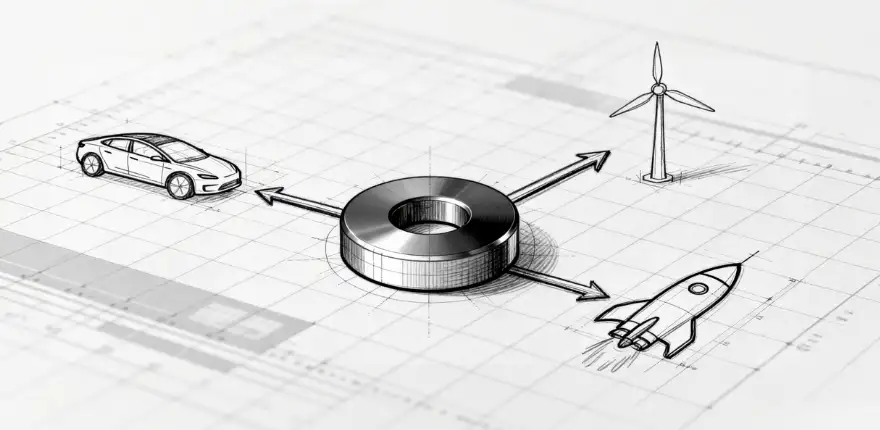
Electric Vehicles (EV)
Rare-earth magnets are key materials in electric vehicle drive motors, and are a major factor determining motor efficiency and overall performance. Neodymium magnets are the best choice because they have the highest magnetic energy product, enabling them to generate very strong magnetic fields within a limited space. Other magnets without rare-earth elements are far inferior to neodymium magnets and cannot meet the power and efficiency requirements of mainstream electric vehicles in the same volume. Neodymium magnets are virtually irreplaceable in the main traction motors of electric vehicles. To withstand the high temperatures of the motor, the industry typically uses high-temperature grade neodymium iron boron magnets containing a small amount of heavy rare earth elements (dysprosium, terbium), such as N45SH, combined with grain boundary diffusion (GBD) technology to improve high-temperature stability and ensure long-term reliable operation of the motor.
NdFeB magnets are widely used in many components of electric vehicles, but the most critical and irreplaceable component is the main traction motor. This is also the fastest-growing area for rare-earth demand.
| Item | NdFeB Magnet Usage | Proportion of Total Vehicle NdFeB Usage |
|---|---|---|
| Main traction motor (PMSM) | 1–3 kg | 70–90% |
| Steering assist motor (EPS) | ≈50–200 g | ≈2–8% |
| Air conditioner compressor motor | ≈50–150 g | ≈2–6% |
| water pump | ≈20–100 g | ≈1–4% |
| Cooling fan motor | ≈10–80 g | ≈0.5–3% |
| Seat adjustment motors | ≈10–50 g | ≈0.5–2% |
| Vibration motor | ≈5–30 g | ≈0.2–1% |
| Speakers | ≈20–150 g | ≈1–6% |
| Sensors | Few grams–20 g | <1% |
Following China’s implementation of stricter export controls on rare earth and permanent magnets in 2025, many international automakers and suppliers will face magnet shortages, forcing some factories to reduce production or even temporarily halt operations.
Note: The stability of the rare earth supply chain directly impacts the speed and cost of global electrification.
Wind Power
Driven by global carbon neutrality goals and strong green low-carbon policies, countries are accelerating the development of renewable energy, with wind power becoming one of the most scalable and commercialized options. Neodymium permanent magnets are the core key material in modern large-scale wind turbines. In the generator rotor, NdFeB magnets are usually arranged as arc segments or rectangular blocks in a circumferential array on the rotor surface. The total magnet usage per unit is enormous: a single 10 MW offshore turbine often requires 2–7 tons of NdFeB magnets. The procurement scale for magnets in a single wind farm project easily reaches tens of millions of dollars or more.
Offshore wind power has an extremely high dependence on NdFeB magnets and faces much harsher operating conditions and performance requirements compared to ordinary applications.
| Performance Requirement | Main Challenge | Countermeasures |
|---|---|---|
| High-temperature stability | Long-term internal operating temperature 100–150℃ | Use high-grade high-temperature magnets |
| Anti-demagnetization | High temperature + strong reverse field + vibration | Add Dy/Tb heavy rare earths to increase HcJ |
| Corrosion resistance | High salt fog and humidity in offshore environment | Apply multi-layer corrosion-resistant coatings |
| Mechanical strength | Huge centrifugal force and vibration fatigue from large rotor diameter | Use high-strength magnets and bonding processes |
Tip: The wind power industry currently relies heavily on Chinese magnets.
Aerospace
Samarium-cobalt and neodymium magnets are critical in the aerospace industry. SmCo magnets are selected for their stability in extreme environments, while NdFeB magnets excel in weight-sensitive applications operating at moderate operating temperatures.
| Magnet Type | Typical Aerospace Application Scenarios |
|---|---|
| SmCo | Engine high-temperature sensors, spacecraft propulsion systems, radar, military aviation high-temperature components |
| NdFeB | Flight control electric actuators, environmental control system motors, starting systems, satellite attitude control motors, lightweight spacecraft motors |
The aerospace industry is highly dependent on rare earth permanent magnets, especially SmCo, which has become the material of choice for many extreme environment applications. Smco’s greatest advantages lie in its ultra-high temperature stability and extremely low demagnetization risk, both of which are zero-tolerance in military applications.
- Ultra-high temperatures: Temperatures near engines, turbine areas, and auxiliary power units (APUs) can reach 200–300°C. Smco’s maximum operating temperature is typically 250–350°C.
- Ultra-low temperatures: Temperatures in the vacuum environment of space can reach -150°C or approach absolute zero. SmCo magnets have an extremely low temperature coefficient, minimal performance degradation, and are almost completely reversible across the entire temperature range.
- Excellent radiation resistance: Space radiation accelerates the demagnetization of NdFeB magnets, while Samarium Cobalt magnets exhibit superior radiation resistance, making them particularly suitable for satellites and deep space probes.
- High corrosion resistance: Withstands high salt spray environments without the need for additional coatings.
- High demagnetization resistance: Irreversible demagnetization loss is extremely low under various harsh combined conditions.
Note: Samarium Cobalt magnets are typically 2-5 times more expensive than NdFeB magnets.
How to Choose Rare Earth Magnets
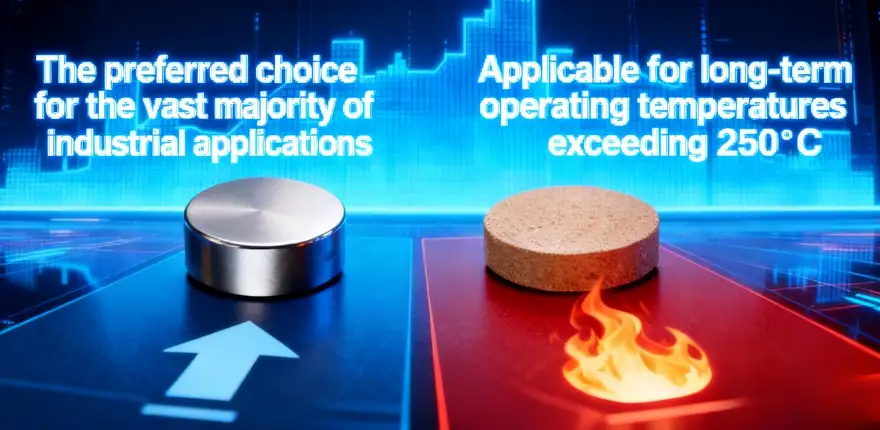
In practical engineering selections, neodymium magnets are the preferred choice for 99% of civilian applications and the vast majority of industrial applications. This is because NdFeB boasts the highest magnetic performance among commercially available permanent magnets, yet its price is significantly lower than that of samarium cobalt. It has become the default choice for common products like consumer electronics and home appliances.
Only when the long-term operating temperature exceeds 250℃ is it truly necessary to switch to SmCo. At that point, NdFeB experiences significant irreversible demagnetization, with rapid magnetic flux loss and even complete failure, causing system reliability to collapse. SmCo demonstrates overwhelming advantages in this extreme temperature range: exceptional temperature stability, excellent anti-demagnetization performance, and almost no irreversible loss. This makes SmCo the only reliable option for high-temperature, harsh scenarios such as aero-engine sensors, missile guidance heads, oil drilling equipment, etc.
Tip: For extreme environments, SmCo magnets are the best choice.
Factors Affecting Rare Earth Magnet Prices

Raw Material Prices
Rare earth raw material price fluctuations are the biggest driver of NdFeB and SmCo finished magnet prices, usually accounting for 70–90% or more of total cost. Any change in upstream rare earth oxide, metal, or alloy prices causes magnet manufacturers to adjust quotations significantly. This is why many factories update prices every few days. As China dominates global rare earth processing and separation, any change in upstream mining, separation, or alloy prices pushes up NdFeB and SmCo finished product prices. In 2025–2026, structural increases in heavy rare earth prices have already caused high-temperature NdFeB and SmCo quotations to remain elevated and volatile.
Geopolitics
Since 2025, changes in China’s rare earth magnet export policies have become a key driver of global rare earth magnet price fluctuations. These policies focus on medium and heavy rare earth elements and their downstream products. The global supply chain is facing adjustment pressures, with some overseas downstream factories reducing production. Prices of neodymium and samarium-cobalt magnets have risen sharply, especially high-temperature heavy rare earth magnets.
Tip: Diversification of rare earth magnet supply chains is accelerating.
Global Rare Earth Market
Market Size
The global rare earth market value has remained relatively stable in the 30–50 billion USD range. From 2010 to 2020, the market was mainly driven by Industrial motors, consumer electronics, and traditional applications with moderate growth. After 2020, the market entered a period of accelerated growth, driven by demand from EV motors, wind power direct-drive generators, robotics, etc.
| Time Period | Market Size (USD Billion) |
|---|---|
| Early 2020s | 40–50 |
| 2024–2025 | 39–52 |
| 2030 (Mainstream Forecast) | 60–100 |
Tip: Compound annual growth rate (CAGR) of approximately 6–10% from 2020–2030, market size expected to roughly double.
Share by Application
Neodymium magnets account for about 96% of global rare earth permanent magnet demand. SmCo is mainly used in high-temperature scenarios and holds a small share, usually less than 5%.
| Application Field | Market Share | Typical Uses |
|---|---|---|
| Electric Vehicles | 30–40% | PMSM permanent magnet synchronous motors |
| Wind Power | 14–20% | Generators |
| Consumer Electronics | 20–25% | Vibration motors, small motors |
| Industrial Motors | 10–15% | Servo motors, automation equipment |
| Others | 10–20% | Data center cooling motors, precision actuators, etc. |
Key Players
Since China implemented export control measures, Western countries and their partners have accelerated efforts to build rare earth permanent magnet supply chains independent of China. With government funding and strategic partnerships, the United States, Europe, Japan, and other allies are expanding NdFeB and SmCo production capacity. Many non-Chinese companies are investing in new magnet manufacturing plants, with many expected to come online in 2025–2026.
| Company | Country / Region |
|---|---|
| China Northern Rare Earth Group | China |
| China Rare Earth Group | China |
| JL MAG Rare-Earth | China |
| Earth-Panda | China |
| TOPMAG | China |
| Shin-Etsu Chemical | Japan |
| Proterial | Japan |
| Vacuumschmelze (VAC) | Germany |
| Lynas Rare Earths | Australia |
| Iluka Resources | Australia |
| MP Materials | United States |
| Energy Fuels | United States |
| Narva magnet plant | Estonia |
Tip: Companies like China Northern Rare Earth Group have production capacity comparable to the total capacity of all non-Chinese countries combined.
Some FAQs
What are the main types of rare earth magnets?
Neodymium magnet and samarium cobalt
Does temperature have a big impact on rare earth magnets?
Significantly affects neodymium magnet, but has little effect on samarium cobalt
Will rare earth magnets demagnetize?
Yes. High temperatures, strong opposing magnetic fields, impacts, or corrosion can cause demagnetization.
Are rare earth magnets harmful to the human body?
Harmless with normal contact, but do not swallow them. Keep away from pacemakers and avoid pinching fingers due to their strong magnetic pull.
Can I bring rare earth magnets on an airplane?
Can I bring rare earth magnets on an airplane?
Can rare earth magnets be used to make a perpetual motion machine?
Can rare earth magnets be used to make a perpetual motion machine?
No, this violates the law of conservation of energy.
For more insights, check these related blogs:
Comprehensive Overview of Permanent Magnets
Six Factors Affecting NdFeB Prices
Global Magnet Supplier TOPMAG: 2025 Canton Fair
5 Factors Affecting Neodymium Magnet Wholesale Prices
Ready to upgrade your project? Browse our full product line at TOPMAG!🧲

I'm dedicated to popular science writing about magnets. My articles mainly focus on their principles, applications, and industry anecdotes. Our goal is to provide readers with valuable information, helping everyone better understand the charm and significance of magnets. At the same time, we're eager to hear your opinions on magnet-related needs. Feel free to follow and engage with us as we explore the endless possibilities of magnets together!