
Comprehensive Overview of Permanent Magnets
- Ethan
- Knowledge base
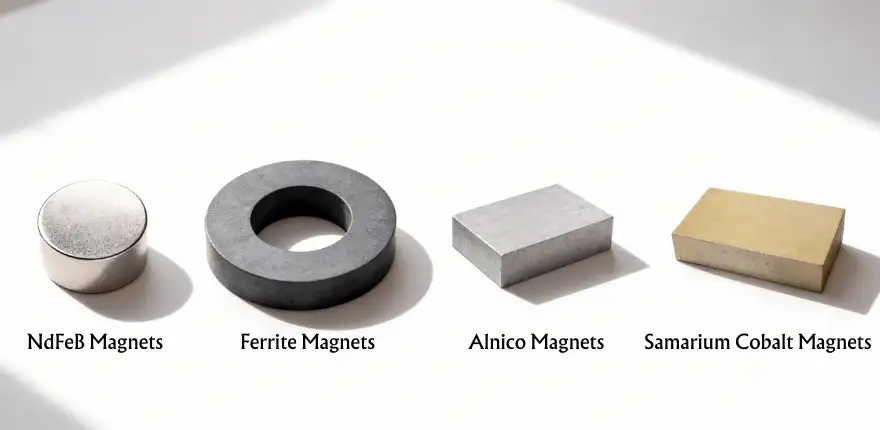
The history of permanent magnets dates back approximately 2,600 years. Currently, mainstream permanent magnets are mainly divided into four categories: neodymium magnets, ferrite magnets, Alnico magnets, and Samarium Cobalt magnets. They are not direct competitors, but rather each has its own unique characteristics and complements the others. So, when choosing a magnet, don’t just pick the strongest or most expensive one. The real trick is to find the one whose strengths line up with what your project actually needs. that’s how you get the best results and the most for your money.
Contents
Key Takeaways
- The global permanent magnet market is projected to reach $34.6 billion to $54.8 billion by 2026.
- Permanent magnets comprise four distinct types, each exhibiting unique performance characteristics.
- Neodymium magnets currently represent the most powerful permanent magnet material available.
- Selecting the appropriate permanent magnet requires precise matching of its performance parameters.
- Geopolitical factors are accelerating diversification within the global rare earth industry.
Industry Economics of Permanent Magnets
Core Market Drivers

The permanent magnet industry plays a strategically vital role, emerging as one of the fastest-growing materials sectors globally in the context of the transition to new energy and electrification. From 2025 to 2026, strong demand for permanent magnets from downstream applications such as electric vehicles, wind power generation, industrial robots, and consumer electronics will support stable market growth in the global market. The international permanent magnet market size is projected to reach approximately US$34.6 billion to US$54.8 billion, with an annual growth rate of 5.8% to 8.5%.
| Application Area | Typical Market Share |
|---|---|
| New Energy Vehicles (EVs) | 30%–40% |
| Wind Power (especially direct-drive) | 10%–20% |
| Industrial Robotics | 10%–15% |
| Consumer Electronics | 20%–25% |
| Others | 15%–20% |
The permanent magnet industry is currently in an accelerated phase of transition from a tight supply-demand balance to a structurally robust growth cycle. Driven by both new energy and intelligent manufacturing, its medium- to long-term growth is highly certain.
Permanent Magnet Industry Chain
China still produces the vast majority of the world’s permanent magnets. China’s annual production capacity of NdFeB sintered magnets exceeds 300,000 tons, accounting for over 85% of global production. The proportion of high-performance magnets continues to rise. However, since 2025, geopolitical tensions and export controls have accelerated the global industrial diversification process, with other countries rapidly expanding their alternative production capacity.
| Region/Country | Current Capacity Share | Representative Companies |
|---|---|---|
| China | 85%–90% | JL MAG, TOPMAG, Yunsheng |
| Japan | 5%–10% | Shin-Etsu, TDK |
| Europe | <5% | Neo Performance Materials |
| North America | <5% | MP Materials |
| Australia | <5% | Lynas |
Rare earth separation, purification, and high-performance NdFeB sintering processes involve extremely high technological barriers and complexities. New projects in the West typically require full-chain verification from scratch, necessitating massive investment and lengthy cycles. Currently, non-Chinese production capacity is mainly concentrated in the element separation stage; true “mine-to-magnet” closed-loop large-scale production of high-performance magnets is still in the capacity ramp-up phase.
Tip: Non-Chinese magnet capacity is expected to grow significantly by 2030, but in the short term, it remains difficult to challenge China's dominance.
Development History of Permanent Magnets
Ancient and Early Exploration
Humanity’s earliest understanding of magnetism began with naturally occurring lodestone. Records go back to around 600 BC, when the Greek philosopher Thales observed that certain stones found in the region of Magnesia could attract iron nails, which led him to develop early ideas about magnetism. The Greeks called magnesian rocks, which is the origin of the English word.
In the late Middle Ages, compass technology was introduced to Europe via the Arab world, helping to launch the Age of Discovery. In ancient times, permanent magnets relied on natural lodestones, which were used in compasses and simple navigation tools.
Early Industrial Applications
In the 19th century, driven by progress in electromagnetism, the source of magnetism shifted from natural lodestones to manufactured permanent magnets. In the mid-to-late 19th century, quenched carbon steel and tungsten steel became the first man-made permanent magnet materials and were used in early generators and motors. However, the low coercivity and easy demagnetization of these steel-based magnets limited their large-scale industrial application.
First-Generation Artificial Permanent Magnets
From the early 20th century to the 1930s, the invention of Alnico marked the beginning of the era of synthetic permanent magnets.
In 1931, building on advancements in metallurgy, Japanese scientists, including Honda Torata, developed the microstructure by adding aluminum, nickel, and cobalt, developing Alnico, which significantly improved its magnetic energy product and coercivity. During World War II, Alnico was widely used in military engines, radar, and communication equipment.
Ferrite Era
In the 1950s, with breakthroughs in ceramic sintering technology, ferrites rapidly replaced AlNiCo magnets, emerging as the second-generation mainstream permanent magnet material. This spurred explosive growth in fields such as loudspeakers, micromotors, refrigerator magnetic strips, and magnetic separators. Ferrites have long accounted for over 70% of global permanent magnet production. However, their relatively weak magnetic properties have limited their development in high-end applications.
Rare Earth Permanent Magnet Era
In the 1960s and 70s, with the maturation of rare earth separation and purification techniques, breakthroughs were achieved in rare earth permanent magnets. The first rare earth permanent magnet was samarium cobalt (SmCo). In 1967, Carl Steiner and others discovered the high magnetocrystalline anisotropy of SmCo₅, with a magnetic energy product reaching 15-25 MGOe, a temperature resistance up to 350°C, and excellent anti-demagnetizing properties.
In the 1980s, the emergence of neodymium magnets marked the arrival of the “king of third-generation magnets.” Between 1982 and 1984, Masato Sagawa of Japan and General Motors of the United States independently invented Nd₂Fe₁₄B compounds. Through powder metallurgy and boron addition to optimize the phase structure, the energy product jumped to 30–52 MGOe.
The exceptional magnetic strength of neodymium magnet materials, their compact size, and excellent value have quickly made them the material of choice in fields such as electric vehicle drive motors, wind turbines, and industrial robots, enabling advances in electrification and intelligentization. Since the 1990s, NdFeB has been the undisputed leader of high-performance permanent magnet materials.
Types of Permanent Magnets
NdFeB Magnets
Neodymium magnet is currently the most powerful commercially available permanent magnet material, divided into sintered NdFeB and bonded NdFeB. Sintered NdFeB is the most common high-performance magnet worldwide. NdFeB is typically the first choice for applications requiring small size, strong magnetic force, and high efficiency, which explains its rapid replacement of other types of magnets over the past decade.
Composition: The main components are neodymium, iron, and boron, with minor additions of elements such as dysprosium, terbium, praseodymium, aluminum, and niobium added to improve performance at high temperatures and resistance to losing magnetism. High-performance grades of NdFeB typically contain 0.5% to 3% heavy rare earth elements to raise the operating temperature to 150 to 200 degrees Celsius.
| Type | Applications | Advantages | Disadvantages |
|---|---|---|---|
| NdFeB | EV drive motors, brushless motors, phone vibration motors | Strongest magnetism, small size, high cost-performance | Poor corrosion resistance, average temperature tolerance, brittle |
Ferrite
Ferrites are based on iron oxide (Fe₂O₃) combined with strontium (Sr) or barium (Ba), with typical chemical formulas of SrFe₁₂O₁₉ or BaFe₁₂O₁₉. Small quantities of other compounds, such as CaO and SiO₂, are also added to improve the manufacturing (sintering) process. Ferrites are made without any rare earth elements, and the raw materials are widely available and low-cost.
Ferrites are the highest-volume and most widely used low-cost permanent magnets, and are classified into sintered and bonded types. Ferrites are widely used in consumer electronics, home appliances, and low-end industrial motors. In these fields where performance requirements are not high, ferrites have long dominated the consumer and low-end industrial markets.
| Type | Applications | Advantages | Disadvantages |
|---|---|---|---|
| Ferrite | Refrigerator strips, speakers, low-end micro-motors | Cheapest, excellent corrosion resistance, temperature tolerance up to ~250°C | Weakest magnetism, large volume, brittle with edge chipping |
Alnico
Composition: The main components are aluminum, nickel, cobalt, and iron, with small amounts of copper and titanium added to optimize performance. It contains no rare earth elements.
AlNiCo magnets offer the best high-temperature performance among commercially available permanent magnets and are available in cast and sintered types. Their applications are relatively niche, primarily targeting applications where magnetic performance requirements are not high but temperature stability is extremely important.
| Type | Applications | Advantages | Disadvantages |
|---|---|---|---|
| Alnico | Guitar pickups, instrument sensors, vintage motors | Exceptional high-temperature tolerance, best temperature stability, corrosion-resistant, low demagnetization | Weaker magnetism, easily demagnetized by reverse fields, medium-high cost |
Samarium Cobalt (SmCo)
Samarium-cobalt (SmCo) magnets are made mostly of samarium and cobalt, with small amounts of other metals added to optimize performance. Although they belong to the rare-earth magnet family, both samarium and cobalt are relatively scarce and expensive.
SmCo offers the highest-temperature stability and coercivity among rare earth magnets and is primarily produced in two types: SmCo₅ and Sm₂Co₁₇. Applications are premium, reserved for extreme stability and near-zero demagnetization in specialized fields, securing their long-term role in aerospace and military.
| Type | Applications | Advantages | Disadvantages |
|---|---|---|---|
| SmCo | Aerospace motors, military high-temp sensors, microwave devices | Strongest high-temperature and anti-demagnetization, excellent corrosion resistance | Most expensive, highly brittle, difficult processing |
How to Select the Right Permanent Magnet?
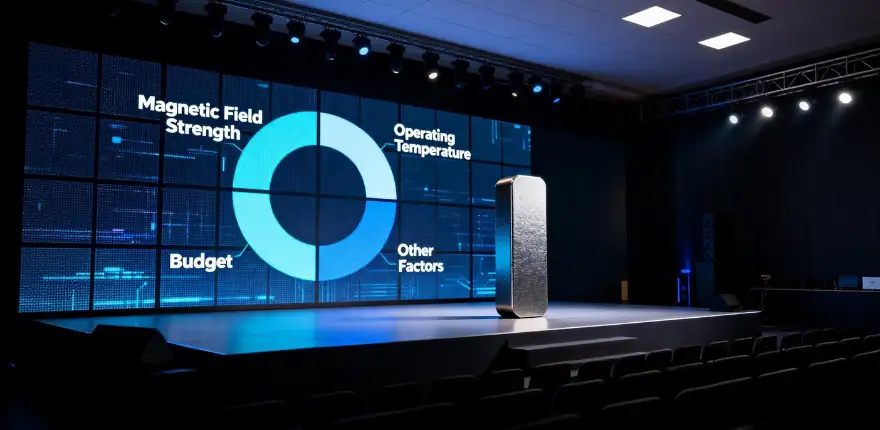
Choosing the right permanent magnet is a gradual screening and matching process, not simply about pursuing the strongest or most expensive. Permanent magnets offer a wide range of customization options; the key is to ensure these options meet project requirements to avoid insufficient performance, shortened lifespan, or even product obsolescence. These considerations are crucial for procurement engineers, product managers, and project leaders.
Magnetic Field Strength
Magnetic field strength refers to the actual pulling force or the corresponding magnet grade. If you have specific pulling force requirements, please refer to the grade table to select the closest magnet. A higher grade doesn’t always mean better quality. Overly pursuing high-grade magnets will waste your budget and may result in excessive magnetic field interference or increased weight.
Tip: Contact us for a permanent magnet grade comparison table.
Operating Temperature
Operating temperature is the key factor to guarantee it works properly over time. Different types of magnets have significantly different heat resistance; exceeding this temperature can lead to irreversible demagnetization, resulting in loss of magnetic force or even failure. First, confirm the actual ambient temperature, then eliminate unsuitable types. General guidelines are as follows:
- ≤80°C: Standard NdFeB (N-series) magnets are sufficient and the most economical.
- 80–150°C: Use high-temperature NdFeB magnets with added heavy rare earth elements (e.g., SH, UH, EH grades).
- 150–250°C: Ferrite magnets are available; if a higher magnetic force is required, samarium cobalt magnets should be selected.
- 250–350°C: Samarium cobalt magnets are the preferred choice.
- 350–500°C: AlNiCo magnets are almost the only option, as their performance degrades least with temperature changes.
Tip: High-temperature grades generally require heavy rare earth elements.
Budget
The price of different types of ferrite varies significantly, driven by rare earth content, manufacturing complexity, and market demand. The prices of NdFeB and Samarium Cobalt ferrites closely follow the cost of rare earth elements, while the price of AlNiCo ferrites is linked to the cobalt-nickel alloy market. Ferrite prices, In contrast, are generally much more stable.
| Type | Price Level | Main Reasons |
|---|---|---|
| Ferrite | Cheapest | No rare earths, abundant raw materials, simple processing |
| NdFeB | Medium | Rare earth dependency |
| Alnico | Medium | Contains Co/Ni, high casting/sintering difficulty |
| SmCo | Most Expensive | Scarce/expensive Sm and Co, brittle with high processing difficulty |
In sourcing from different suppliers, avoid solely pursuing the lowest price. Excessive price differences often indicate lower product quality or cost-cutting, which can lead to further problems later on.
Other Factors
Beyond the core factors, practical applications are more complex, requiring assessments of corrosion resistance, oxidation resistance, mechanical strength, and demagnetization resistance. These factors directly impact service life, maintenance costs, and reliability. A brief comparison follows.
| Factor | Ranking (Best to Worst) |
|---|---|
| Corrosion Resistance | SmCo > Alnico > Ferrite > NdFeB |
| Mechanical Strength | Alnico > Ferrite > NdFeB > SmCo |
| Anti-Demagnetization | SmCo > Alnico > NdFeB > Ferrite |
Note: Special applications require comprehensive parameter evaluation.
Some FAQs
What is currently the strongest commercial permanent magnet material?
Sintered neodymium magnets
Which magnet is the cheapest? Which is the most expensive?
Under identical conditions, ferrite magnets are the cheapest, while SmCo magnets are the most expensive.
Which magnet is primarily used in electric vehicles?
High-performance neodymium magnets are predominantly used.
Why are NdFeB magnets prone to corrosion?
NdFeB contains iron, which oxidizes and rusts easily. Corrosion is typically prevented through surface treatments like nickel or zinc plating.
Where are most permanent magnets globally produced?
China accounts for 85%–90%, Japan 5%–10%, while Europe, America, and Australia combined make up less than 10%.
Will China's monopoly in NdFeB be broken in the future?
Non-Chinese production capacity will grow significantly by 2030, but China’s dominant position remains unchallenged in the short term.
For more insights, check these related blogs:
How to Get the Best Wholesale Price for Neodymium Magnets in 2026
Top 5 Permanent Magnet Manufacturers in India 2026
Global Magnet Supplier TOPMAG: 2025 Canton Fair
N52: The Strongest Neodymium Magnets
Ready to upgrade your project? Browse our full product line at TOPMAG!🧲

I'm dedicated to popular science writing about magnets. My articles mainly focus on their principles, applications, and industry anecdotes. Our goal is to provide readers with valuable information, helping everyone better understand the charm and significance of magnets. At the same time, we're eager to hear your opinions on magnet-related needs. Feel free to follow and engage with us as we explore the endless possibilities of magnets together!