
Are Neo Magnets, NdFeB Magnets, and Neodymium Magnets the Same Thing?
- Ethan
- Knowledge base
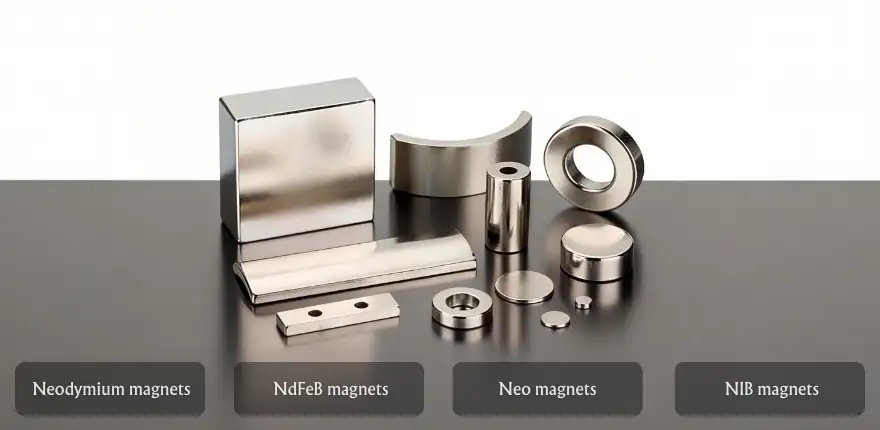
As a professional supplier of neodymium magnets, we receive inquiries, drawings, and technical specifications from customers worldwide every day. One of the most common ways to indicate these specifications is by using “Neo magnet” or “NdFeB” instead of always writing the full “Neodymium magnet.” Many customers, upon seeing these abbreviations, will call or email to confirm: “What exactly is Neo or NdFeB on the drawing? Is it different from a Neodymium magnet?”
The answer is very simple: they are completely the same material, with no difference whatsoever. Whether it’s Neo, NdFeB, NIB, or Neodymium magnet, these different names all refer to neodymium permanent magnets, with the chemical formula Nd₂Fe₁₄B. There is no new formula or different material. The reason these abbreviations are used simultaneously in the industry is mainly that the word “Neodymium” is quite long, and writing the full term in daily emails, internal communications, and drawing annotations is inconvenient. “NdFeB,” on the other hand, is directly taken from the element symbol in its chemical composition. As for “Neo,” it’s the most natural and colloquial abbreviation for Neodymium. Internally, and in conversations with many long-term clients, we almost always use “Neo.”
- Neodymium magnets: The most common name, directly derived from the main component “Neodymium.”
- NdFeB magnets: Names depend on the abbreviations of the chemical elements: Nd, Fe, B.
- Neo magnets: Names depend on common abbreviations of Neodymium.
- NIB magnets: Names depend on the initials of Neodymium magnets.
Contents
Key Takeaways
- Neodymium magnet is also known as Neo, NdFeB, NIB, and Nd₂Fe₁₄B. these are all the same material, and there is no difference between them.
- Neodymium magnet is currently the world’s most powerful rare-earth magnet.
- NdFeB grades consist of letters and numbers.
- TOPMAG provides custom magnet solutions.
Why is NdFeB so popular?
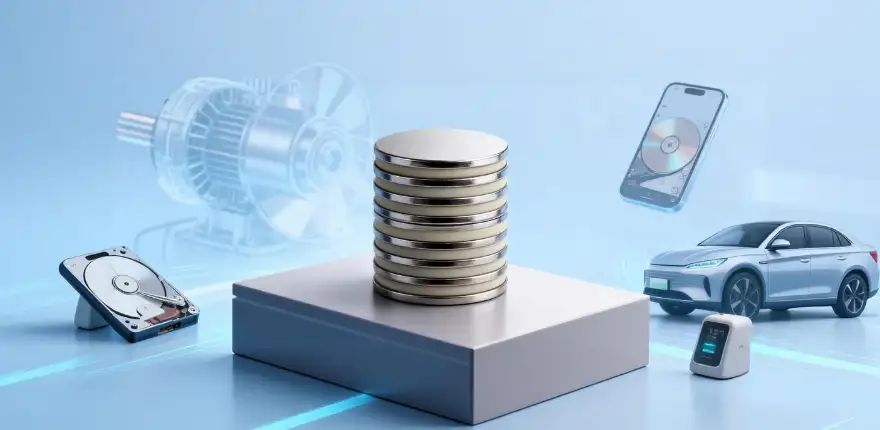
NdFeB‘s biggest advantage lies in its extremely high energy product (BH), enabling it to achieve high magnetic performance in a very small size. It is almost the first choice for modern motors, sensors, and new energy equipment.
| Magnet Type | Energy Product (BH)max (MGOe) | Relative Price | Typical Applications |
|---|---|---|---|
| NdFeB | 30–52 | Medium | Motors, Hard Drives, Mobile Phone Vibration, New Energy Vehicles |
| Samarium Cobalt (SmCo) | 16–32 | High | Aerospace, Military, High-Temperature Sensors |
| Ferrite | 3–5 | Very Low | Speakers, Fridge Magnets, Low-End Motors |
| Alnico | 5–12 | Medium | Instruments, High-Temperature Sensors |
Got a specific application in mind? Just share more details, and we’ll suggest the best grade for it and send you a quote. Need custom NdFeB magnets? Request a Quote Anytime!
How to Read Neodymium NdFeB Magnet Grades?
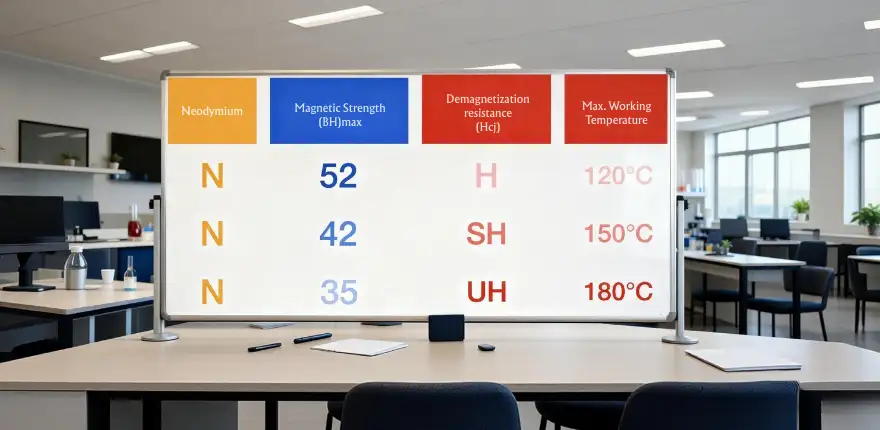
The grade is the core identifier of NdFeB magnet specifications. Many customers are confused when they see “N52” or “N42H” on drawings: Does a larger number mean stronger magnetism? What do the letters after it represent? It’s actually quite simple. the grade consists of two parts, which are easy to understand at a glance.
First, it’s “N” followed by a number. The number tells you the magnet’s max energy, measured in MGOe. The bigger the number, the stronger the magnet is at normal room temperature, and the stronger the magnetic field it can generate. Common commercial grades range from N35 to N52. However, a larger number isn’t always the “best” choice, as magnetic strength is also affected by volume, shape, magnetization direction, and the actual working environment. Blindly choosing N52 can sometimes increase costs and risks.
| Grade | (BH)max (MGOe) | Maximum Operating Temperature (°C) |
|---|---|---|
| N35 | 33–36 | 80 |
| N38 | 36–39 | 80 |
| N40 | 38–41 | 80 |
| N42 | 40–43 | 80 |
| N45 | 43–46 | 80 |
| N48 | 46–49 | 80 |
| N50 | 48–51 | 80 |
| N52 | 50–52 | 80 |
Tip: This table only applies to the N series without a temperature suffix. Grades with M/H/SH/UH/EH/AH have higher temperature resistance but are not included in this table.
Next, the following letter indicates the temperature rating of the magnet. The default setting (without a letter) is N, with a maximum continuous operating temperature of approximately 80°C. Higher letters indicate better temperature resistance:
| Grade | Maximum Operating Temperature (Approx.) |
|---|---|
| N | 80°C |
| M | 100°C |
| H | 120°C |
| SH | 150°C |
| UH | 180°C |
| EH | 200°C |
| AH | 220°C |
Tip: Demagnetization is the most common customer complaint. When selecting suitable NdFeB magnets, in addition to considering the required magnetic properties, the ambient temperature of the magnet's operating environment must also be taken into account to ensure long-term reliable operation.
How to Quickly Customize NdFeB Magnets?
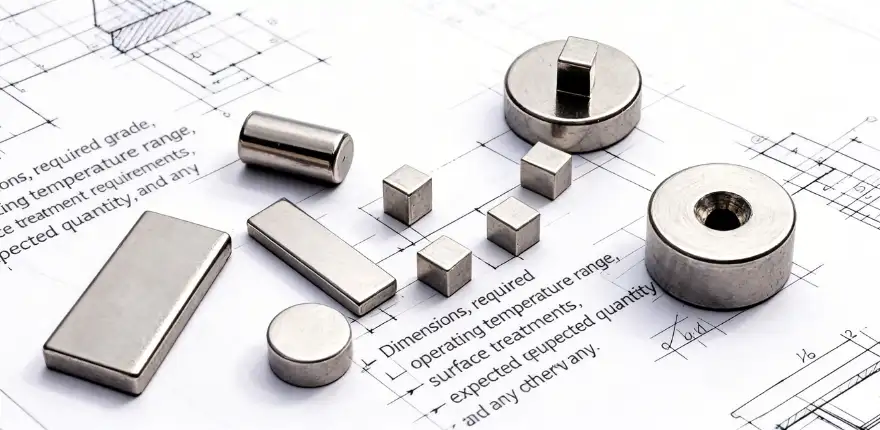
If you need to customize NdFeB magnets, please send us your requirements. Our team will help you find the most suitable solution and quote as soon as possible. Please compile the key information about the magnet: dimensions, required grade, operating temperature range, surface treatment requirements, expected quantity, and any other special requirements. If you already have drawings or specifications, please attach them directly. this will allow for a faster and more accurate response.
We will reply with the latest quote within 12 business hours after receiving your inquiry. Act now!
Some FAQs
Why is my magnet demagnetizing even though the temperature doesn't exceed 80°C?
The max operating temperature is a safe guideline. Real demagnetization usually comes from reverse magnetic fields, mechanical impacts, or high-heat spikes.
Is a higher grade always better?
Not necessarily. How strong the magnet actually is also depends on its size, shape, magnetization direction, and working temperature.
Can I use it directly without plating?
Absolutely not. Neodymium magnets rust very easily, and can lose their strength in just days. Commercial magnets must be plated with Ni-Cu-Ni, zinc, or epoxy.
Is stronger magnetism always better?
Not necessarily. Excessively strong magnetism can cause tight adhesion, make disassembly dangerous, and interfere with sensors or chips.
Will magnets demagnetize naturally?
Yes, but very slowly. Under normal conditions, the loss is <1% per year, approximately 5% over 100 years.
For more insights, check these related blogs:
Surface-Mounted vs. Interior Permanent Magnet Motors
The Comprehensive Guide to Rare Earth Magnets in 2026
Comprehensive Overview of Permanent Magnets
Six Factors Affecting NdFeB Prices
Global Magnet Supplier TOPMAG: 2025 Canton Fair
Ready to upgrade your project? Browse our full product line at TOPMAG!🧲

I'm dedicated to popular science writing about magnets. My articles mainly focus on their principles, applications, and industry anecdotes. Our goal is to provide readers with valuable information, helping everyone better understand the charm and significance of magnets. At the same time, we're eager to hear your opinions on magnet-related needs. Feel free to follow and engage with us as we explore the endless possibilities of magnets together!