
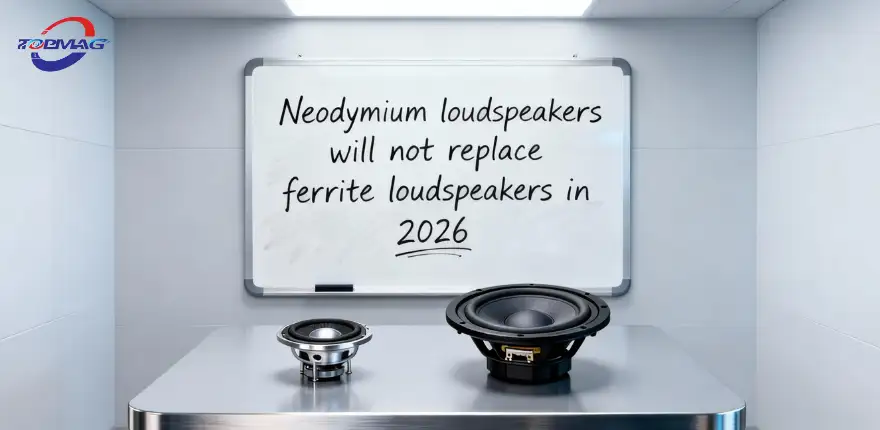
Neodymium loudspeakers will not replace ferrite loudspeakers in 2026
- Ethan
- Knowledge base
The possibility of neodymium loudspeaker magnets completely replacing ferrite magnets by 2026 is extremely low, virtually impossible. The two types of magnets will coexist for a long time, forming a clear division of labor based on their respective material properties and application requirements. Each will occupy irreplaceable market segments in a complementary, coexisting relationship, rather than a competitive situation where one completely eliminates the other.
| Name | Magnet Type | Neodymium Market Share |
|---|---|---|
| Stage speakers | Neodymium | 90%+ |
| Car audio | Neodymium | 80% |
| Portable Bluetooth speakers | Neodymium | 90% |
| Hi-Fi speakers | Ferrite | 40% |
| consumer-grade speakers | Ferrite | 15% |
| subwoofers | Ferrite | 50% |
Neodymium loudspeakers currently dominate the market segments focused on slim, portable designs and high-end sound quality, and are steadily expanding into the mid-range market. However, this does not mean that ferrite loudspeakers will be phased out. As of 2026, a significant portion of the global speaker market will still use ferrite magnets, accounting for a considerable proportion of shipments. These are mainly concentrated in traditional scenarios where size requirements are less stringent and in mid-to-low-end products where cost is highly sensitive. This division of labor based on a balance between performance needs and economics is expected to continue for a long time, and there will be no fundamental upheaval in the next 5 to 10 years.
Contents
Key Takeaways
- Neodymium magnet speakers will not completely replace ferrite magnet speakers in 2026. Both types of magnets will coexist and occupy their respective market segments.
- The main advantage of neodymium magnets is their ability to generate extremely strong magnetic fields in a very small size and weight.
- Ferrite magnets offer excellent heat resistance and stability over extended use.
- Focus on well-known brands and choose the right speaker for your needs (2026 Buying Guide)
Speaker Magnet Basics
Why Do Speakers Need Magnets?
Without permanent magnets, speakers create nearly inaudible sounds, with typical output being some sort of weak hum. This serves to explain why magnets are part of speakers. Magnets form the foundation for converting electrical signals into mechanical vibrations. They provide a stable, powerful magnetic field that interacts with the changing magnetic field within the voice coil, generating the Lorentz force. This drives the voice coil and diaphragm into vibration, creating sound waves. In this very gradual manner, music, voices, and all other forms of audible sounds are created.
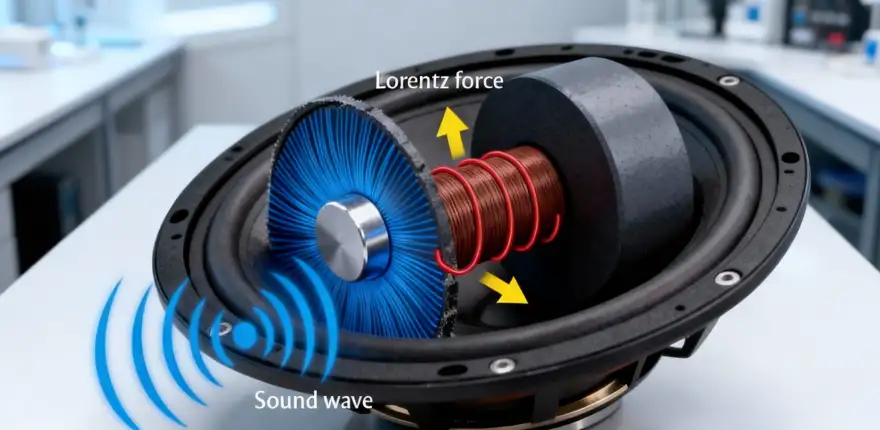
| Component | Main Function |
|---|---|
| Permanent Magnet | Generates a strong and stable static magnetic field |
| Voice Coil | Interacting with the constant magnetic field provided by the permanent magnet |
| Diaphragm | Converts mechanical vibration into air vibration to produce sound waves |
| Former | Supports voice coil windings and efficiently transfers vibration to diaphragm |
| Damper (Spider) | Provides restoring force and controls linear motion |
- Audio signal input: Digital audio signals from mobile phones, amplifiers, players, etc., are amplified and converted into alternating audio current, which flows into the voice coil through wires.
- Current generates a changing magnetic field: According to Ampere’s law and the principle of electromagnetic induction, the alternating current flowing through the voice coil generates a magnetic field around it, the intensity and direction of which change rapidly with time.
- Magnetic field interaction results in Lorentz force: The voice coil wraps around a changing magnetic field, while a strong, steady magnetic field from a permanent magnet remains fixed in a magnetic gap, generating an axial driving force on the voice coil wires that changes with the audio signal.
- Driving the voice coil and diaphragm to vibrate synchronously: This Lorentz force propels the voice coil to move rapidly back and forth in the magnetic gap. Because the voice coil and diaphragm are rigidly connected, the diaphragm subsequently generates mechanical vibrations with amplitude and frequency faithful to the original audio signal.
- Sound wave generation and radiation: The large-area reciprocating motion of the diaphragm compresses and rarefies the air in front, producing a sound pressure wave that corresponds to the audio waveform. These sound waves travel in all directions through the air until they reach the ear, where they are interpreted as sound.
Today, most manufacturers utilize neodymium magnets in their design because this kind of magnet provides great magnetic flux density within a relatively small volume. Compared with traditional ferrite magnets, neodymium enables phones, earphones, and portable speakers to deliver powerful sound output while dramatically reducing size.
Tip: The absence of magnets will result in low speaker efficiency and severe distortion.
Mainstream Magnet Types: Neodymium, Ferrite, Alnico
In the 2026 speaker market, Neodymium, Ferrite, and Alnico remain the three dominant permanent magnet materials, each occupying distinct market niches.
| Magnet Type | Typical Application Fields |
|---|---|
| Neodymium | TWS earbuds, smartphone speakers, high-end HiFi |
| Ferrite | Professional PA systems, large subwoofers, car audio |
| Alnico | Vintage guitar amplifiers, audiophile collector products |
Note: Neodymium has become the preferred material for most high-end and portable speakers.
Where Neodymium Really Excels
Smaller, Lighter, and More Efficient
For purists, neodymium magnets truly achieve the perfect balance between compactness and high sound quality. Key advantages include:
- Ultimate Miniaturization and Lightweight Design: Neodymium magnets possess a magnetic strength far exceeding that of other materials, allowing for a 40-70% reduction in driver size and weight.
- Higher efficiency and sensitivity: The powerful magnetic field of neodymium iron boron improves the coupling efficiency between the voice coil and the magnetic field, enabling the driver unit to achieve higher sound pressure levels with less electrical power.
- Faster Transient Response: The powerful magnetic field makes the voice coil movement more linear, resulting in a more natural and transparent high-frequency extension, and a significant reduction in overall distortion.
- Greater Control: Neodymium magnets allow for deeper low-frequency extension of the diaphragm, delivering bass that is both impactful and textured.
The greatest advantage of neodymium in speakers is its ability to deliver extremely strong magnetic fields in a very small volume and weight, which has greatly driven the miniaturisation and high performance trend of modern audio devices.
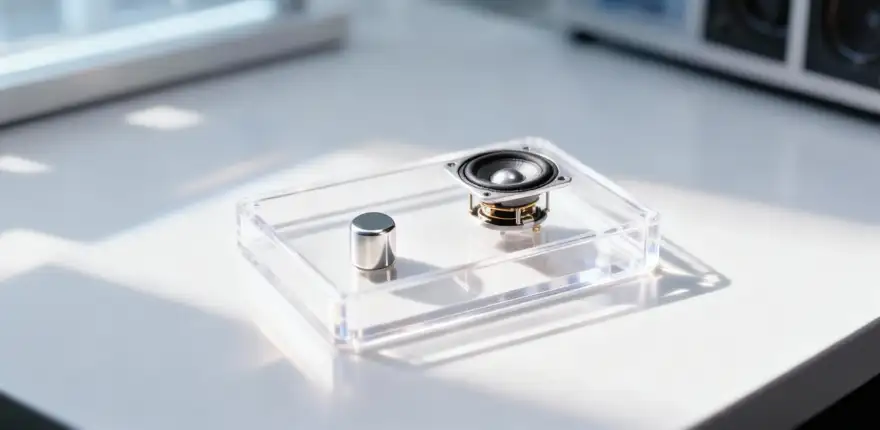
| Type | Advantages | Disadvantages |
|---|---|---|
| NdFeB | Extremely strong magnetism, smallest size, lightest weight | Higher cost |
| Ferrite | Extremely high cost performance, low price, excellent heat resistance | Weaker magnetism, large & heavy |
| Alnico | Classic warm tone, natural dynamics, strong compression feel | Medium-weak magnetism, high cost |
Tip: If you want excellent sound quality without taking up too much space, neodymium is your best choice.
Neodymium ≠ Automatically Superior Sound Quality
Neodymium magnets don’t automatically assure better sound quality. They provide a better physical base. Sound quality depends heavily on multiple factors, including diaphragm material, voice coil design, surround structure, cabinet acoustics, damping system, and crossover network. The table below lists the individual impacts of these core components on sound quality:
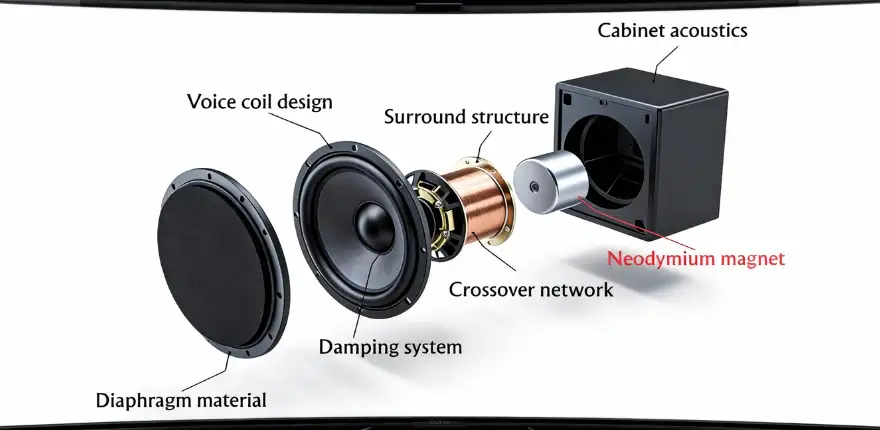
| Component | Sound Quality |
|---|---|
| Diaphragm material | Determines overall tonal color, resolution, rigidity & damping |
| Voice coil design | Affects power handling, thermal stability, linearity & distortion |
| Surround structure | Controls compliance, restoring force and linear excursion |
| Cabinet acoustics | Determines bass response, standing waves, resonance & overall balance |
| Damping system | Keeps voice coil centered, controls low-frequency resonance |
| Crossover network | Handles frequency division, phase coherence & impedance matching |
Tip: The magnet material is only one factor affecting the sound quality of a speaker.
Why Ferrite Magnets Are Still Not Obsolete
You might wonder, given the obvious advantages of neodymium magnets, why haven’t ferrite magnets been phased out? The truth is, ferrite magnets will not only survive, but will continue to hold a significant share of the speaker market in 2026, especially in professional audio, car audio, and subwoofers.
- Cost: King of cost-effectiveness, suitable for mass production and large-scale systems with limited budgets.
- Heat Resistance and Stability: Minimal magnetic attenuation at high temperatures, suitable for prolonged high-power use.
- High-Power Reliability: Stable and reliable magnetic force, strong resistance to demagnetization.
- Bass-like Performance: Fuller, more relaxed, and powerful low frequencies.
- Geopolitical Risk: Completely independent of rare earth elements, raw materials such as iron oxides are globally abundant.

Tip: Ferrite magnets haven't been phased out because they still possess irreplaceable advantages in cost, heat resistance, and specific bass characteristics.
Practical Speaker Buying Tips
Rational Purchasing Principles
When purchasing speakers, the core principle of rational decision making is to avoid impulse buying and ensure you select products that genuinely match your needs and provide long-term satisfaction. The following purchasing tips are most practical:
- Brand: Prioritize well-known brands like Sonos, KEF, Klipsch, and Bowers & Wilkins. It is widely accepted that these brands will create and control quality, consistency in production, and after-sales service.
- Usage Scenarios: Speakers differ in boisterous living rooms, cars, or outdoors, while their sound quality varies according to the environment. Choosing the right scenario helps to save budget while providing real-world audio performance.
- Budget: Affordability should be set beforehand. There is no better option than choosing speakers within a budget that meets needs, rather than running after supposedly better specs.
- Sound Quality: This is paramount. One should insist on an in-store listening test and compare several speakers to find one that truly appeals to one’s taste.
- After-Sales Support: check the brand warranty period, demagnetisation risks, and resale value. Trendy items with a short life span are to be avoided.

Tip: Don't blindly follow trends. While neodymium magnets dominate the market, if sound quality is your priority, focus on rational listening comparisons rather than solely choosing neodymium magnets.
2026 Hot & Representative Recommendations
The speaker market in 2026 was highly fragmented. Below is a list of the most representative and popular models in each major category, provided as a quick reference. You can directly view the corresponding brand series based on your needs to quickly locate products of interest.
| Category | Recommended Models / Series |
|---|---|
| Portable Bluetooth speakers | Ultimate Ears Wonderboom 4 JBL Flip 7 JBL Charge 6 |
| Home wireless smart speakers | Sonos Era 100 Sonos Era 300 Apple HomePod Mini |
| floorstanding speakers | Klipsch Reference series Bowers & Wilkins 606 S3 KEF LS50 Meta |
| Car audio speakers | JL Audio C1 series Focal Universal Integration series Rockford Fosgate Power series |
Note: These are the most active and well-regarded models in 2026. Simply search the model names for the latest reviews, pricing, or purchasing channels. Always match your actual usage scenario and budget when choosing.
Some FAQs
Will neodymium speakers completely replace ferrite speakers by 2026?
Highly unlikely. As of now, NdFeB controls most of the portable and high-end speaker markets, whereas ferrite still holds a significant portion of the mid-to-low-end speaker market.
Does it follow that the use of NdFeB will always ensure better sound quality?
Not at all! While NdFeB allows for better efficiency, compactness, and transient response, actual sound quality is more dependent on the diaphragm, voice coil, cabinet, surround, and crossover.
In which applications does NdFeB find its most appropriate uses?
TWS earphones, Bluetooth speakers, smartphone speakers, high-end Hi-Fi, and car audio systems
In which applications is ferrite still widely used?
Professional power amplifiers, large subwoofers, traditional mid-to-low-end Hi-Fi, and consumer-grade home speakers.
What kind of magnet should one choose when buying a speaker?
Any kind of speaker magnet should not be pursued based solely on Neodymium. Actual listening tests should be given importance, matched with the intended use case and budget.
For more insights, check these related blogs:
How to Get the Best Wholesale Price for Neodymium Magnets in 2026
Top 5 Permanent Magnet Manufacturers in India 2026
The Basic Principles of Magnetism
Comprehensive Guide to Magnet Magnetization
Ready to upgrade your project? Browse our full product line at TOPMAG!🧲

I'm dedicated to popular science writing about magnets. My articles mainly focus on their principles, applications, and industry anecdotes. Our goal is to provide readers with valuable information, helping everyone better understand the charm and significance of magnets. At the same time, we're eager to hear your opinions on magnet-related needs. Feel free to follow and engage with us as we explore the endless possibilities of magnets together!