
Switchable Permanent Magnets Working Principle
- Ethan
- Knowledge base
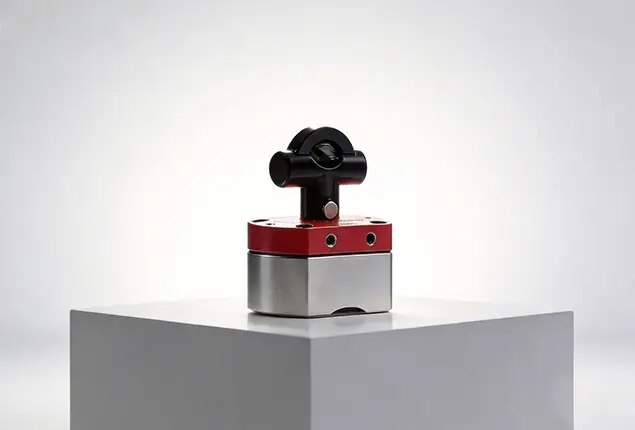
You might wonder if there’s a portable magnet that can control its magnetic field like an electromagnet with on/off switching. However, electromagnets require continuous power and are typically larger, consume more energy, and are mainly used in heavy industrial settings. The switchable magnet we’re introducing today is essentially a permanent magnet that needs no power at all. The magnetic force can be switched at will simply by rotating a button.
Its core lies in its precise internal magnetic circuit design. By rotating the button, the direction of the magnetic field lines inside the permanent magnet is changed, thus altering the overall magnetic force. This switchable permanent magnet technology is widely used in industrial scenarios such as machining, welding, positioning, and mold installation, and is gradually replacing some applications of traditional electromagnets.
Contents
Key Takeaways
- A switchable magnet is a permanent magnet with an adjustable magnetic force.
- Switchable magnets come in two types: NdFeB and Alnico.
- The main components of a switchable magnet are a permanent magnet, a switching button, and magnetic pole pieces.
- Switchable magnets are ideal for small to medium-sized workshops.
- Electromagnets require a continuous power supply to operate, while switchable magnets can run without a power source.
What are switchable magnets?
Switchable magnets, also known as on/off magnets, are permanent magnets that allow their magnetic force to be adjusted at will. Unlike ordinary permanent magnets that are always on, they allow for easy control of the magnetic force simply by rotating a knob, tossing a control lever, or sliding a switch. This design greatly simplifies operational processes such as adsorption, positioning, handling, and release.
Working principle of a switchable magnets
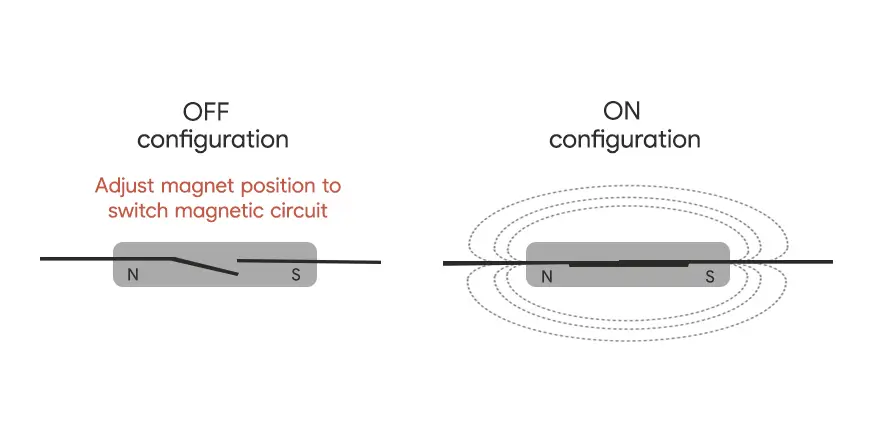
The core operating principle of the switchable permanent magnet lies in its internal magnetic circuit, which is a precise design. working together, the permanent magnet, the switching mechanism, and the pole pieces enable it to function. As the source of magnetism, the permanent magnet produces a strong and stable magnetic field. The ability to freely switch magnetic force depends on the ability to change the magnetic circuit through the switching mechanism. It actively controls the direction and path of magnetic flux flow by changing the relative spatial position and angle between the permanent magnet core and the magnetic pole pieces.
When turned ON, the switching device adjusts the permanent magnet to the aligned position, maximizing the outward radiation of magnetic flux across the entire working surface, forming a low-reluctance, low-loss external working magnetic circuit. Magnetic flux is efficiently guided externally, passing directly through the metal pole pieces and exiting the working surface, forming a complete external magnetic loop, thus firmly gripping ferromagnetic objects. At this time, the metal magnetic shielding sheet does not internally guide the magnetic field, but rather allows the magnetic force to concentrate outwards.
When switched OFF, the switching mechanism rotates the permanent magnet, and the magnetic flux is redirected to form a closed internal magnetic circuit. Nearly no magnetic flux escapes from the external working surface. This results from the change in the magnetic flux path inside the system.
Types of switch magnets
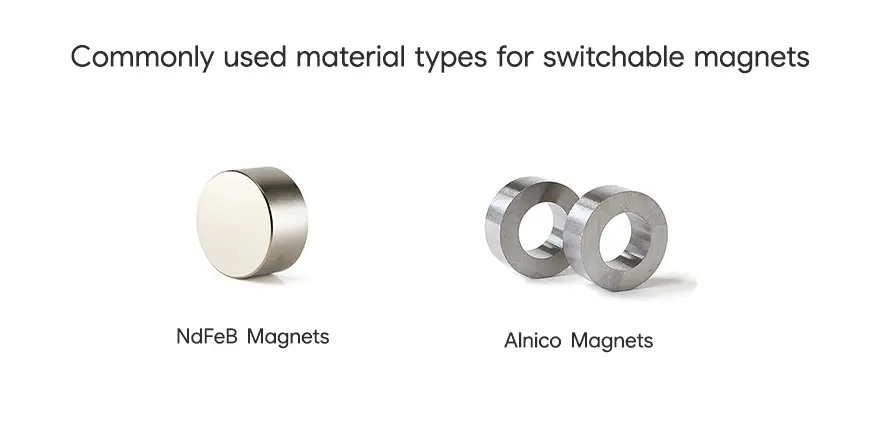
The most commonly used permanent magnet materials for switching magnets are NdFeB and Alnico. Your choice depends primarily on the requirements of your specific application. Neodymium switching magnets are the ones that can generate exceptionally strong magnetic fields. In fact, their holding force is several times stronger than that of any other material of the same volume. Therefore, they are a good choice if you need to get a magnet to hold or adsorb very strongly in a very small space. On the other hand, alnico switching magnets can withstand high temperatures quite well, so their magnetic properties remain stable even if they are used at pretty high temperatures. Therefore, they are a better option to be used in places where the temperature is regularly quite high.
The advantages of switchable magnets
The main advantage of switchable magnets lies in their clever combination of the strong magnetic force of permanent magnets and the switchable control, significantly outperforming fixed permanent magnets in versatility and safety and making them an ideal choice for a wide range of industrial and workshop applications.
Precise Control:
The biggest highlight of switchable magnets is the ability to easily turn the magnetic force on or off with a simple switch. In the on state, it provides a strong and reliable attraction force, firmly securing metal workpieces. in the off state, the magnetic force is completely released, allowing the workpiece to easily detach or be repositioned.
Safety and Efficiency:
Because the magnetic force can be turned off at any time, operators do not need to worry about the strong magnetic field causing accidental injury to themselves or nearby tools, especially when handling heavy or large metal parts. At the same time, the quick release and repositioning function greatly improves work efficiency, making it particularly suitable for complex scenarios such as welding, assembly, hoisting, and machining.
Energy-Free Operation:
switchable magnets rely on a permanent magnet core. The magnetic field is generated entirely by permanent magnetism, not by electricity. It consumes zero energy during use, eliminating concerns about the sudden loss of magnetic force due to power outages and avoiding the overheating problems common to electromagnets.
Tip: Neodymium switch magnets are the most popular due to their high performance.
Precautions
Safety Warning:
When the switchable magnet is turned on, it instantly produces a powerful magnetic force, can suddenly attract nearby ferrous metals. The work area must be thoroughly cleaned before operation to prevent accidental pinching injuries. Even when the magnet is off, protective gloves must be worn when handling the switch magnet.
Operation and Use:
When switching the magnet button, push or rotate slowly and evenly within the normal range of force. Do not push or pull forcefully or switch quickly, as this may damage internal mechanical parts.
Routine Maintenance:
To ensure the long-term stability and lifespan of the switchable magnet, regularly check its appearance for rust, wear, cracks, loose moving parts, etc.
Tip: Avoid using the switch magnet in high-temperature environments, as this will demagnetize it, causing a permanent decrease in magnetic force.
Applications of switch magnets
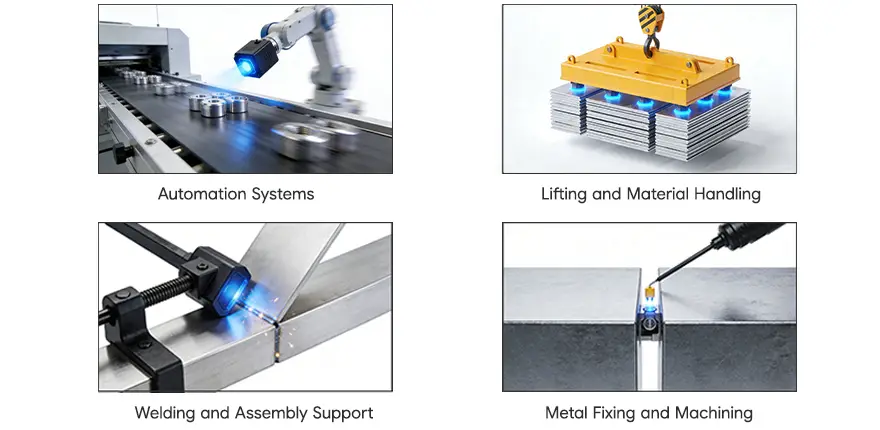
Metal Fixing and Machining
In workshop production, switchable magnets are often used as ideal temporary replacements for traditional clamps to quickly fix metal parts for laser cutting, grinding, drilling, assembly, or calibration. Operators can activate the magnets at any time to attract workpieces, and easily release them by deactivating the magnets after machining, avoiding the cumbersome steps of clamp installation. Typical applications include sheet metal processing, structural component fabrication, and mold repair in manual or semi-automatic scenarios.
Welding and Assembly Support
Switchable magnets are a classic welding aid, firmly fixing workpieces at common angles such as 45°, 90°, and 135° for easy spot welding, butt welding, or continuous weld seam welding. Turning off the switch instantly releases the workpiece, avoiding the hassle of post-weld disassembly. They can be used as magnetic angle irons, multi-angle welding clamps, or temporary fixtures.
Automation Systems
Switchable magnets can be integrated into robotic arm end effectors, automated assembly lines, or conveyor systems as magnetic grippers, enabling precise picking and releasing of metal parts. Widely used in automotive parts welding lines, stamping loading and unloading, quality screening, etc.
Lifting and Material Handling
Switchable magnets are designed specifically for light to medium-sized metal parts and are safer than traditional mechanical clamps. They overcome the limitation of industrial electromagnets, which are only suitable for heavy-duty applications, and provide the most practical and efficient option for small and medium-sized workshops and warehouses.
Tips: Switching magnets are more like a derivative of electromagnets, and are more suitable for applications with limited space.
Comparison of Switching Magnets and Electromagnets
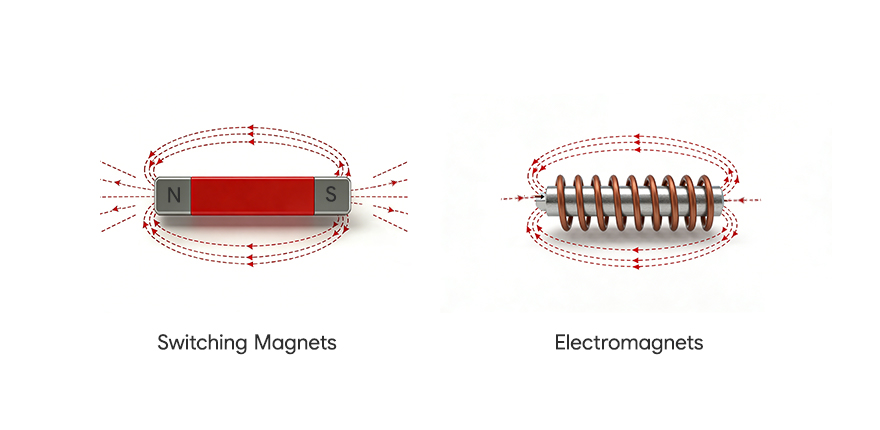
Electromagnets need constant electricity to work. Switchable magnets, however, are based on permanent magnets and operate with zero power. For this very reason, switching magnets have quickly captured the market in applications with limited space, high portability, and no power supply, perfectly filling the gap left by electromagnets’ large size and need for continuous power.
| Feature | Switchable Permanent Magnet | Electromagnet |
|---|---|---|
| Power Requirement | No electricity required | Requires continuous power supply |
| Control Method | Switched via lever, slider, or knob | Controlled via power switch |
| Magnetic Field Strength | Depends on the permanent magnet material | Depends on current strength, coil turns, and size |
| Temperature Resistance | Medium | High |
| Size / Volume | Medium | Large |
| Response Speed | Fast | Slow |
| Maintenance Requirements | Clean the magnet surface and check for wear | Requires regular maintenance of coils, wiring, and power system |
| Convenience / Portability | High | Low |
| Cost | Lower | Higher |
| Typical Applications | Securing/fixing in metalworking shops, welding auxiliary fixtures | Heavy industrial lifting, magnetic separation equipment |
Switchable magnets are suitable for small to medium sized portable applications. Electromagnets are better suited for heavy-duty industrial use where you need ultra-strong, continuously adjustable holding power. When deciding which to use, always evaluate based on load weight, how often you’ll switch it on/off, and key safety factors.
Some FAQs
What is the fundamental difference between switchable magnets and permanent magnets?
Permanent magnets cannot be switched off by their magnetic force, while switchable magnets allow the magnetic circuit to be switched off by rotating a switch.
Which is better, NdFeB or Alnico switchable magnets?
NdFeB is generally preferred, while Alnico is preferred for high-temperature applications.
Can switchable magnets attract stainless steel?
Presumably not. Common stainless steel is non-magnetic or weakly magnetic, resulting in very weak attraction.
Can switchable magnets be used in automated robot grippers?
Perfectly suited! Widely used for robots to grasp metal parts.
What is the typical lifespan of switchable magnets?
Under proper use, switchable magnets can last 5-10 years for industrial use.
For more insights, check these related blogs:
Surface-Mounted vs. Interior Permanent Magnet Motors
The Comprehensive Guide to Rare Earth Magnets in 2026
Comprehensive Overview of Permanent Magnets
Six Factors Affecting NdFeB Prices
Ready to upgrade your project? Browse our full product line at TOPMAG!🧲

I'm dedicated to popular science writing about magnets. My articles mainly focus on their principles, applications, and industry anecdotes. Our goal is to provide readers with valuable information, helping everyone better understand the charm and significance of magnets. At the same time, we're eager to hear your opinions on magnet-related needs. Feel free to follow and engage with us as we explore the endless possibilities of magnets together!