
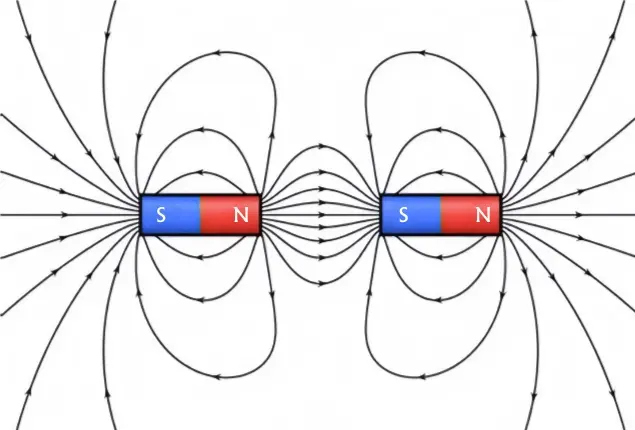
 Magnetic force is an invisible and intangible non-contact force that profoundly influences the world. Its most intuitive manifestation is the attraction and repulsion between magnets: the two magnetic poles, North (N) and South (S), adhere to the basic law of “opposite poles attract, as poles repel.” This macroscopic phenomenon is rooted in the order of the microscopic world. Within atoms, the tiny magnetic moments generated by electron motion and spin are the fundamental source. In ferromagnetic materials like iron, cobalt, and nickel, a large number of atomic magnetic moments spontaneously align in an orderly fashion, forming strong spontaneous magnetization, which manifests as the familiar macroscopic magnetic force we observe.
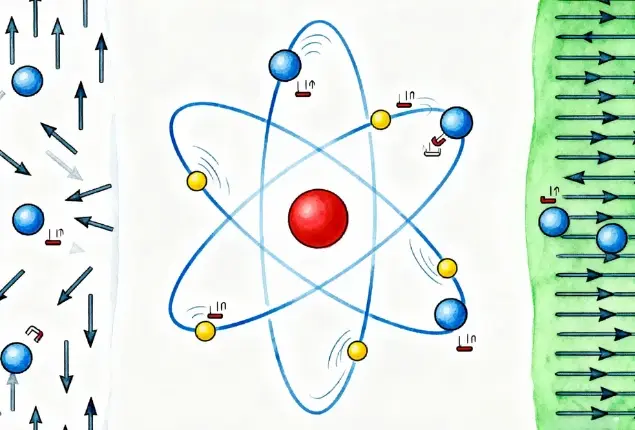 To deeply understand magnetic force, one must penetrate the surface of matter and delve into the atomic interior. All substances are composed of atoms, and the charge of electrons outside the atomic nucleus, combined with their ceaseless motion, makes each atom akin to a tiny magnet with an intrinsic magnetic moment.
However, the vast majority of substances do not exhibit magnetism at the macroscopic level. This is because the magnetic moments of their atoms or molecules are oriented randomly, canceling each other out, resulting in a near-zero net magnetic moment. Only in ferromagnetic substances does a special “exchange interaction” between atoms exist, prompting adjacent magnetic moments to spontaneously align in parallel, forming macroscopic magnetic domains and thereby producing strong collective magnetism. This explains why magnets can exert force “out of thin air.”
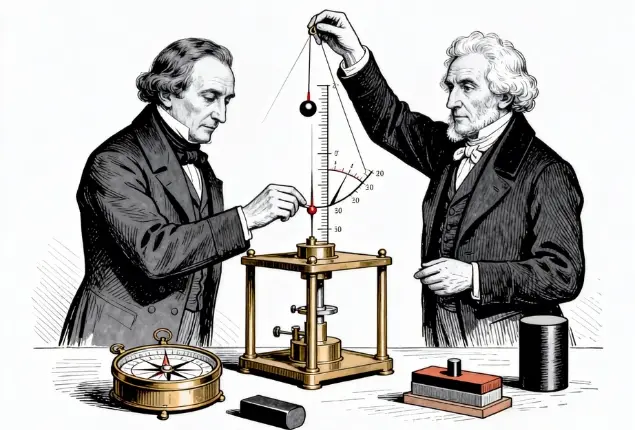 In the 1830s, German mathematicians and physicists Carl Friedrich Gauss and Wilhelm Weber collaborated to invent an early magnetometer. Its main principle was to measure the strength and direction of the magnetic field by the deflection angle of a magnetic needle in the Earth’s magnetic field. They achieved the first quantitative study of the Earth’s magnetic field, opening a new chapter in geophysics.
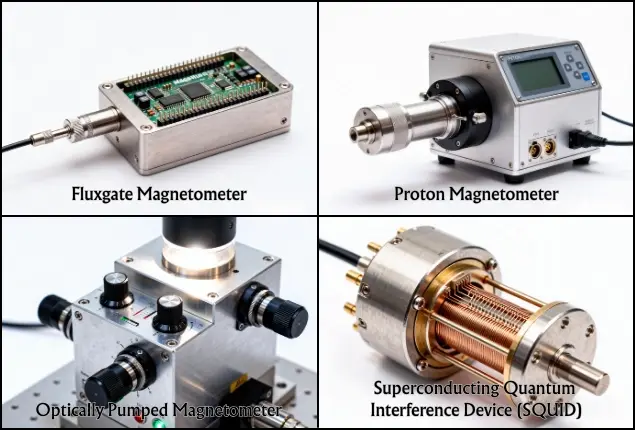
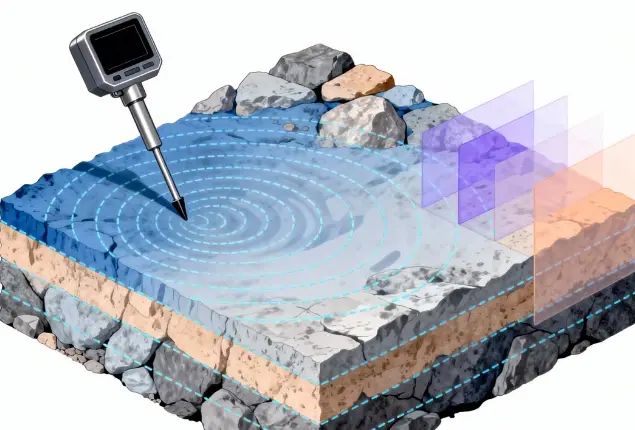 The core purpose of magnetic surveying is to detect magnetic anomalies caused by differences in the magnetic properties of near-surface subsurface media, thereby inferring subsurface structures and the spatial distribution of materials. These differences mainly stem from variations in the induced magnetization and remanent magnetization of rocks and minerals. Magnetic surveying is efficient, economical, and has a wide coverage, making it suitable for all stages of detailed exploration.
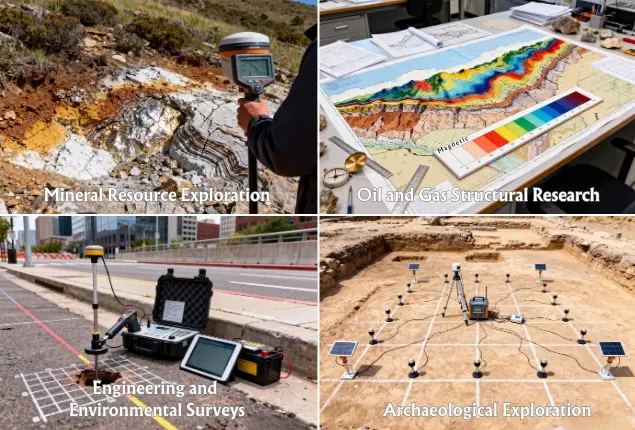 By capturing these subtle changes in magnetic fields with high-precision magnetometers, we can locate, image, and study invisible subsurface targets without disturbing the Earth’s surface. Its main applications are as follows:
Mineral Resource Exploration: Directly detecting deposits rich in strongly magnetic minerals. Alteration zones or structures associated with certain metallic ores can produce indirect magnetic anomalies, providing clues for mineral exploration.
Oil and Gas Structural Research: Primarily used to identify sedimentary basin boundaries, determine basement depth and undulation, and trace major deep faults, providing crucial data for assessing oil and gas prospects and regional geological structures.
Engineering and Environmental Surveys: Used to detect concealed faults, karst caves, and other geological hazards.
Archaeological Exploration: Ancient human activities often produce significant thermoremanence due to heating or the presence of magnetic materials, creating a striking contrast with the surrounding soil.
