
How Segmented Magnets Reduce Eddy Current Loss
Contenu
Principaux enseignements
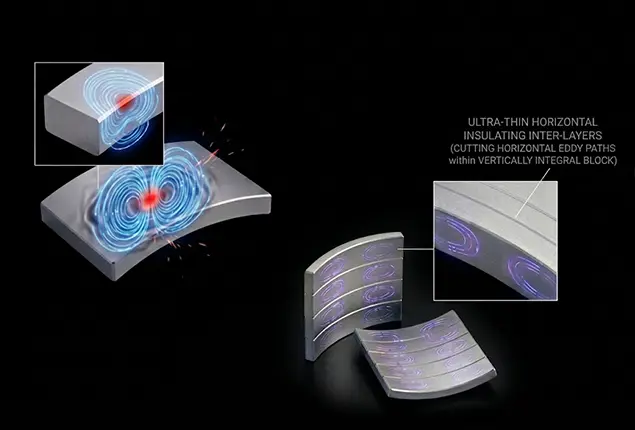
- Segmented magnets reduce eddy current loss by breaking conductive current loops.
- Smaller segment size significantly lowers heat generation and demagnetization risk.
- High-speed motors benefit most because eddy loss rises rapidly with frequency.
- Circumferential, axial, and laminated designs suit different performance requirements.
- Laminated magnets are preferred for ultra-high-speed, high-power-density motors.
Why Do Integral Magnets Generate Severe Eddy Current Loss?
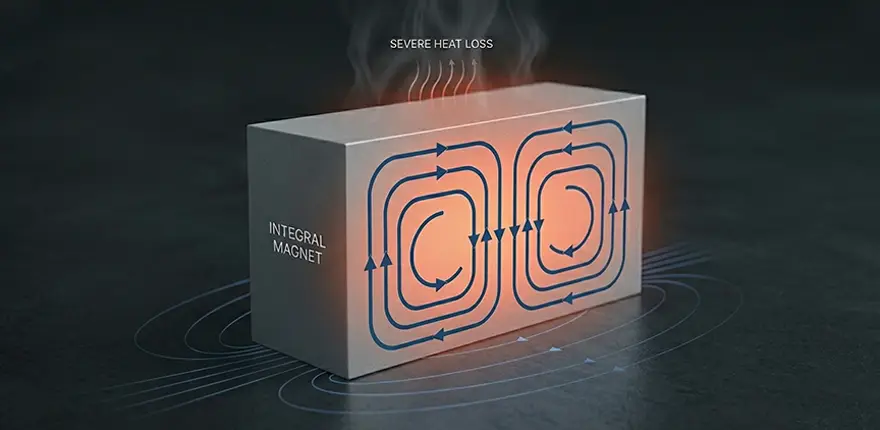
- Energy waste and reduced efficiency: Excessive eddy current loss lowers the motor’s energy conversion efficiency and increases continuous operating power consumption.
- Thermal demagnetization and shortened lifespan: Accumulated heat rapidly raises magnet temperature. The coercivity of NdFeB decreases by approximately 0.55–0.65% per 1°C temperature rise. Once the temperature exceeds the material threshold, irreversible demagnetization occurs, continuously degrading motor performance and shortening equipment service life.
How Segmented Magnets Reduce Eddy Current Loss
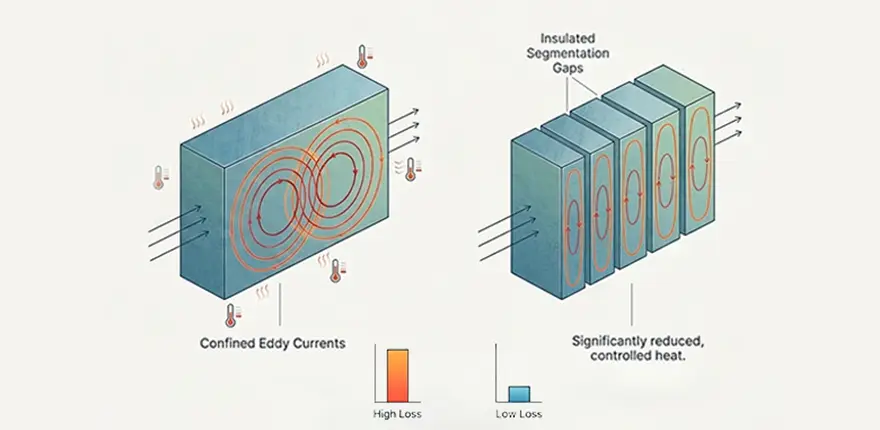
Shorten eddy current path size
Increase circuit resistance
Reduce total heat generation and eliminate hotspots
Improve high-speed operational stability
Common Segmented Magnet Structure Types
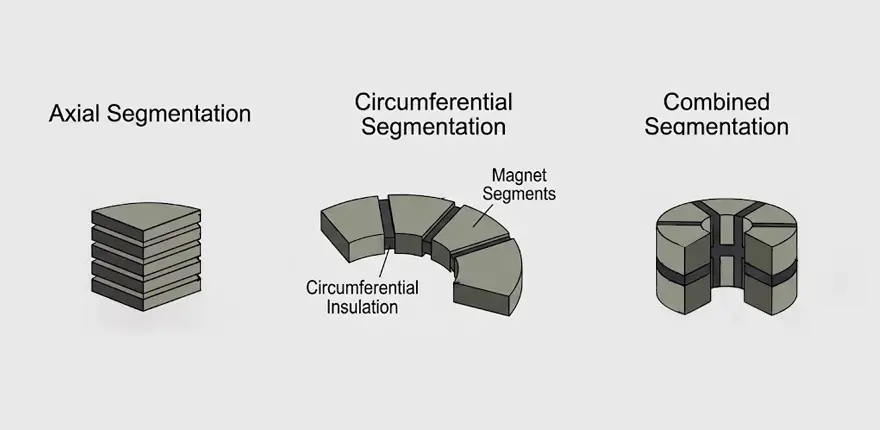
Circumferential Segmentation
Axial Segmentation
Combined Segmentation
Eddy Loss Reduction Data by Segmentation Quantity
| Segments per Pole | Relative Eddy Current Loss (Integral = 100%) | Engineering Performance Features |
|---|---|---|
| 1 (Integral Magnet) | 100% | Maximum eddy loop, highest heat and loss |
| 2 Segments | 30%-40% | Most significant performance improvement stage |
| 4 Segments | 10%–25% | Entering high-efficiency optimal range |
| 6 Segments | 5%–15% | Ideal for high-frequency high-speed motors |
| 8+ Segments | <10% (Stable) | Marginal benefit decreases obviously |
Note: The data is for engineering reference. Actual performance varies according to motor structure, rotating speed, winding design, and inverter switching frequency.
Core Application Fields of Segmented Magnets
- New Energy Vehicle Drive Motors: Most passenger car motors run at 8,000–15,000 RPM, adopting 2–4 circumferential segments with SH or EH grade NdFeB magnets. This configuration balances low eddy loss and anti-demagnetization performance, stabilizing power output and improving vehicle endurance.
- Wind Turbine Generators: Direct-drive PMSG turbines consume 500–1000 kg magnets per megawatt with long-term continuous operation. Offshore wind turbines commonly adopt axial segmentation plus high-corrosion-resistance coatings to ensure high efficiency and salt spray durability.
- Industrial Servo Motors: Frequent variable-speed operation generates rich harmonic interference. Segmented structures suppress harmonic eddy loss, guaranteeing consistent torque output and high-precision positioning accuracy for automated equipment.
- Aerospace & eVTOL High-Speed Motors: These motors feature ultra-high power density and rotating speed over 15,000 RPM. Combined segmentation or laminated magnet structures are widely used, with extreme working conditions adopting Samarium-Cobalt magnets for superior high-temperature stability.
Conclusion
Magnet segmentation is a fundamental design strategy for reducing eddy current loss in permanent magnet motors. Instead of being separate technologies, circumferential, axial, and combined segmentation represent different geometric levels of the same physical principle: breaking conductive current loops inside the magnet.
With increasing adoption of high-speed motors et SiC inverter technology, axial segmentation (laminated magnets) and multi-dimensional segmentation are becoming increasingly important for achieving high efficiency, thermal stability, and power density in modern electric drive systems.
Quelques questions fréquemment posées
Does magnet segmentation weaken magnetic force and performance?
What happens if the insulation layer between segmented magnets fails?
Segmented magnet vs laminated magnet, which is more common in mass-production EV motors?
What is stepped skew pole? How is it different from regular segmentation?
How to judge whether a motor has excessive eddy current loss?
Pour en savoir plus, consultez les blogs suivants :
Arc Magnet vs Block Magnet: Key Differences in Motor Applications
Why do Permanent Magnet Motors Demagnetize?
Comment les assemblages de stator alimentent les systèmes de moteur
Injection Molded Magnets – All You Need to Know
2026 Magnet Report: Rare Earths & Supply Chain Truths Prices
Prêt à améliorer votre projet ? Consultez notre gamme complète de produits sur TOPMAG!🧲

Je me consacre à la rédaction d'articles de vulgarisation scientifique sur les aimants. Mes articles portent principalement sur leurs principes, leurs applications et les anecdotes de l'industrie. Notre objectif est de fournir aux lecteurs des informations précieuses, afin de les aider à mieux comprendre le charme et l'importance des aimants. Par ailleurs, nous sommes impatients de connaître votre avis sur les besoins liés aux aimants. N'hésitez pas à nous suivre et à vous engager avec nous pour explorer ensemble les possibilités infinies des aimants !