
2026 Magnet Report: Rare Earths & Supply Chain Truths
- Ethan
- Base de connaissances
In 2026, the global magnet industry stands at a critical crossroads defined by resource constraints, technological bifurcation, and geopolitical restructuring. Demand from humanoid robots and high-performance electric drives is rapidly reshaping the global supply chain.
We are entering a hybrid era: aimants en terre rare continue to anchor high-end applications, while rare-earth-free technologies are emerging as a vital shield for supply chain security. For industry buyers, understanding this dual-track trend is essential for making smarter sourcing and investment decisions.
Contenu
Principaux enseignements
- 2026 global magnet industry runs on light rare earth & REE-free dual-track layout.
- NdPr deficit expands; heavy rare earth prices keep surging.
- REE-free tech is supplementary, not a full replacement for high-end scenarios.
- GBD technology dominates high-performance magnet cost & performance optimization.
- China’s rare earth supply chain dominance remains unshakable short-term.
Industry Status: Three Major Shifts in 2026
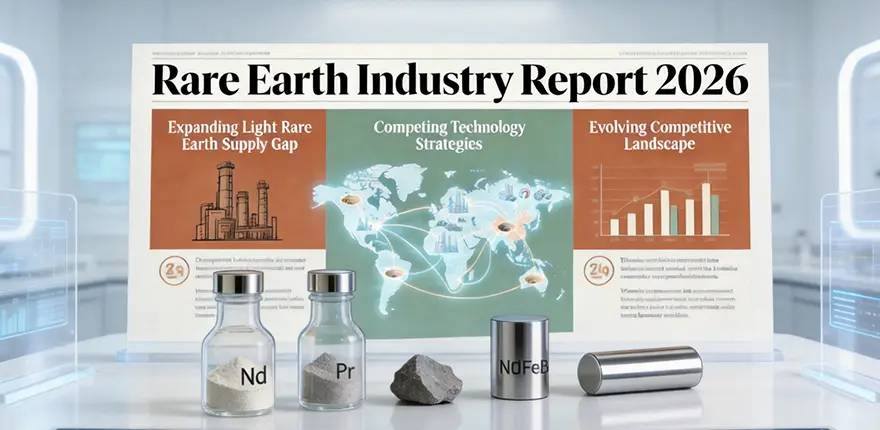
Supply-Demand Imbalance: Light Rare Earth Deficit Widens
The explosive growth in new energy vehicles, humanoid robots, and wind power is driving an unprecedented surge in demand for high-performance permanent magnets.
The global Praseodymium-Neodymium (NdPr) oxide market is facing a severe supply gap, with an estimated deficit of 9,000 tons in 2026—representing approximately 10% of total demand—which is projected to widen to 21,000 tons by 2028. At the same time, prices for heavy rare earths have skyrocketed, with Dysprosium rising over 80% year-on-year due to mining suspensions in Myanmar and Chinese quota controls. Critical data indicates that while light rare earth elements are more naturally abundant than heavy rare earths, the current growth in demand is significantly outpacing the expansion of global supply.
Technology Diversion: "Light REE Reduction" vs. "REE-Free"
The industry has split into two primary technical paths to effectively balance magnetic performance, production costs, and supply chain security.
The first path focuses on Light Rare Earth Element (REE) reduction, which aims to minimize or completely eliminate the use of expensive heavy rare earths like Dysprosium and Terbium while maximizing the efficiency of light rare earths such as Neodymium and Praseodymium. This approach is designed to maintain high performance levels while significantly lowering overall material costs. Alternatively, the “Rare-Earth-Free” path seeks to remove dependency on these materials entirely by substituting them with Ferrite magnets or utilizing Synchronous Reluctance motors. The ultimate goal of this strategy is to achieve zero dependency on rare earth supply chains and reach the lowest possible manufacturing cost.
Supply Chain Shift: From "Resource Hoarding" to "Tech Barriers"
The competitive logic has shifted from simply owning mining rights to mastering “Light REE production + Grain Boundary Diffusion (GBD) + REE-free design.” China remains dominant (37% of global reserves, 90%+ refining), but the West is accelerating its own LREE capacities and alternative tech.
Rare-Earth-Free Magnets: Real Value vs. Limits
Core Technologies
| Technology | Principle | Characteristics |
|---|---|---|
| Ferrite | Sintered ferrite replacing NdFeB | 1/5 the cost, but low magnetic energy. |
| Synchronous Reluctance (SynRM) | No magnets, relies on reluctance torque | Simple, robust, narrow speed range. |
| Electrically Excited (EESM) | Wound rotor instead of magnets | Mainstream capable (BMW), complex controller. |
Major Breakthrough: Main Drive Commercialized
Core Advantages & Limits
These alternative solutions offer significant advantages in terms of cost, supply chain security, and thermal stability, typically reducing expenses by 30% to 50% compared to rare-earth motors. However, they also present certain drawbacks, such as a lower torque density that reaches only 50% to 80% of their rare-earth counterparts, a more limited speed range, and increased system complexity, particularly in the case of Electrically Excited Synchronous Motors (EESM).This makes rare-earth-free magnets merely a backup option for high-power main drive applications.
Realistic 2026 Positioning
- Mature for: Home appliances, pumps, small scooters, auxiliary drives in EVs (windows/fans).
- Validated for Main Drive: BMW i-Series (EESM), Astemo demo (SynRM).
- Not-Ready for: High-dynamic humanoid robot joints, extreme-performance hypercar main drives.
Light Rare Earths: The Most Mature "Balanced" Solution
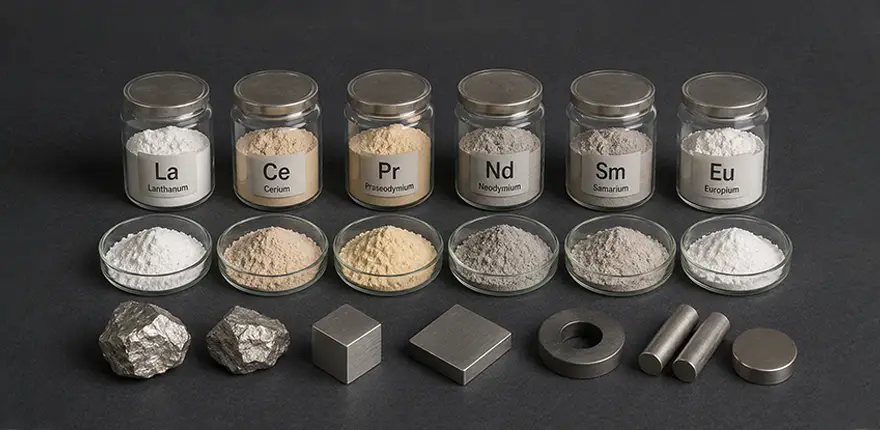
Advantages of Light Rare Earths
1. Abundance and Supply Chain Stability
Unlike heavy rare earths, which are geologically scarce, light rare earths are significantly more abundant in the Earth’s crust. This geological reality translates directly into supply chain resilience. For large-scale industrial projects—such as EV motor production or humanoid robot actuators—LREs offer the volume required without the volatile “bottleneck” risks associated with HREs.
2. Superior Cost-Efficiency
Abundance leads to affordability. The raw material cost of LREs is substantially lower than that of HREs. By utilizing LRE-dominant compositions, manufacturers can produce high-performance magnets that meet rigorous technical standards while maintaining a competitive edge in pricing.
3. The Core Driver of Magnetic Flux
It is a common misconception that all rare earths contribute equally to power. In reality, Neodymium and Praseodymium are the primary carriers of magnetic energy. LREs are the essential components for creating the high magnetic energy product ($BH_{max}$) found in Sintered NdFeB magnets. Heavy rare earths are merely auxiliary additives used to improve heat resistance; they are not the “engine” of the magnet’s strength.
Core Technologies
To further decouple performance from cost and scarcity, two primary technical routes have become industry benchmarks:
Rare-Earth Reduced Motors (Hybrid Solutions)
By strategically blending Ferrite with small amounts of Light Rare Earths, engineers can achieve a “best of both worlds” scenario. This approach can reduce LRE consumption by approximately 40% while maintaining reliable motor performance. This is the ideal solution for mid-range industrial applications where cost-balancing is a priority.
Heavy-Rare-Earth-Free (HRE-Free) Technology
The most significant breakthrough in recent years is the perfection of Grain Boundary Diffusion (GBD). This process allows manufacturers to achieve the high coercivity and thermal stability of traditional HRE magnets using only Light Rare Earths.
- Résultat : Elimination of expensive Dy/Tb.
- Performance: Equivalent anti-demagnetization capabilities.
- Impact: This is now the core development direction for high-end magnetic materials, offering maximum stability for the global supply chain.
Core Technology: Grain Boundary Diffusion (GBD)
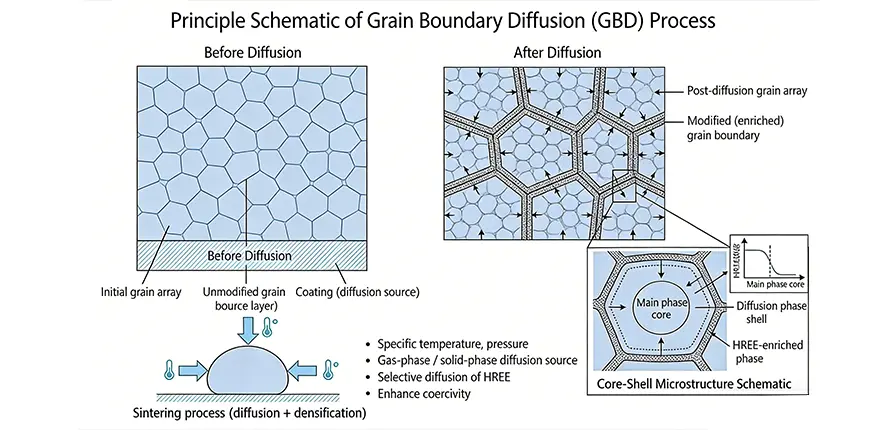
GBD is the critical breakthrough enabling “Light REE first” strategies by drastically cutting the need for expensive, scarce Heavy Rare Earths (Dy/Tb) .
How it works:
Instead of mixing heavy REEs into the entire magnet (wasteful), GBD coats them on the surface. Through heat, the heavy REEs diffuse only along the grain boundaries. This uses 80-90% less HREE but increases coercivity by 30-50% .
2026 Impact:
- Cost Reduction: 25-35% cheaper than traditional Dy-doped magnets.
- Adoption Rate: Over 70% of NEV main drives in China use GBD + Light REE solutions. Globally, 50-60% of high-performance NdFeB uses this .
Application Guide: Humanoid Robots & EV Motors
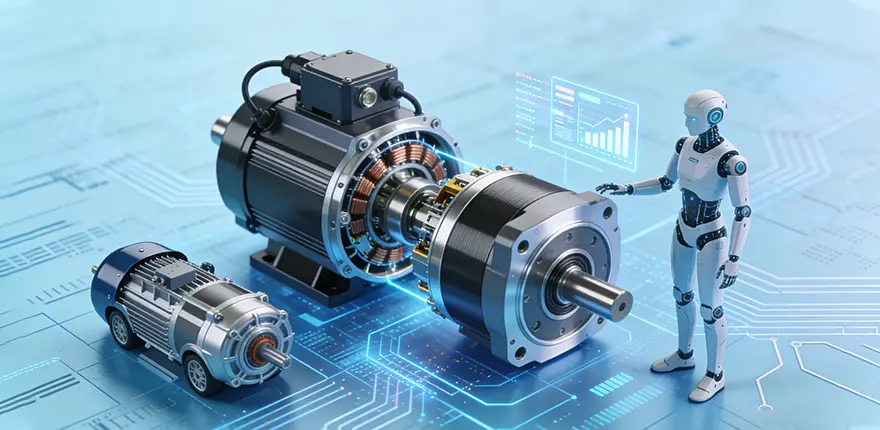
Humanoid Robots (Servo Joints)
- Requirement: Extreme torque density, high response, miniaturization.
- Winner: Light REE + GBD (NdFeB). Achieves 12+ kW/kg. No REE-free solution has matched this for dynamic joints (Tesla Optimus, Unitree). REE-free is only suitable for low-load, proof-of-concept service bots.
New Energy Vehicle (NEV) Motors
Main Drive:
- Dominant (>90%): Light REE GBD (Tesla, BYD). Peak efficiency >97%.
- Alternative (Growing): REE-Free EESM (BMW). Slightly lower peak efficiency (95-96%) but zero REE.
Auxiliary Drives (Oil pumps, fans, wipers):
- Winner: REE-Free (Ferrite/SynRM) . Cost is 40% lower than LREE. Mass adopted in 2026.
Global Supply Chain: Will China’s Dominance Shake?
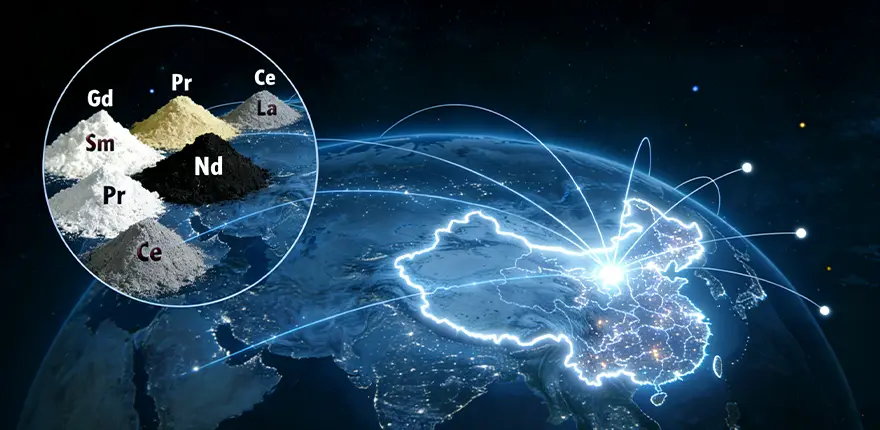
China’s dominant position in the global rare earth magnet supply chain is unlikely to be shaken in the short to medium term.
China’s Three Moats:
- Resource: China holds approximately 37% of the world’s total rare earth reserves, including over 50% of global light rare earth resources, laying a stable raw material foundation for downstream processing.
- Capacity: China controls more than 90% of the world’s rare earth refining and separation capacity. Its light rare earth magnetic separation capacity alone reaches 350,000 tons per year, while the combined capacity of all other regions is less than 50,000 tons per year — a substantial gap that cannot be easily closed.
- Tech: China boasts a complete, vertically integrated rare earth industrial chain, covering everything from ore mining, separation, and smelting to permanent magnet manufacturing and end-use applications. The cost advantages of large-scale production and a mature global supply chain ecosystem are nearly impossible to replicate in the near term.
The West’s Challenge:
- Slow Expansion of Overseas Production: Companies like Lynas (Australia) and MP Materials (USA) are scaling up operations, but their combined neodymium-praseodymium output is projected to remain below 10% of China’s production by 2026, making them unable to serve as an effective alternative.
- Significant Cost Disadvantage: Light rare earth permanent magnets produced outside China currently cost 30-50% more than comparable products made in China, severely limiting their market competitiveness.
- Alternative Risk: Some “low-rare-earth” or “rare-earth-free” motor designs attempt to reduce reliance on light rare earths, but certain technical shifts transfer demand to materials like gallium — of which China supplies 98% of the global market. These alternatives do not truly break the dependence on Chinese supply chains.
China’s full industrial chain advantage in rare earth magnet production will remain unrivaled for the foreseeable future, with the global high-performance permanent magnet market expected to stay under Chinese dominance over the next decade. Western efforts at supply chain diversification are primarily risk mitigation strategies within the existing framework, not attempts to overturn the current order.
Strategic Buyer Recommendations
As a procurement manager or engineer in 2026, you must navigate this matrix:
| Application Scenario | Recommended Tech | Key Metrics |
|---|---|---|
| Highest Performance (Humanoid robots, Hypercar Drives, High-power Wind) | Light REE + GBD NdFeB | Max torque density, Safety factor. |
| Balanced (Standard EV Main Drive, Industrial Servos) | Light REE / Reduced REE | Best cost/performance ratio. |
| Cost & Security Priority (Auxiliary EV motors, Pumps, Small scooters) | REE-Free (Ferrite/SynRM) | Lowest BoM cost, zero geopolitical risk. |
| Specific Main Drive (Fleet vehicles, EU compliance focus) | REE-Free EESM (e.g., BMW) | Accept volume/weight trade-off for ESG goals. |
Compliance & ESG: > In 2026, performance is only half the story. Global regulations now require verified Product Carbon Footprint (PCF) data under ISO 14067. When sourcing Light REE or GBD magnets, ensure your supplier provides full-lifecycle emission transparency to avoid "green-tariff" penalties at the border.
Conclusion
There is no perfect magnetic material; there is only the right fit for the scenario.
In 2026, the industry has matured to accept a “dual-track” future. Light REE + GBD is the undisputed king of high performance and the only validated path for cutting-edge humanoid robots. Rare-earth-free technology, however, is no longer a lab project; it is a commercial reality for auxiliary drives and specific main drive architectures (EESM), offering a robust shield against geopolitical supply risks.
The smartest strategy today is “Chinese Depth Supply + Global Compliance Backup” —utilizing China’s efficient LREE & GBD supply chain for core performance while validating REE-free designs for secondary applications to build long-term resilience.
Quelques questions fréquemment posées
Can rare-earth-free magnets fully replace NdFeB by 2026?
Not yet. While EESM (Electrically Excited Synchronous Motors) and Ferrite options have matured for auxiliary and specific main drives (like BMW’s), they still only reach 60-80% of the power density of NdFeB. For humanoid robots and high-performance EVs where weight and space are critical, NdFeB remains indispensable.
Why is Grain Boundary Diffusion (GBD) so critical in 2026?
GBD is the “survival tool” for cost control. In 2026, heavy rare earth (Dy/Tb) prices are extremely volatile. GBD allows us to achieve high coercivity (SH/UH grades) by using 80-90% less heavy rare earths, effectively shielding buyers from the worst price surges while maintaining performance.
How does the 2026 supply chain risk affect overseas buyers?
The risk has shifted from “mining” to “refining and processing.” China still controls over 90% of global separation capacity. Overseas buyers in 2026 face a 30-50% price premium for non-Chinese sourced magnets. A “dual-source” strategy—combining Chinese cost-efficiency with localized compliance backups—is the standard 2026 response.
Is magnet recycling a viable supply source in 2026?
It is growing but still small. Driven by ESG regulations and “urban mining,” recycling contributes about 5-10% of global supply in 2026. While it maintains performance, high collection costs mean recycled magnets are often used as a “green premium” option rather than a low-cost alternative.
What should I look for when selecting magnets for humanoid robots?
Prioritize Densité du couple et Thermal Stability. For 2026-gen robots, look for N52H or N55H grades processed with GBD. Ensure your supplier provides ISO 14067 carbon footprint data, as compliance is now as important as performance in global markets.
Pour en savoir plus, consultez les blogs suivants :
N52 : Les aimants en néodyme les plus puissants
Injection Molded Magnets – All You Need to Know
Vue d'ensemble des aimants permanents
Principe de fonctionnement des aimants permanents commutables
Six facteurs influençant les prix du NdFeB
Prêt à améliorer votre projet ? Consultez notre gamme complète de produits sur TOPMAG!🧲

Je me consacre à la rédaction d'articles de vulgarisation scientifique sur les aimants. Mes articles portent principalement sur leurs principes, leurs applications et les anecdotes de l'industrie. Notre objectif est de fournir aux lecteurs des informations précieuses, afin de les aider à mieux comprendre le charme et l'importance des aimants. Par ailleurs, nous sommes impatients de connaître votre avis sur les besoins liés aux aimants. N'hésitez pas à nous suivre et à vous engager avec nous pour explorer ensemble les possibilités infinies des aimants !