
Injection Molded Magnets – All You Need to Know
- Ethan
- Base de connaissances
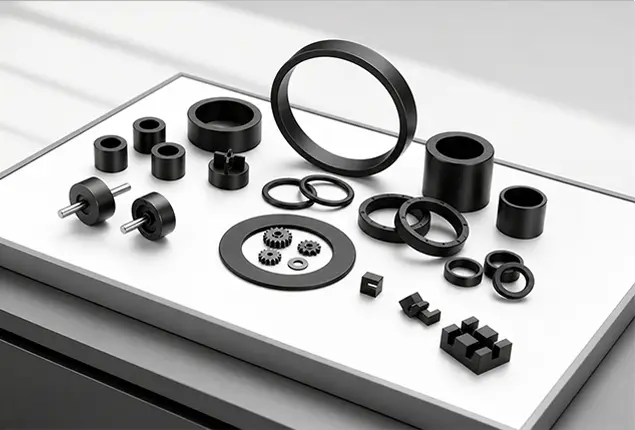
Over the past decade, global manufacturing has undergone a fundamental shift from volume-driven production to precision-oriented engineering. As devices continue to evolve toward miniaturization, intelligence, and higher efficiency, traditional magnet manufacturing processes have shown limitations in meeting the demands for complex geometries and net-shape forming without secondary operations. Against this backdrop, injection molded magnets have emerged as a critical complementary solution. By compounding rare-earth or ferrite magnetic powders avec high-performance engineering plastics, injection molded magnets deliver reliable magnetic performance while achieving net-shape precision for complex geometries—something traditional processes struggle to accomplish cost-effectively.
As a professional magnetic material supplier, we have witnessed firsthand how injection molded magnet technology helps engineers solve real-world challenges involving shape complexity et high-volume consistency. This guide provides a comprehensive overview of where and how injection molded magnets excel in precision manufacturing, along with key selection considerations.
Contenu
Principaux enseignements
- Injection molded magnets combine magnetic powders with plastic binders to deliver both magnetic performance and structural toughness.
- Injection molded NdFeB suits compact high-power motors, while injection molded ferrite offers low cost for home appliance sensors.
- Injection molded magnets achieve as-molded tolerances of ±0.03–0.05 mm, eliminate secondary processing, and support insert molding for integrated assemblies.
- Injection molded magnets have lower magnetic performance than sintered NdFeB and operate below 150°C, making sintered magnets better for extreme performance or small batches.
What Are Injection Molded Magnets?
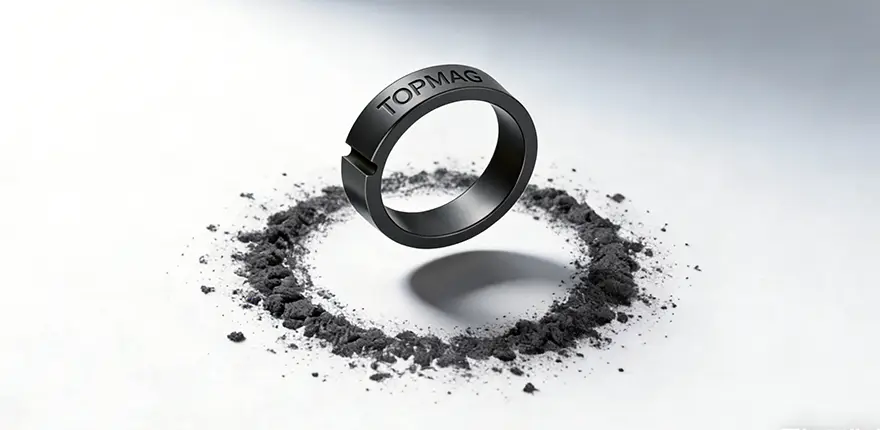
Injection molded magnets are a type of bonded magnet made by mixing permanent magnetic powders with a thermoplastic binder, then injecting the compound into a precision mold—similar to how standard plastic parts are manufactured.
The market is primarily divided into two categories: injection molded neodymium magnets et injection molded ferrite magnets. Unlike traditional sintered magnets, injection molded magnets use plastic as the binding matrix, giving them high toughness et resistance to breakage. Additionally, injection molded magnets can be customized in shape, size, and magnetic strength to meet the requirements of different applications.
Manufacturing Process of Injection Molded Magnets
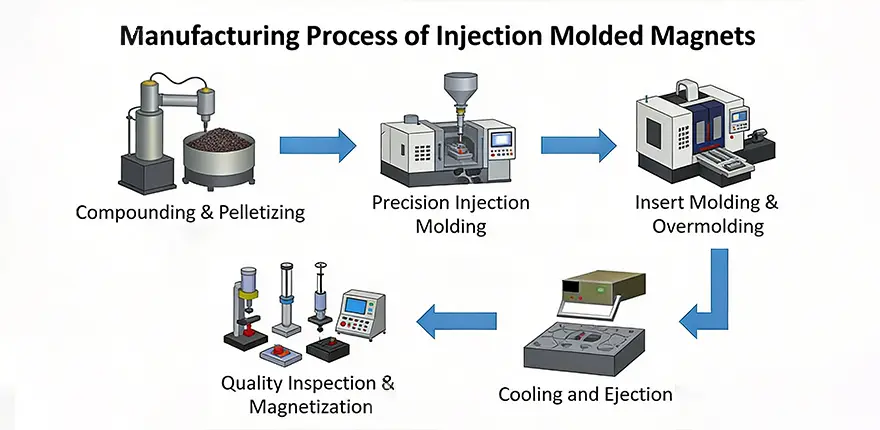
Post-molding, parts undergo rigorous testing, including:
- Flux Density Testing: Measuring the magnetic field strength.
- Magnetic Angle Deviation: Ensuring the magnetic poles are perfectly aligned with the mechanical geometry.
- Dimensional Checks: Using CMM or automated vision systems.
The Building Blocks of Injection Molded Magnets
The Building Blocks of Injection Molded Magnets The superior performance of injection molded magnets begins with the formulation and compatibility of their raw materials.
Magnetic Powders
Three core types of magnetic powders are commonly used in injection molded magnets:
- Isotropic NdFeB: Offers the highest energy product (up to 5–10 MGOe), making it the first choice for miniaturized, high-power motors.
- Ferrite : Extremely low cost and excellent corrosion resistance, widely used in home appliance sensors and low-cost motors.
- Samarium Cobalt (SmCo): Although expensive, it provides unmatched stability in extreme high-temperature environments (>200°C).
Binders: The Structural Backbone
The binder determines the magnet’s mechanical strength, temperature rating, and processing rheology:
- PA6 / PA12 (Nylon): Offers good toughness and machinability. PA12 has extremely low moisture absorption and better dimensional stability than PA6, making it ideal for high-precision sensors.
- PPS (Polyphenylene Sulfide): This engineering plastic provides high thermal stability and chemical inertness. It resists engine oil and coolant, making the standard choice for components in automotive engine compartments.
Why Choose Injection Molded Magnets?
Unmatched Design Complexity:
Traditional sintered magnets are typically limited to simple shapes like blocks or discs. Injection molding breaks these constraints, enabling the creation of magnets with integrated gears, holes, or even ultra-thin wall structures. If you can design it in CAD, we can mold it.
Precision and Zero Secondary Processing:
One of the biggest headaches in magnet sourcing is the brittleness of sintered magnets, which require expensive grinding to achieve tight tolerances. Injection molded magnets come out of the mold with high precision—achieving ±0.03–0.05 mm as-molded. This eliminates secondary processing and significantly reduces total landed cost.
Insert Molding & Integrated Assembly:
We can inject magnetic material directly onto metal shafts, bearings, or plastic housings (known as insert molding). This creates a single, robust component, eliminating adhesives, manual assembly, and complex quality inspection steps from your production line.
Superior Mechanical Strength:
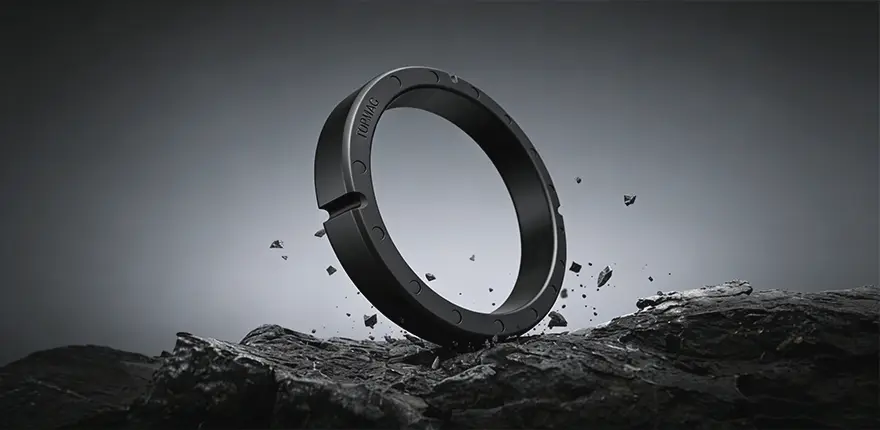
Unlike sintered neodymium magnets, which are brittle as ceramic, injection molded magnets are tough. The polymer binder provides excellent impact resistance, preventing chipping or cracking during high-speed rotation or rough handling.
⚠️ When Is Injection Molding NOT the Best Choice?
- You need maximum magnetic performance (e.g., ultimate torque density) → Choose sintered NdFeB.
- Your operating temperature consistently exceeds 150°C → Choose sintered UH/EH or SmCo.
- Your batch size is very small (<1,000 pieces) → Tooling costs become prohibitive; sintering offers more flexibility.
Injection Molded Magnets vs. Sintered Magnets
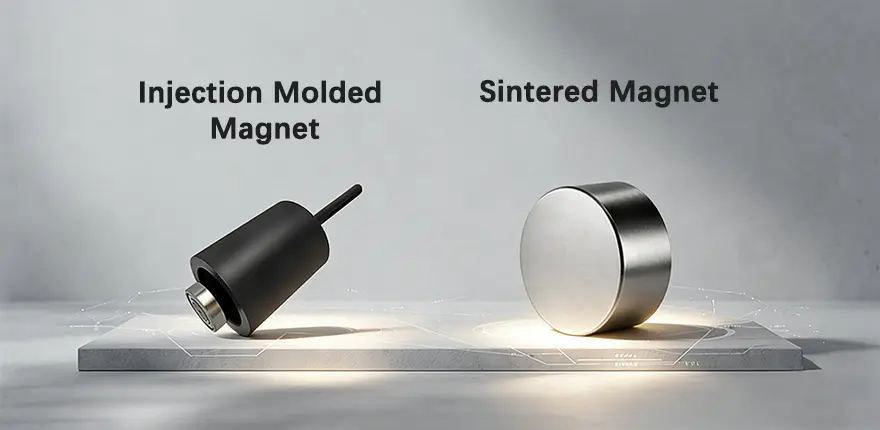
Both injection molded magnets and sintered magnets are widely used magnetic materials in the industry. Their core difference lies in manufacturing processes, which directly leads to obvious gaps in magnetic performance, dimensional accuracy, structural flexibility and comprehensive cost. Below is a detailed comparison between injection molded magnets et sintered NdFeB magnets.
| Dimension de comparaison | Injection Molded Magnet | NdFeB fritté |
|---|---|---|
| Magnetic Energy Product (BHmax) | 1 - 12 MGOe | 30 - 55 MGOe |
| Performance magnétique | Faible à moyen | Très élevé |
| Max Working Temperature | 120 - 150°C | 150 - 220°C (SH-AH) |
| Dimensional Tolerance | ±0.03 - 0.05 mm (Net Size) | ±0.01 - 0.03 mm (After Grinding) |
| Shape Complexity | Extremely High (Gears, Threads, Undercuts) | Faible à moyen |
| Secondary Processing | Not Required | Required (Grinding, Cutting) |
| Résistance à la corrosion | Excellent (Plastic Encapsulation) | Coating Required (Ni, Epoxy, etc.) |
| Mold Cost | High ($2k-8k per set) | Low (No Mold Needed) |
| Mass Unit Cost | Très faible | Moyen |
| MOQ | High (Mold Dependent) | Low & Flexible |
Key Applications of Injection Molded Magnets
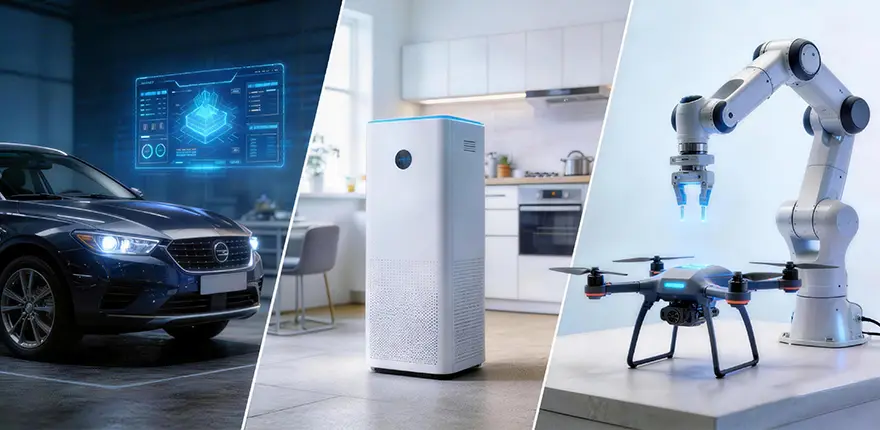
Injection molded magnets have become a favorite in modern industry because they provide magnetic force while also serving as precision structural components. Below are three core application areas.
Automotive Electronics: The Soul of Precision Sensing
In electric and hybrid vehicles, injection molded magnets are everywhere:
- EPS (Electric Power Steering): Used in angle sensors with precise magnetic deviation control, ensuring accurate steering signals.
- ABS (Anti-lock Braking System): Used for wheel speed sensing.
- Water Pumps & Cooling Systems: PPS-based injection molded magnet rotors operate reliably in hot coolant over long periods.
Lorsque l'aimant commutable est mis en marche, il produit instantanément une force magnétique puissante qui peut attirer soudainement les métaux ferreux situés à proximité. La zone de travail doit être soigneusement nettoyée avant l'utilisation de l'appareil afin d'éviter tout risque d'électrocution. prévenir les blessures par pincement accidentel. Même lorsque l'aimant est éteint, il faut porter des gants de protection pour manipuler l'aimant de l'interrupteur.
Smart Home Appliances: Quiet and Efficient
The proliferation of Moteurs BLDC owes much to injection molded magnets:
- Inverter Air Conditioners: The high balance of injection molded magnet rotors significantly reduces vibration and noise.
- Dishwasher Pumps: One-piece molded magnets eliminate complex shaft seal structures.
Industrial Robots & Drones
- Magnetic Encoders: Provide high-precision closed-loop control signals.
- Micro Motors: Enable fine movements in dexterous robotic hands.
From automotive safety to home comfort, injection molded magnets are replacing traditional magnetic assemblies. They reduce total system cost (by reducing part count) while enhancing end-product competitiveness through superior precision stability. As a supplier, we understand the demanding requirements across industries and provide one-stop support from material formulation to tooling development.
Sourcing & Selection Guide
For procurement managers and design engineers, evaluating an injection molded magnet supplier is not about how many injection molding machines they own—but rather their control over four key metrics:
Magnetic Deviation Control
For precision sensors (e.g., automotive EPS, throttle position sensors), magnetic deviation is the “first lifeline” of quality. If a supplier cannot provide a detailed magnetic scanning distribution report, they lack precision control capability.
Thermal Irreversible Loss Testing
Injection molded magnets are often used in automotive engine compartments or industrial motors—environments with stringent requirements for thermal stability. A professional supplier will recommend the optimal magnetic powder loading ratio and binder grade based on your operating temperature.
Dimensional Consistency (CPK Values)
In high-volume production, maintaining tolerances at the micron level is a major challenge. If tolerances can be consistently held to ±0.02 mm or better without relying on 100% inspection, it indicates mature process control over mold temperature and injection pressure compensation.
Moldflow Analysis Capability
Magnetic particles are significantly denser than ordinary plastics, making them prone to air traps, weld lines, or uneven magnetic powder distribution due to shear forces during injection. Suppliers with moldflow analysis capability can identify these risks before the mold is built, optimizing gate locations to ensure magnetic uniformity and structural integrity.
Conclusion
As rare-earth prices fluctuate, the material utilization advantage of injection molding becomes increasingly evident. Injection molded magnets achieve near-zero scrap production (runner material can be reground and recycled), aligning well with global ESG requirements for green supply chains.
Looking ahead, as additive manufacturing (3D-printed magnets) matures, injection molded magnets will continue evolving toward increasingly customized solutions.
Injection molded magnets are more than just components—they are a solution for efficiency, precision, and system integration. At TOPMAG, we understand how critical every micron of tolerance and every gauss of magnetic field is to our customers’ products.
If you are facing challenges such as low motor efficiency, high assembly costsou brittle magnets, injection molded magnets may be the key answer.
Quelques questions fréquemment posées
Can injection molded magnets be magnetized in any direction?
Yes. This is one of their greatest advantages. Because the magnetic powder is suspended in a polymer matrix, we can apply an external magnetic field during the molding process (orientation) or magnetize the finished part afterward. We can achieve radial, axial, multi-pole (on a single surface), or even skewed magnetization to reduce cogging torque in motors.
Why is the magnetic strength lower than that of "sintered" magnets?
It comes down to density. Sintered magnets are nearly 100% magnetic alloy. Injection molded magnets are a “composite” containing roughly 65% to 80% magnetic powder by weight (and even less by volume), with the rest being plastic binder. This “dilution” results in a lower Maximum Energy Product ($BH_{max}$), typically ranging from 1 to 12 MGOe.
Are these magnets prone to "aging" or degradation because of the plastic?
Modern engineering binders like PPS ou PA12 are extremely stable. However, “aging” usually refers to:
- Oxidation: The plastic binder actually protects the magnetic grains better than traditional coatings.
- Thermal Softening: If the operating temperature exceeds the binder’s glass transition temperature, the part may lose dimensional stability. Choosing the right binder (like PPS for automotive) prevents this.
Can I recycle the runner material from the injection process?
Yes. Unlike sintered magnets, which produce “sludge” or scrap during grinding that is difficult to reclaim, injection molding runners can be reground and mixed with virgin material. This makes the process nearly zero-waste, which is a significant cost-saver and a “green” manufacturing advantage.
How do I handle "Weld Lines" in a magnetic part?
Weld lines (where two flow fronts meet) are a critical concern because they are structurally weaker and can disrupt the magnetic flux. We use Moldflow Analysis to position gates so that weld lines occur in “non-critical” areas of the magnetic circuit or where mechanical stress is lowest.
Pour en savoir plus, consultez les blogs suivants :
Bonded vs Sintered NdFeB Magnets: Which One Should You Choose?
Ultimate Guide to Coating Selection for NdFeB Magnets 2026
How to Separate Strong Magnets
Principe de fonctionnement des aimants permanents commutables
Six facteurs influençant les prix du NdFeB
Prêt à améliorer votre projet ? Consultez notre gamme complète de produits sur TOPMAG!🧲

Je me consacre à la rédaction d'articles de vulgarisation scientifique sur les aimants. Mes articles portent principalement sur leurs principes, leurs applications et les anecdotes de l'industrie. Notre objectif est de fournir aux lecteurs des informations précieuses, afin de les aider à mieux comprendre le charme et l'importance des aimants. Par ailleurs, nous sommes impatients de connaître votre avis sur les besoins liés aux aimants. N'hésitez pas à nous suivre et à vous engager avec nous pour explorer ensemble les possibilités infinies des aimants !