
Ultimate Guide to Coating Selection for NdFeB Magnets 2026
- Ethan
- Base de connaissances
Contenu
Principaux enseignements
- NdFeB magnets corrode easily—coating is essential.
- Which magnet coating to choose? Ni-Cu-Ni is the most versatile, epoxy excels in corrosion resistance, Parylene is premium, and zinc is economical but dry-indoor only.
- Rule of thumb: zinc/nickel for indoor, epoxy/Parylene for marine/chemicals, Ni-Cu-Ni for high heat.
- Avoid mistakes: no pure zinc/nickel in marine, no epoxy above 150°C, use hydrogen baking for load-bearing parts.(Salt spray test >500 hours for harsh environments.)
- Coatings don’t raise temperature limits—exceed the magnet’s rating (e.g., ~80°C for N-grade) and it still demagnetizes.
Why Coatings Are Critical for NdFeB Magnets?

The Inherent Weakness of NdFeB
Protective Functions of Coatings
- Corrosion protection: Forms a physical barrier against oxidation and chemical attack.
- Improved mechanical strength: Enhances hardness, prevents edge chipping, boosts wear resistance, and extends service life.
- Enhanced appearance: Delivers a uniform metallic finish.
Mainstream Coatings Explained and Compared
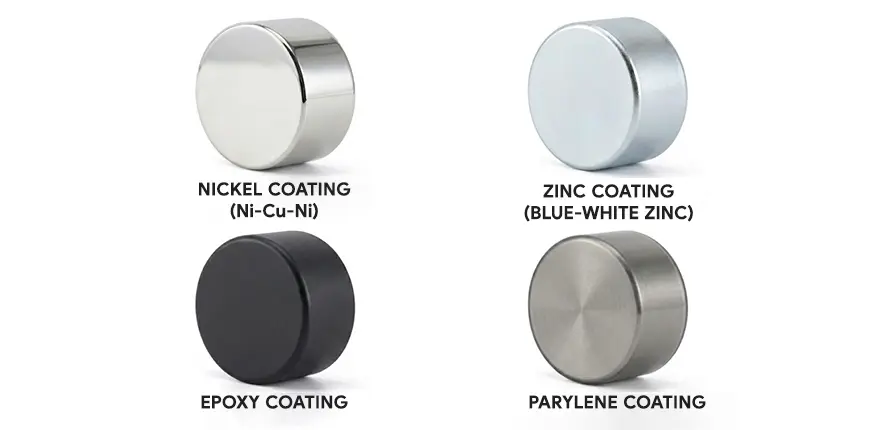
| Characteristics | Zinc Coating | Ni-Cu-Ni Coating | Epoxy Coating | Parylene Coating |
|---|---|---|---|---|
| Salt Spray Test | General (24–72h) | Moderate (48–96h) | High (>500h) | Ultra-High (>1000h) |
| Résistance à la corrosion | Général | Modéré | Haut | Ultra-haut |
| Coating Thickness | Thin–Medium (5–15 μm) | Medium (15–21 μm) | Thick (20–28 μm) | Ultra-Thin (Micron Level) |
| Conductivity | Conductive | Conductive | Non-Conductive | Non-Conductive |
| Abrasion Resistance | Medium–Low | Haut | Modéré | Modéré |
| Chemical Resistance | Général | Modéré | Haut | Excellent |
| Niveau de coût | Le plus bas | Low–Medium | Moyen | Haut |
| Biocompatibility | Général | General (Nickel allergy risk) | General (Medical grade optional) | Excellent (Medical grade standard) |
| Processing Method | Electroplating (Simple, high-speed mass production) | Electroplating (Mature & reliable) | Dip/ Spray Coating (Medium difficulty) | Vacuum Deposition (Professional & complex) |
Ni-Cu-Ni Coating
- EV motors and automotive components (IATF 16949 compliant)
- Industrial motors, sensors, and magnetic separators
- Consumer electronics (speakers, wireless chargers, smartphones)
- Indoor and mild outdoor applications (industrial fixtures, small wind turbines)
Zinc Coating
- General electronic parts (toy magnets, simple sensors, enclosure magnets)
- Hardware products (magnetic door/window catches, hanging fixtures, fastener magnets)
- Low-end industrial equipment (conveyors, basic instruments)
- High-volume consumer products (magnetic stationery, small appliance magnets)
Epoxy Coating
- Offshore wind turbines and marine equipment (saltwater exposure)
- Chemical processing equipment and sensors
- Outdoor industrial applications (construction machinery, agricultural equipment)
- Magnets requiring adhesive bonding (transparent epoxy)
Parylene Coating
- Aerospace components (high temperature, vacuum, chemical exposure)
- Medical devices (MRI machines, surgical tools, implantable devices)
- Extreme-temperature industrial equipment (oil and gas drilling tools)
- Precision micro-sensors and electronics (tight coating thickness requirements)
Other Special Coatings
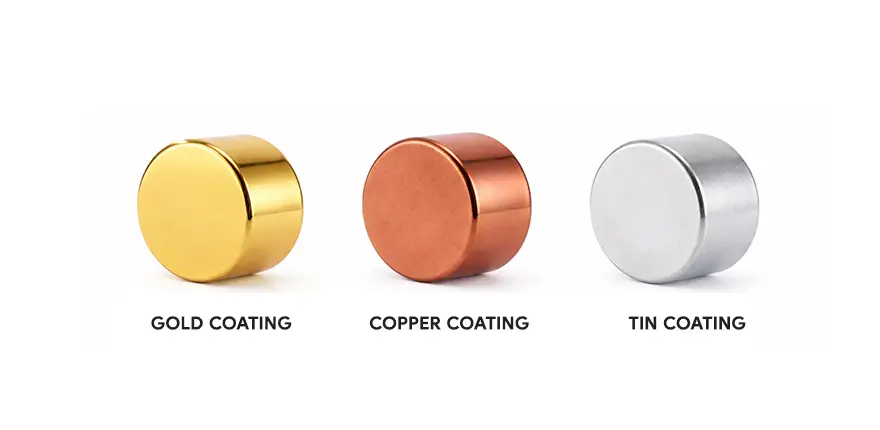
Tip: Injection overmolding is a complementary protection process used alongside coatings. When coatings cannot withstand extreme impact, plastic overmolding absorbs shock energy, prevents magnet cracking, and completely seals out corrosive media. In practice, a “coating first, then overmolding” combination is often used.
How to Select the Right Magnet Coating

First Factor: Operating Environment
- Dry indoor environments (toys, office equipment, indoor sensors): Zinc or nickel coating provides basic rust protection. Zinc is more cost-effective; nickel offers better appearance and wear resistance. Choose based on cost and aesthetic needs.
- High humidity or marine environments (outdoor equipment, marine instruments, automotive exterior components): Epoxy coating or a Ni-Cu-Ni + epoxy dual coating is the best choice. Epoxy effectively blocks moisture and salt spray. The dual coating is suitable for extreme marine environments, combining mechanical strength with corrosion resistance.
- Chemical exposure environments (acids, alkalis, industrial solvents): Chemicals can damage standard coatings, requiring an inert protective barrier. Use PTFE (Teflon) or Parylene—both are chemically inert.
- High temperature environments (≤200°C): High temperatures can cause coating cracking or accelerated oxidation. Ni-Cu-Ni has good thermal stability. Epoxy coatings degrade above 150°C.
- Medical or precision electronics environments: Parylene offers ultra-thin, pinhole-free properties, excellent dielectric performance, and chemical resistance—meeting the stringent requirements of aerospace and medical applications. Its biocompatibility also complies with medical standards.
Consider Process Limitations
- Hydrogen embrittlement: Hydrogen released during electroplating can cause magnets to crack under stress. Load-bearing parts must undergo hydrogen relief baking.
- Dimensional deviation: Coating thickness typically ranges from 10–30μm. Precision-fit parts require tolerance allowances to avoid assembly jamming.
Balance Cost and Service Life
- Consumer-grade products (toys, low-end stationery): Prioritize cost. Choose zinc or thin nickel for basic short-term rust protection.
- Industrial-grade products (general industrial motors, power tools): Prioritize value. Choose zinc-nickel alloy or standard-thickness Ni-Cu-Ni (15–25μm per side)—the most cost-effective option.
- High-end or automotive-grade products (critical automotive components, outdoor base station equipment): Prioritize reliability. Recommend epoxy + nickel composite or Parylene. These solutions require a neutral salt spray test of >500 hours.
Key Points to Confirm Before Ordering (Recommend Including in Technical Agreement)
- What is the neutral salt spray test duration without red rust? This is the most direct indicator of corrosion resistance.
- Is hydrogen relief baking required? Necessary if the magnet will bear mechanical stress.
- What are the coating adhesion (cross-cut test) and thickness range? Thickness should comply with drawing tolerances.
- Will the coating baking temperature affect magnet performance? For example, N-grade NdFeB has a maximum operating temperature of only about 80°C. If the coating curing temperature exceeds this, irreversible demagnetization will occur.
- What are the environmental compliance requirements? RoHS restricts hazardous substances such as hexavalent chromium and lead.
Pitfalls to Avoid
- Avoid pure nickel or pure zinc coatings in marine environments (neutral salt spray test typically <72 hours).
- Avoid epoxy coatings in environnements à haute température (>150°C).
- Avoid using electroplated magnets without hydrogen relief baking for load-bearing structures.
Scientific Selection for Long-Term Protection
- Ni-Cu-Ni: The versatile, high-value choice for most applications.
- Epoxy: An excellent choice for harsh, chemically aggressive environments.
- Parylene: The premium standard for haute température, medicalet aerospace applications.
Quelques questions fréquemment posées
Is thicker coating always better?
Epoxy coating is vulnerable to scratching. How can I prevent protection failure?
What is the difference between epoxy coating and rubber overmolding?
Can a rusted magnet be repaired?
Does coating change the magnet's operating temperature?
Ni-Cu-Ni vs epoxy — which one is better?
Ni‑Cu‑Ni offers better corrosion resistance, adhesion, and conductivity; epoxy is cheaper and faster but less durable in harsh environments. Choose Ni‑Cu‑Ni for performance, epoxy for cost‑sensitive applications.
Pour en savoir plus, consultez les blogs suivants :
How to Separate Strong Magnets
Principe de fonctionnement des aimants permanents commutables
Processus de fabrication des aimants
Global Magnet Supplier TOPMAG : Foire de Canton 2025
5 facteurs influençant les prix de gros des aimants en néodyme
Prêt à améliorer votre projet ? Consultez notre gamme complète de produits sur TOPMAG!🧲

Je me consacre à la rédaction d'articles de vulgarisation scientifique sur les aimants. Mes articles portent principalement sur leurs principes, leurs applications et les anecdotes de l'industrie. Notre objectif est de fournir aux lecteurs des informations précieuses, afin de les aider à mieux comprendre le charme et l'importance des aimants. Par ailleurs, nous sommes impatients de connaître votre avis sur les besoins liés aux aimants. N'hésitez pas à nous suivre et à vous engager avec nous pour explorer ensemble les possibilités infinies des aimants !