
HRE-Free Magnets Explained: Technology and Manufacturing Innovations
- イーサン
- 知識ベース
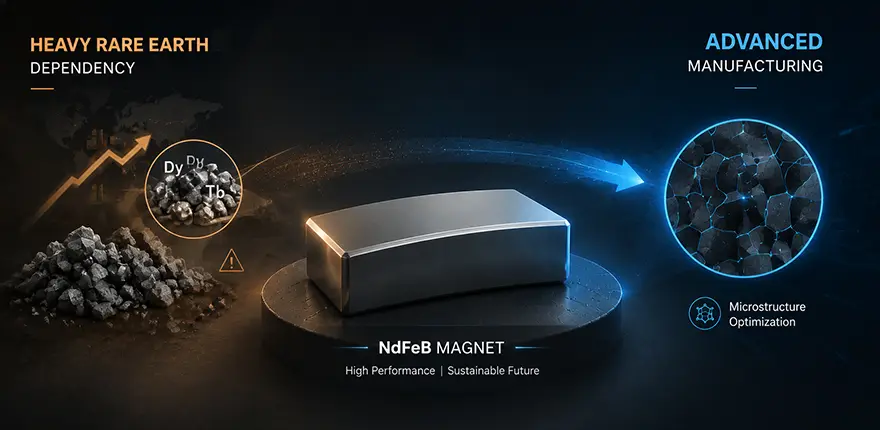
High-performance motors demand stronger magnets—but relying on expensive heavy rare earth elements like ジスプロシウム (Dy) and テルビウム (Tb) is becoming increasingly unsustainable.
So how can modern ネオジム磁石 maintain high coercivity without these critical materials?
The answer lies in HRE-Free technology. By combining advanced grain boundary engineering with innovative manufacturing processes, today’s HRE-Free magnets deliver exceptional magnetic performance while significantly reducing heavy rare earth consumption.
In this article, we’ll explore how HRE-Free magnets work, why they are becoming the industry’s preferred solution, and how TOPMAG’s Advanced F Process further enhances coercivity for demanding industrial applications.
内容
要点
- Learn why HRE-Free magnets are becoming the preferred solution for high-performance applications.
- Discover how grain boundary engineering replaces traditional heavy rare earth additions.
- Understand how TOPMAG’s Advanced F Process increases intrinsic coercivity while maintaining high remanence.
- Compare Standard HRE-Free そして Advanced F Process grades for different operating requirements.
- Find the right HRE-Free magnet solution for EV motors, robotics, automation, and industrial equipment.
Why Is HRE-Free Becoming an Industry Trend?
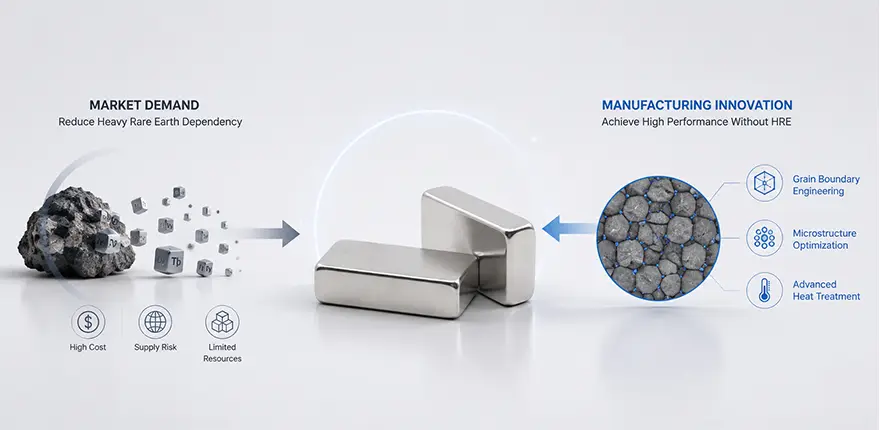
The rapid development of HRE-Free technology is driven not only by changing market demands, but also by continuous advances in manufacturing technology.
Market Demand Is Driving Heavy Rare Earth Reduction
On one hand, heavy rare earth materials are expensive, have relatively limited availability, and are increasingly affected by global supply chain uncertainties. As a result, relying solely on heavy rare earth additions significantly increases manufacturing costs while creating supply risks.
On the other hand, magnet manufacturers worldwide are placing greater emphasis on resource efficiency and sustainable manufacturing, creating strong demand for technologies that reduce heavy rare earth consumption without sacrificing magnetic performance.
Consequently, reducing dependence on heavy rare earth elements while maintaining high magnetic performance has become an important development direction for the NdFeB magnet industry.
Manufacturing Innovation Makes HRE-Free Technology Possible
Reducing heavy rare earth consumption does not mean sacrificing magnetic performance.
Thanks to continuous advances in grain boundary engineering, sintering technology, and heat treatment processes, manufacturers are now able to achieve higher intrinsic coercivity by optimizing the magnet’s microstructure instead of adding more heavy rare earth elements.
Today, precise control of grain boundary structure, grain size, and elemental diffusion has become one of the most important factors influencing magnetic performance.
What Are HRE-Free Magnets?
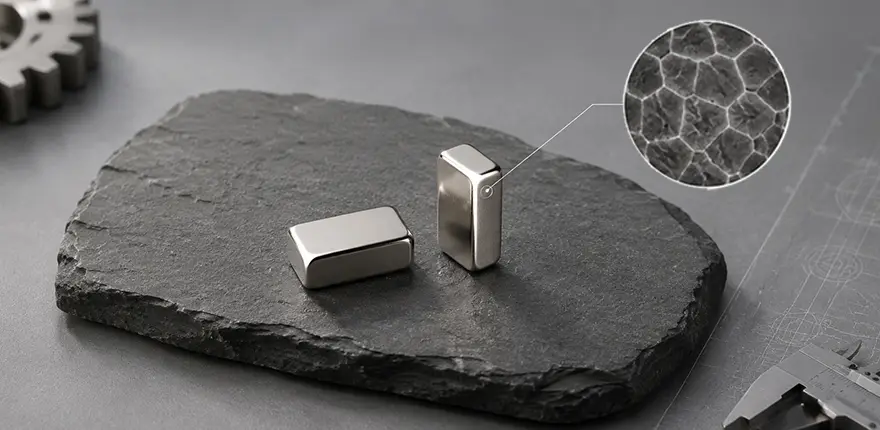
HRE-Free magnets are sintered NdFeB permanent magnets that achieve the required magnetic performance without adding 重希土類元素 such as Dysprosium (Dy) and Terbium (Tb) during manufacturing.
To achieve this goal, manufacturers typically optimize multiple aspects of the production process, including:
- Alloy composition design
- Powder processing control
- Grain boundary optimization
- Sintering process optimization
- Heat treatment optimization
- Manufacturing precision control
The objective of HRE-Free technology is not simply to eliminate heavy rare earth elements. Instead, it maximizes the effectiveness of grain boundary structures to suppress magnetic domain reversal while maintaining high remanence (Br), thereby providing excellent resistance to demagnetization.
With continuous improvements in manufacturing technology, HRE-Free magnets are now widely used in a growing range of high-performance industrial applications.
How Can HRE-Free Magnets Maintain High Coercivity?
HRE-Free technology represents a shift from traditional approaches to magnet performance enhancement, enabling high magnetic performance while reducing the dependence on heavy rare earth elements.
The following sections will discuss the limitations of conventional coercivity enhancement methods and how modern manufacturing technologies provide new solutions for HRE-Free magnets.
Traditional Approach to Improving Coercivity
Conventional NdFeB magnets increase intrinsic coercivity by adding Dysprosium or Terbium to enhance the magnetocrystalline anisotropy field of the main magnetic phase, thereby improving resistance to magnetic domain reversal.
Although this method effectively increases coercivity, it also presents two major disadvantages:
- Higher manufacturing costs
- Excessive heavy rare earth additions may reduce remanence (Br)
Therefore, simply adding more heavy rare earth elements is not considered a sustainable long-term solution.
The Role of Grain Boundary Engineering
The core of modern HRE-Free technology lies in Grain Boundary Engineering.
By improving grain isolation, enhancing grain boundary continuity, and optimizing elemental diffusion, grain boundary engineering effectively suppresses magnetic domain reversal, allowing magnets to achieve high intrinsic coercivity without relying on large amounts of heavy rare earth elements.
Compared with conventional approaches, this technology offers several key advantages:
- Higher intrinsic coercivity (Hcj)
- Better resistance to demagnetization
- Lower heavy rare earth consumption
- Improved production consistency
As performance requirements continue to increase, manufacturing capability has become just as important as material composition in determining the final magnetic properties.
TOPMAG's Manufacturing Innovation: Advanced F Process
The performance of HRE-Free magnets depends not only on optimized material composition, but also on precise control of the entire manufacturing process and the magnet’s microstructure.
To further improve magnetic performance while maintaining an HRE-Free solution, TOPMAG has developed the Advanced F Process, an innovative manufacturing process built upon the standard HRE-Free production route.
Compared with the standard HRE-Free manufacturing process, the Advanced F Process introduces an additional Grain Boundary Optimization Treatment during production. This extra process further refines the grain boundary microstructure, improves magnetic isolation between grains, and enables the magnet to achieve higher intrinsic coercivity (Hcj) while maintaining similar remanence (Br). It also enhances production consistency and long-term manufacturing stability.
TOPMAG Available HRE-Free Grades

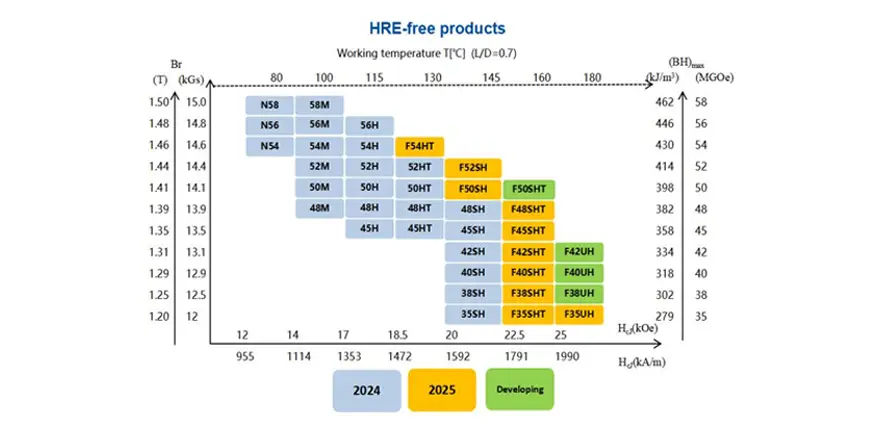
With continuous manufacturing improvements, TOPMAG currently offers two categories of HRE-Free magnet solutions.
Standard HRE-Free
Standard HRE-Free magnets improve resistance to demagnetization by optimizing the grain boundary structure and creating highly continuous, low-magnetization grain boundaries that weaken intergranular exchange coupling.
TOPMAG currently provides stable mass production of the following grades:
- H Series (Intrinsic Coercivity Hcj ≥ 1353 kA/m)
- SH Series (Intrinsic Coercivity Hcj ≥ 1592 kA/m)
Advanced F Process Products
For applications requiring even higher intrinsic coercivity, TOPMAG also manufactures HRE-Free magnets using the Advanced F Process.
These products are manufactured using the Advanced F Process to achieve higher intrinsic coercivity while maintaining similar remanence.
Available grades include:
- F42SH
- F45SH
- F48SH
- F50SH
- F52SH
- F54SH
カスタマイズ SHT Series magnets (Intrinsic Coercivity Hcj ≥ 1790 kA/m) are also available based on customer requirements.
When Should You Choose the Advanced F Process?
For many conventional industrial applications, Standard HRE-Free magnets already provide sufficient magnetic performance.
However, when an application requires greater resistance to demagnetization or must operate under more demanding conditions, HRE-Free magnets manufactured using the Advanced F Process offer a more suitable solution.
Typical applications include:
- Electric vehicle (EV) traction motors
- High power density motors
- High-speed motors
- Robotic servo motors
- Industrial automation equipment
- High-performance magnetic assemblies
For these applications, higher intrinsic coercivity (Hcj) provides greater design margin while maintaining similar remanence (Br), helping improve long-term system reliability under demanding operating conditions.
結論
The development of HRE-Free technology represents an important step toward high-performance NdFeB magnets with reduced dependence on heavy rare earth elements.
Through continuous advances in grain boundary engineering and manufacturing technology, HRE-Free magnets can now deliver excellent magnetic performance for a wide range of industrial applications. TOPMAG’s Advanced F Process further improves intrinsic coercivity while maintaining similar remanence, providing a reliable solution for demanding motor and magnetic assembly applications.
If you are evaluating HRE-Free magnets for your next project, TOPMAG’s engineering team can help you select the most suitable solution based on your operating conditions and performance requirements.
よくある質問
Can HRE-Free magnets completely replace heavy rare earth-containing magnets?
It depends on the operating temperature. For most applications below 150–180°C, HRE-Free magnets manufactured using the Advanced F Process can replace conventional heavy rare earth-containing grades. Applications above 200°C should be evaluated based on specific operating conditions.
What is the difference between the Advanced F Process and Standard HRE-Free?
Standard HRE-Free magnets achieve magnetic performance through optimized alloy composition and conventional manufacturing. The Advanced F Process adds an additional grain boundary optimization treatment, enabling higher intrinsic coercivity (Hcj) while maintaining similar remanence (Br).
Which industries are HRE-Free magnets suitable for?
HRE-Free magnets are widely used in electric vehicles, industrial motors, robotics, automation equipment, renewable energy systems, and other high-performance applications where both magnetic performance and cost efficiency are important.
Is the Advanced F Process a new magnetic material?
No. The Advanced F Process is a manufacturing innovation, not a new magnetic material or alloy. It improves grain boundary microstructure to enhance coercivity while maintaining similar remanence.
How do I choose the right HRE-Free magnet grade?
The appropriate grade depends on your operating temperature, demagnetization conditions, magnetic performance requirements, dimensions, and cost targets. If you’re unsure, TOPMAG’s engineering team can recommend the most suitable solution for your application.
さらに詳しい洞察については、以下の関連ブログをご覧いただきたい:
Rare Earth Magnets vs Ferrite Magnets: Key Differences
Magnetic Separator Magnets: Types and Applications
How to Separate Strong Magnets
Arc Magnet vs Block Magnet: Key Differences in Motor Applications
How to Customize High-Quality Neodymium Magnets
プロジェクトをアップグレードする準備はできていますか?TOPMAGの全製品をご覧ください!🧲。

私は磁石に関するポピュラー・サイエンスの執筆に専念している。私の記事は主に、磁石の原理、応用、業界の逸話に焦点を当てています。読者の皆様に価値ある情報を提供し、磁石の魅力や意義をより深く理解していただくことが目標です。同時に、磁石にまつわる皆さんのご意見もお待ちしています。磁石の無限の可能性を一緒に探っていきましょう!