
Magnetic Separator Magnets: Types and Applications
- イーサン
- 知識ベース
Magnetic separation technology removes unwanted ferromagnetic contaminants from material streams and is widely used in mining, food processing, recycling, pharmaceutical manufacturing, and chemical processing industries. It plays a critical role in ensuring product quality, protecting valuable equipment, and meeting regulatory requirements.
The performance of a 磁気分離器 largely depends on the type of magnet used, magnetic field strength, and magnetic circuit design. Selecting the right magnetic separator magnets for a specific application not only improves separation efficiency but also enhances product purity and ensures long-term operational reliability.
As a professional magnet manufacturer, TOPMAG provides customized magnets for magnetic separators to meet a wide range of industrial requirements.
内容
要点
- Magnetic Separator Magnets determine separation efficiency through magnet type そして magnetic field design.
- フェライト magnets, ネオジム magnets, and 電磁石 are used for different industrial applications.
- Application requirements such as food-grade purity or mining capacity are more important than magnet cost.
- Magnetic field gradient, capture depthそして operating temperature affect long-term performance.
- Proper magnet selection improves 効率, reduces downtime, and increases ROI.
What Is Magnetic Separation?
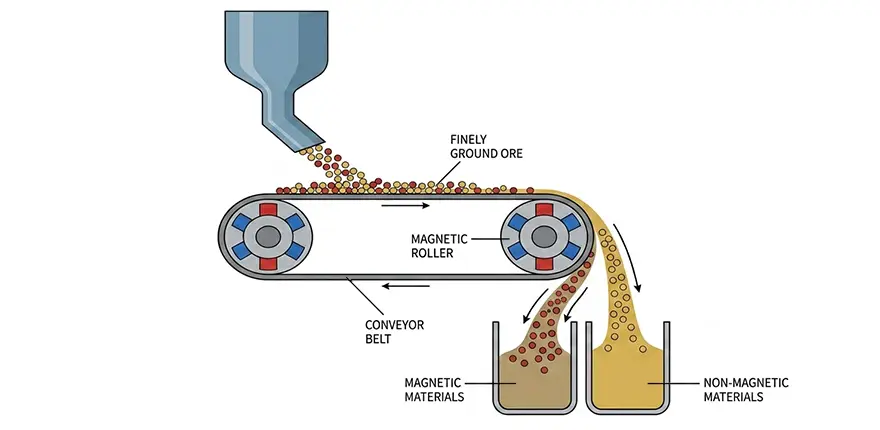
Magnetic separation is a process that uses magnetic force to separate magnetic materials from non-magnetic materials. All magnets have a north pole and a south pole and generate a 磁場 around them. When a mixture of magnetic and non-magnetic materials passes through the magnetic field region, magnetic particles are attracted by the magnet and separated from the non-magnetic materials.
The effectiveness of magnetic separation is mainly influenced by the following factors:
- 磁場強度
- Magnetic field gradient
- Magnetic penetration depth
- Particle size
- Material flow rate
In general, stronger magnetic fields provide better capture capability for weakly magnetic contaminants and fine particles. However, higher magnetic field strength often requires more expensive magnetic materials and more complex magnetic circuit designs. Therefore, magnetic separator system design must balance performance and cost.
Types of Magnets Used in Magnetic Separators
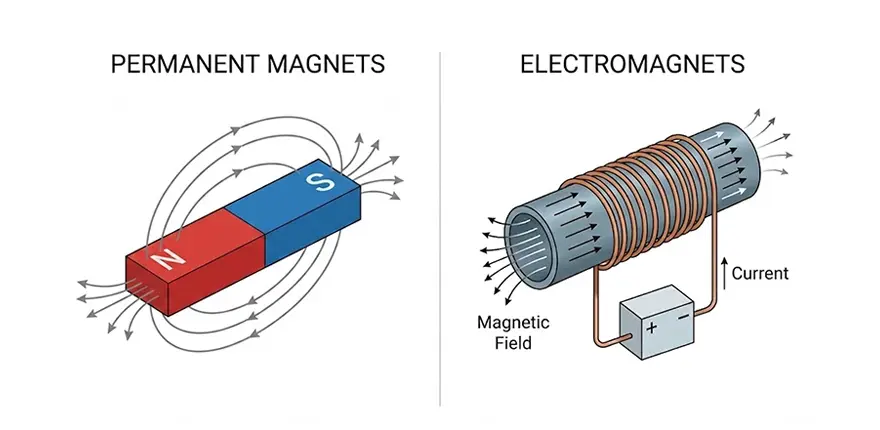
永久磁石
Permanent magnets retain their magnetism without requiring an external power source. Due to their low operating cost and minimal maintenance requirements, most industrial magnetic separator systems utilize permanent magnets.
The two most common permanent magnets used in magnetic separators are ferrite magnets and neodymium iron boron magnets.
- Ferrite Magnets:
Ferrite magnets are the most widely used magnetic material in conventional magnetic separator equipment. They are particularly suitable for applications requiring magnetic force over a greater distance. - NdFeB Magnets:
NdFeB magnets, also known as 希土類磁石, are the core material used in high-performance magnetic separators. They are widely used in applications requiring precise contaminant removal, such as food processing, pharmaceutical manufacturing, and specialty chemical production.
電磁石
However, electromagnets require substantial electrical power and often need cooling systems to prevent coil overheating.
As a result, electromagnetic separators are commonly used in large-scale mining operations そして heavy industrial processing lines.
Permanent Magnets vs Electromagnets
| マグネットタイプ | Surface Magnetic Field | Operating Cost | Maintenance Requirement | 代表的なアプリケーション |
|---|---|---|---|---|
| フェライト磁石 | 1,500–4,000 Gs | 低い | 低い | Mining, Recycling |
| ネオジム磁石 | 8,000–15,000 Gs | 低い | 低い | Food, Pharmaceutical, Chemical |
| 電磁石 | 調節可能 | 高い | ミディアム-ハイ | Large Mining Operations, Heavy Industry |
For applications requiring the removal of micron-sized metal contaminants, NdFeB magnets are generally the preferred solution.
Magnets Used in Different Types of Magnetic Separators
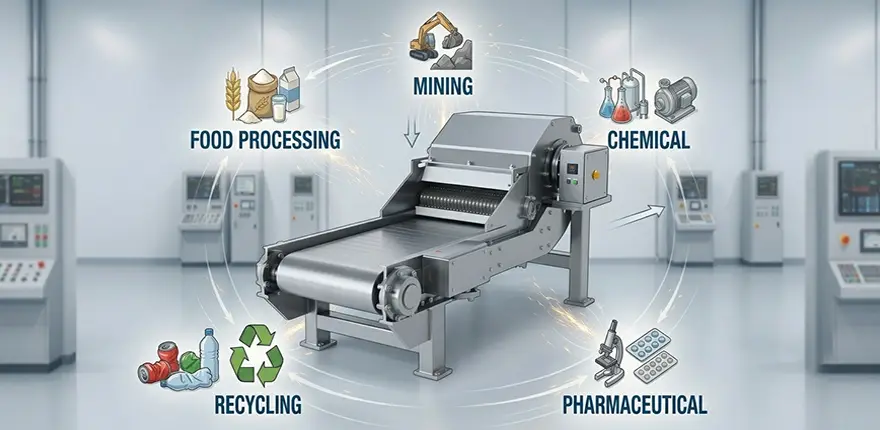
Magnetic Grid Separators and Drawer Magnets
- Recommended Magnet: High-performance ネオジム磁石
- Application Logic: These magnetic separator magnets are designed for powders, granules, and liquid materials where the goal is to capture extremely fine metallic contaminants. NdFeB magnets can provide magnetic field strengths of 8,000–12,000 Gauss within compact spaces, ensuring maximum contaminant capture efficiency.
Magnetic Drum Separators
- Recommended Magnet: Ferrite magnets or Ferrite-NdFeB hybrid magnetic systems
- Application Logic: Magnetic drum separators are commonly used for high-volume ore processing and recycling operations. Ferrite magnets offer low cost and broad magnetic coverage, while hybrid systems use NdFeB magnets to enhance surface attraction. Together, they provide optimal capture depth and processing capacity.
Overband Magnetic Separators and Cross Belt Separators
- Recommended Magnet: Ferrite magnets or custom NdFeB blocks
- Application Logic: These magnetic separator systems are installed above conveyor belts and are designed to remove large ferrous contaminants from bulk material streams. This prevents tramp metal from entering downstream crushers and other processing equipment, reducing maintenance costs and equipment damage.
Eddy Current Separators
- Recommended Magnet: Ultra-high-strength ネオジム磁石
- Application Logic: Widely used in recycling facilities, eddy current separators utilize rapidly changing magnetic fields to generate repulsive forces that separate non-ferrous metals such as aluminum and copper from mixed waste streams.
Typical Applications of Magnetic Separator Magnets
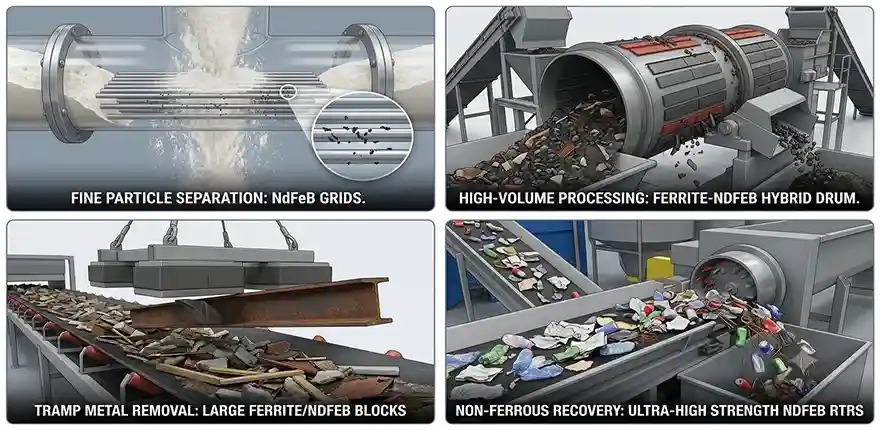
- Mining Industry
Magnetic separator magnets are used to remove tramp iron from ore streams and protect downstream processing equipment. - Food Processing Industry
Used to remove metallic contaminants from flour, sugar, spices, grains, and dairy products to ensure product safety and quality. - Recycling Industry
Used for separating ferrous and non-ferrous metals from mixed waste streams. - Pharmaceutical Industry
Ensures product purity and helps manufacturers comply with strict regulatory standards. - Chemical Industry
Protects pumps, mixers, and downstream processing systems while improving final product quality.
How to Select the Right Magnet for a Magnetic Separator
Material Characteristics
- Particle Size and Flow Rate: Fine powders typically require high-gradient magnetic grid separators, while large bulk materials often require magnetic drum separators with deeper magnetic penetration.
- Material Condition: Is the material dry or wet? Wet processing environments may require enhanced sealing and corrosion protection to prevent magnet degradation.
Contaminant Type and Separation Requirements
If the objective is to remove micron-sized contaminants, such as in food processing applications, NdFeB magnets are usually required. For removing large ferrous objects, ferrite magnets may be a more economical solution.
動作温度
Operating temperature is one of the most frequently overlooked factors in magnet selection. If the production line involves heating or cooling processes, the maximum operating temperature must be clearly specified to avoid performance loss caused by demagnetization.
Maintenance and Operating Costs
- Permanent Magnets: Low operating cost and minimal maintenance requirements.
- Electromagnets: Greater flexibility but require continuous power consumption and additional maintenance.
結論
マグネット are the core component of every magnetic separator. From powerful rare earth magnets used for high-gradient separation to adjustable electromagnets designed for heavy industrial systems, selecting the right magnet technology is essential for achieving optimal separation performance.
If you are facing challenges in magnet selection, TOPMAG’s engineering team can recommend the most 適切な磁気ソリューション based on your material characteristics, separation requirements, and operating conditions.
よくある質問
Why does a magnetic separator lose performance over time?
Common reasons include high temperature exposure, surface contamination buildupあるいは internal corrosion due to sealing failure.
How often should magnetic separators be cleaned?
Cleaning frequency depends on contamination levels. For continuous operation, self-cleaning systems are recommended.
Is higher magnetic field always better?
Not necessarily. Excessively high magnetic fields may cause particle buildup and reduce separation efficiency due to shielding effects.
Does magnet shape affect performance?
Yes. Magnet geometry influences field distribution and gradient, which directly impacts separation efficiency.
Why are magnetic separators polished?
Mirror polishing reduces material adhesion, improves hygiene, and enhances separation performance, especially in food and pharmaceutical applications.
さらに詳しい洞察については、以下の関連ブログをご覧いただきたい:
Why Do Neodymium Magnets Need Edge Treatment?
What is Passivation for NdFeB Magnets?
How Segmented Magnets Reduce Eddy Current Loss
Arc Magnet vs Block Magnet: Key Differences in Motor Applications
プロジェクトをアップグレードする準備はできていますか?TOPMAGの全製品をご覧ください!🧲。

私は磁石に関するポピュラー・サイエンスの執筆に専念している。私の記事は主に、磁石の原理、応用、業界の逸話に焦点を当てています。読者の皆様に価値ある情報を提供し、磁石の魅力や意義をより深く理解していただくことが目標です。同時に、磁石にまつわる皆さんのご意見もお待ちしています。磁石の無限の可能性を一緒に探っていきましょう!