
Rare Earth Magnets vs Ferrite Magnets: Key Differences
- イーサン
- 知識ベース
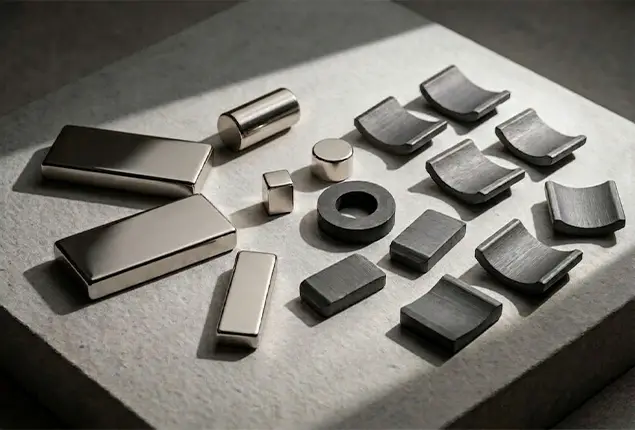
希土類磁石 そして フェライト磁石 are the two most widely used permanent magnet materials in modern industry. Although both generate permanent magnetic fields, they differ significantly in material composition, operating conditions, and application requirements.
Selecting the appropriate magnetic material can directly affect product performance, manufacturing cost, reliability, and service life.
This article compares rare earth magnets and ferrite magnets in terms of 磁力, 耐熱温度, コストそして typical applications to help engineers, designers, and buyers make informed decisions.
内容
要点
- 希土類磁石 provide stronger magnetic performance in smaller sizes.
- フェライト磁石 offer better temperature stability and corrosion resistance.
- Rare earth magnets deliver higher performance but at a higher cost.
- Ferrite magnets provide lower costs and more stable supply chains.
- The right magnet depends on パフォーマンス, environment, spaceそして budget requirements.
希土類磁石とは?
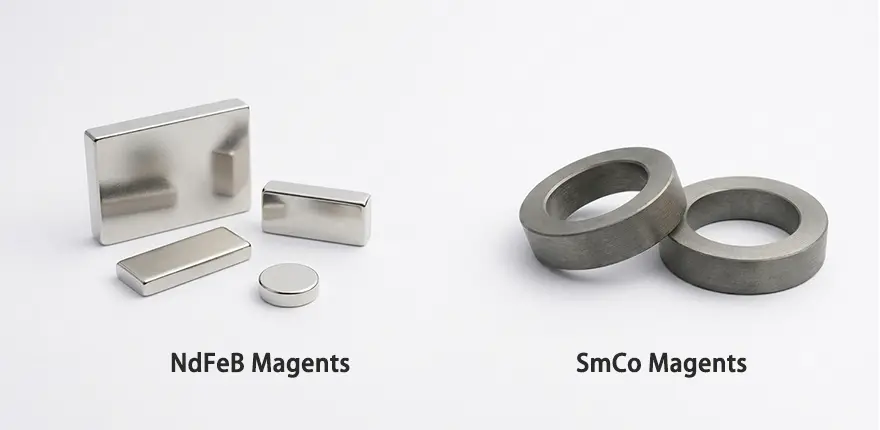
希土類磁石 are high-performance permanent magnets manufactured using rare earth elements such as neodymium and samarium. They are widely used in applications that require compact designs and high magnetic performance.
The two primary types of rare earth magnets are ネオジム磁石 そして samarium cobalt magnets.
ネオジム磁石 (NdFeB)
ネオジム磁石 are composed of neodymium, iron, and boron. They are currently the most widely used rare earth magnets and are available in various grades to satisfy different operating requirements.
Typical applications include:
- 電気自動車用モーター
- Servo motors
- ロボット工学
- Industrial automation equipment
- Wind generators
Samarium Cobalt Magnets (SmCo)
サマリウム・コバルト磁石 are manufactured using samarium and cobalt alloys. They are commonly used in demanding environments where stable magnetic performance is required.
Typical applications include:
- Aerospace equipment
- Military systems
- Medical devices
- High-temperature motors
- Oil and gas equipment
What Are Ferrite Magnets?
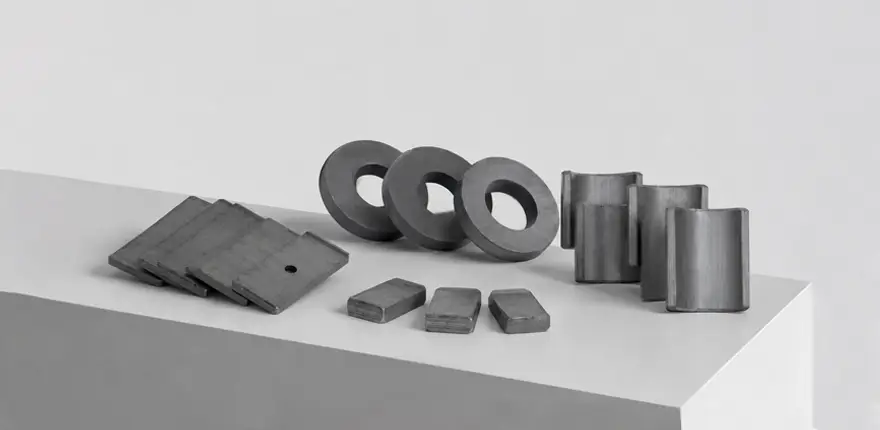
フェライト磁石, also known as セラミック磁石, are permanent magnets produced from iron oxide combined with strontium or barium compounds through powder metallurgy and sintering processes.
Due to their mature manufacturing technology, low production cost, and wide application range, ferrite magnets remain one of the most widely produced permanent magnetic materials.
Applications of Ferrite Magnets
Ferrite magnets are commonly used in:
- Loudspeakers
- Household appliances
- 冷蔵庫用マグネット
- DCモーター
- Water pumps
- Automotive components
Rare Earth Magnets vs Ferrite Magnets: Key Differences
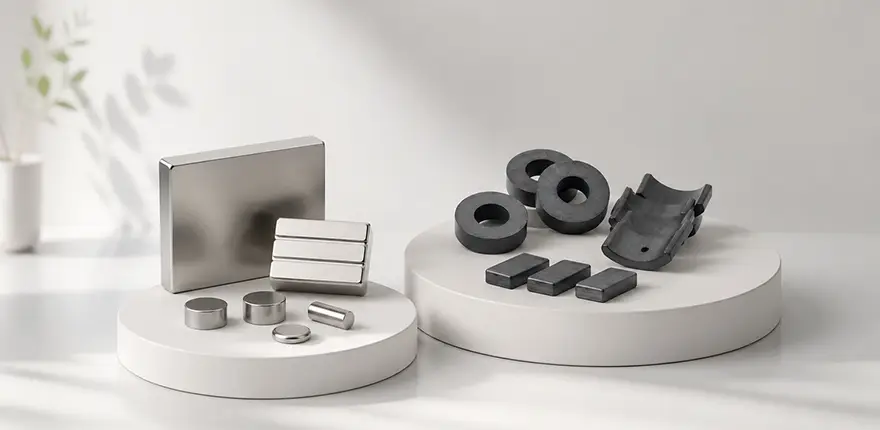
Magnetic Strength Comparison
Rare earth magnets provide significantly higher magnetic performance than ferrite magnets.
| パラメータ | Rare Earth Magnets (NdFeB) | フェライト磁石 |
|---|---|---|
| 最大エネルギー製品 | 200–400 kJ/m³ | 10–40 kJ/m³ |
| レマネンス | 1.0–1.4 T | 0.2-0.4 T |
| Relative Magnetic Strength | 非常に高い | Approximately 10–20% of NdFeB |
Practical testing clearly demonstrates the difference.
A ネオジム磁石 with a volume of approximately 3.14 cm³ can generate about 11 kg of pull force, while a ferrite magnet of the same size produces only around 1.4 kg.
To achieve a similar pull force of approximately 9.5 kg, a ferrite magnet would require a volume of roughly 56.5 cm³, with its weight increasing from approximately 14 g to 270 g.
Therefore, rare earth magnets are generally preferred when installation space is limited and high magnetic force is required.
Temperature Resistance Comparison
Ferrite magnets typically provide better thermal stability than standard neodymium magnets.
| パラメータ | Rare Earth Magnets (NdFeB) | フェライト磁石 |
|---|---|---|
| 最高使用温度 | 60–150°C | Up to 250°C |
| Curie Temperature | Approximately 310°C | 450–460°C |
| Thermal Stability | Performance decreases at elevated temperatures | Stable over a wide temperature range |
When operating temperatures exceed design limits, neodymium magnets may experience irreversible demagnetization.Ferrite magnets maintain relatively stable magnetic performance under elevated temperatures.
Applications requiring both strong magnetic performance and high-temperature resistance often use samarium cobalt magnets.
Cost and Supply Chain Comparison
Cost differences remain one of the most important considerations when selecting magnetic materials.
| Comparison Item | Rare Earth Magnets (NdFeB) | フェライト磁石 |
|---|---|---|
| Raw Material Cost | 高い | 低い |
| Price Stability | 中程度 | 高い |
| Supply Risk | より高い | より低い |
| Material Availability | 限定 | Widely Available |
| Cost per Unit Holding Force | より高い | より低い |
The higher cost of 希土類磁石 is mainly attributed to the mining and refining of rare earth elements such as neodymium and praseodymium.
Additionally, rare earth supply chains are concentrated in limited regions, making prices more sensitive to market fluctuations and policy changes.
フェライト磁石 primarily use iron oxide and other widely available materials, resulting in lower supply risks and more stable pricing.
From a system design perspective, ferrite magnets often offer lower costs in large-volume applications, while rare earth magnets may reduce overall system size and weight.
How to Choose Between Rare Earth and Ferrite Magnets
Selecting the appropriate magnetic material requires evaluating magnetic performance, operating conditions, installation space, and budget.
Five-Step Selection Guide
| ステップ | Consideration | 希土類磁石 | フェライト磁石 |
|---|---|---|---|
| 1 | 磁力 | High holding force required | Moderate force sufficient |
| 2 | Space Limitation | Compact design required | Larger size acceptable |
| 3 | 動作温度 | Below 80°C | 80–250°C |
| 4 | Environmental Conditions | Dry or protected environments | Humid or corrosive environments |
| 5 | 予算 | Performance priority | Cost priority |
Choose Rare Earth Magnets When:
- Strong magnetic force is required.
- Installation space is limited.
- Lightweight designs are preferred.
- High-performance motors are used.
- High energy efficiency is important.
- Compact products are necessary.
Choose Ferrite Magnets When:
- Cost reduction is important.
- Large production volumes are involved.
- Operating temperatures are high.
- Corrosion resistance is critical.
- Space limitations are less important.
- General industrial applications are involved.
Hybrid Design Strategy
Many manufacturers adopt hybrid magnetic designs by using rare earth magnets in performance-critical locations and ferrite magnets in non-critical areas.
This approach helps balance magnetic performance, product cost, and supply chain risks while optimizing overall system efficiency.
結論
希土類磁石 そして フェライト磁石 each offer unique advantages.
Rare earth magnets are commonly selected for applications requiring compact dimensions and high magnetic performance, while ferrite magnets remain a cost-effective solution for many industrial and consumer products.
Understanding the differences between these two magnetic materials allows engineers and buyers to select the most suitable solution based on application requirements, operating conditions, and budget considerations.
Whether you require stronger magnetic force, higher temperature resistance, or a more cost-effective magnetic solution, TOPMAG can provide professional support based on your application requirements. Our engineering team assists customers with magnet selection, magnetic circuit optimization, sample testing, and custom manufacturing to help achieve the best balance between performance, size, and cost. Contact us today for free technical consultation and sample support.
よくある質問
Which magnet is better for magnetic separators?
Ferrite magnets are frequently used in large industrial magnetic separators because of their lower cost.
Why are ferrite magnets still used in motors?
Ferrite magnets provide a lower-cost solution for many industrial and household motors.
Are rare earth magnets dangerous?
Rare earth magnets are generally safe when properly handled. However, their strong magnetic force can cause pinching injuries または damage electronic devices if used improperly.
Which magnet lasts longer?
Both rare earth magnets and ferrite magnets can maintain their magnetic properties for many years.
Ferrite magnets usually offer better corrosion resistance, while coated rare earth magnets can also provide excellent long-term durability.
Do magnets lose strength over time?
Both ferrite magnets and rare earth magnets can retain most of their magnetic strength for decades under proper operating conditions.
さらに詳しい洞察については、以下の関連ブログをご覧いただきたい:
Magnetic Separator Magnets: Types and Applications
Why Do Neodymium Magnets Need Edge Treatment?
2026 Magnet Report: Rare Earths & Supply Chain Truths
プロジェクトをアップグレードする準備はできていますか?TOPMAGの全製品をご覧ください!🧲。

私は磁石に関するポピュラー・サイエンスの執筆に専念している。私の記事は主に、磁石の原理、応用、業界の逸話に焦点を当てています。読者の皆様に価値ある情報を提供し、磁石の魅力や意義をより深く理解していただくことが目標です。同時に、磁石にまつわる皆さんのご意見もお待ちしています。磁石の無限の可能性を一緒に探っていきましょう!