
Wet Press vs Dry Press Ferrite Magnets: Key Differences
- Ethan
- Base de connaissances
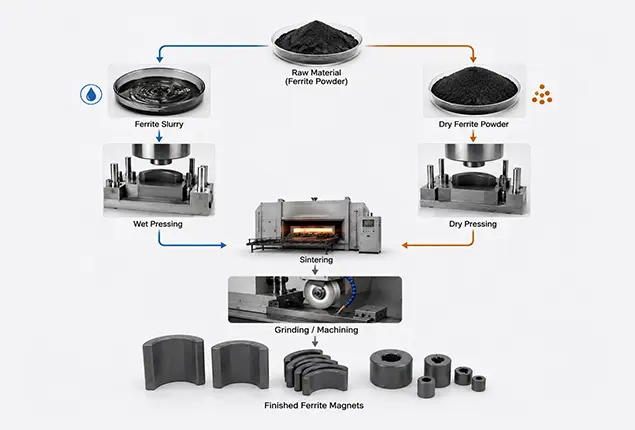
Permanent ferrite magnets can be divided into two manufacturing processes based on their forming methods: wet pressing and dry pressing.The forming process not only affects the internal grain orientation and magnetic performance of ferrite magnets, but also influences production efficiency, dimensional control, and final application performance.Understanding the differences between these two processes helps customers select the most suitable ferrite magnet manufacturing process according to their application requirements.
Contenu
Principaux enseignements
- Wet pressing provides better magnetic performance and is commonly used for motor magnets and other high-performance applications.
- Dry pressing offers higher production efficiency and better dimensional control, making it suitable for standardized, high-volume products.
- The two processes differ in material condition, magnetic orientation, performance, production efficiency, and cost.
- Ferrite magnet quality should be evaluated through magnetic performance, dimensional accuracy, appearance, and batch consistency.
- The right forming process should be selected based on the application requirements, production volume, performance targets, and cost objectives.
What is Wet Pressing for Ferrite Magnets?
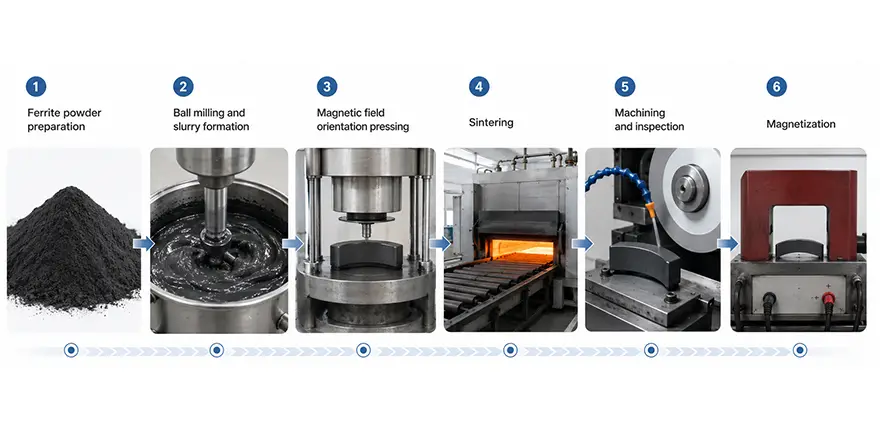
Wet pressing is one of the most commonly used manufacturing processes for permanent ferrite magnets, especially for products requiring higher magnetic performance, such as ferrite arc magnets.
The main manufacturing process include:
Ferrite powder preparation → Ball milling and slurry formation → Magnetic field orientation pressing → Sintering → Machining and inspection → Magnetization
During the wet pressing process, ferrite powder is mixed with water after ball milling to form a slurry. The slurry is then pressed under an external magnetic field.
The magnetic field guides the powder particles to align in a specific direction. As a result, the material obtains better grain orientation, allowing wet pressing to achieve higher magnetic performance.
However, wet pressing also has certain limitations. Due to its relatively complex manufacturing process, it requires higher equipment requirements and has lower production efficiency compared with dry pressing.
What is Dry Pressing for Ferrite Magnets?
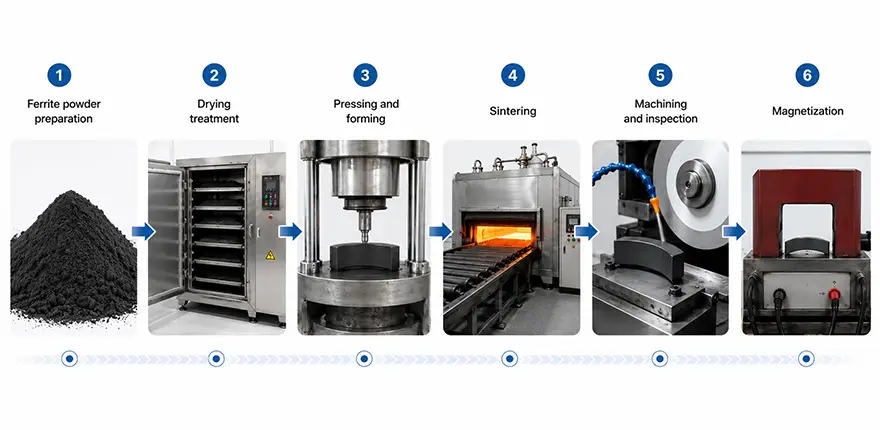
Dry pressing is a manufacturing process that directly compresses dried ferrite powder into the required shape. It is mainly used for producing standardized and high-volume permanent ferrite magnets.
The main manufacturing process includes:
Ferrite powder preparation → Drying treatment → Pressing and forming → Sintering → Machining and inspection → Magnetization
During the dry pressing process, the material is compressed in a dry powder state. Since no slurry preparation and dehydration process are required, the manufacturing process is simpler, and the equipment has a higher level of automation.Therefore, dry pressing provides advantages in production efficiency.
However, because the powder particles have limited alignment ability during dry pressing, the magnetic grain orientation is generally not as effective as wet pressing. Therefore, the magnetic performance of dry pressed ferrite magnets is usually lower than that of wet pressed products.
Wet Pressing vs Dry Pressing Ferrite Magnets Comparison
Wet pressing and dry pressing ferrite magnets each have their own characteristics.
The following comparison provides a clearer understanding of the differences between these two manufacturing processes and helps select the appropriate process based on specific application requirements.
| Application | Applications typiques | Why Ferrite Magnets Are Suitable |
|---|---|---|
| Appareils ménagers | Washing machines, fans, small appliances | Low unit cost is important, while high torque density is not critical |
| Automotive Auxiliary Motors | Wiper motors, power window and seat adjustment motors, air-conditioning blowers | High production volume and cost-driven design; extreme power density is not required |
| Moteurs industriels | Water pumps, conveyor drives | Durability and cost-effectiveness are prioritized over compact size |
How to Evaluate Ferrite Magnet Quality?
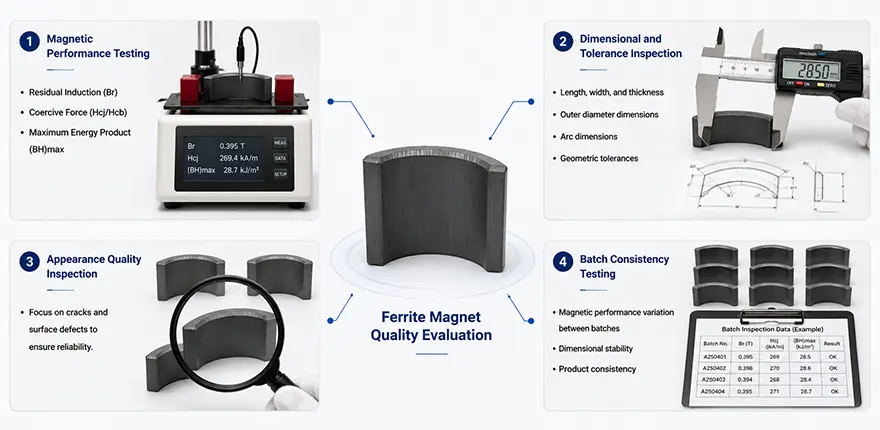
Regardless of whether wet pressing or dry pressing is used, the quality evaluation of ferrite magnets mainly focuses on magnetic performance, dimensional accuracy, appearance quality, and product consistency.
Magnetic Performance Testing
Magnetic performance is the key indicator for evaluating the quality of ferrite magnets. The main parameters include:
- Residual Induction (Br)
- Coercive Force (Hcj/Hcb)
- Maximum Energy Product ((BH)max)
These parameters reflect the magnetic strength and demagnetization resistance of ferrite magnets.
Dimensional and Tolerance Inspection
Precision measuring equipment is used to verify whether the product meets the design requirements, including:
- Length, width, and thickness
- Outer diameter dimensions
- Arc dimensions
- Geometric tolerances
For products such as ferrite motor magnets, dimensional accuracy directly affects the assembly performance.
Appearance Quality Inspection
Ferrite magnets are brittle materials, so quality inspection mainly focuses on obvious cracks and abnormal surface defects to ensure product reliability during use.
Batch Consistency Testing
For high-volume applications, such as motor manufacturing, it is important to monitor:
- Magnetic performance variation between batches
- Dimensional stability
- Product consistency
A stable manufacturing process is essential for ensuring long-term and reliable supply.
Application of Wet Pressed and Dry Pressed Ferrite Magnets
Wet Pressed Ferrite Magnet Applications
Wet pressed ferrite magnets are mainly used in applications requiring higher magnetic performance.
1. Motor Ferrite Magnets
This is one of the main applications of wet pressed ferrite magnets.
Examples include DC Motors、Automotive Motors、Pump Motors et Fan Motors.
2. High-Performance Magnetic Components
Including Customized irregular-shaped magnets and Special motor magnetic circuit structures
Dry Pressed Ferrite Magnet Applications
Dry pressed ferrite magnets are mainly used for standardized and high-volume products.
1. Speaker Magnets:
Examples include Speaker Magnets and Audio Equipment
2. General Industrial Magnets:
Including Small magnetic components、General holding magnets and Various standard magnetic products.
Conclusion
Wet pressing and dry pressing are both widely used for permanent ferrite magnets. The right process depends on the product’s magnetic performance, production requirements, and cost targets.
Wet pressing is generally preferred for applications requiring higher magnetic performance, while dry pressing is more suitable for high-volume production and cost-sensitive applications.
Quelques questions fréquemment posées
Does the ferrite magnet forming process affect the service life of magnets?
The forming process does not directly determine magnet life, but it can affect the internal structure and long-term performance stability of ferrite magnets.
Is small-batch customization of ferrite magnets possible?
Yes. However, the suitable manufacturing solution needs to be evaluated based on product dimensions, tooling cost, and performance requirements.
What is the difference between wet pressed and dry pressed ferrite magnets?
Wet pressing focuses on improving magnetic performance, while dry pressing focuses on production efficiency and dimensional control. Both processes are suitable for different applications.
Why are wet pressed ferrite magnets more expensive?
Wet pressing usually has higher costs because the manufacturing process is more complex, requiring higher equipment investment and stricter process control.
Does the forming process affect the mechanical strength of ferrite magnets?
Yes. The forming process affects material density and internal structure, which can influence the mechanical properties of ferrite magnets.
Pour en savoir plus, consultez les blogs suivants :
Magnet Temperature Limits:Maximum Operating Temperature vs Curie Temperature
Multipole Ring Magnet: Complete Guide
Can Magnetized Magnets Be Machined? Risks and Solutions
How Segmented Magnets Reduce Eddy Current Loss
Why Ferrite Magnets Are Still Used in Motors?
Prêt à améliorer votre projet ? Consultez notre gamme complète de produits sur TOPMAG!🧲

Je me consacre à la rédaction d'articles de vulgarisation scientifique sur les aimants. Mes articles portent principalement sur leurs principes, leurs applications et les anecdotes de l'industrie. Notre objectif est de fournir aux lecteurs des informations précieuses, afin de les aider à mieux comprendre le charme et l'importance des aimants. Par ailleurs, nous sommes impatients de connaître votre avis sur les besoins liés aux aimants. N'hésitez pas à nous suivre et à vous engager avec nous pour explorer ensemble les possibilités infinies des aimants !