
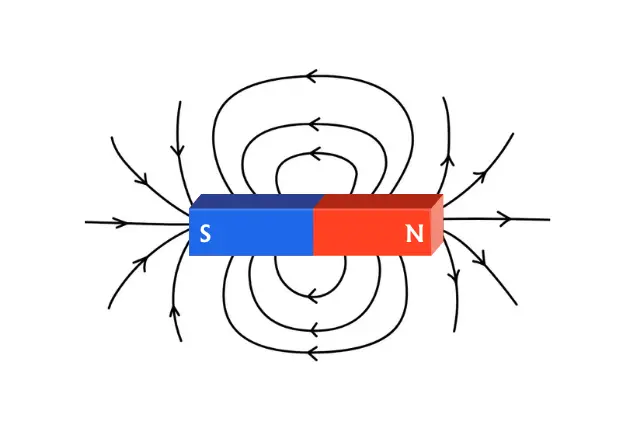
 You might think that magnetic permeability is a property unique to “magnetic materials,” but in fact, all substances (including vacuum, air, copper, water, etc.) have magnetic permeability. It is a physical quantity that measures the degree of response of any medium to an applied magnetic field. Magnetic permeability determines how strong the magnetic flux density can be maintained inside the material under an external magnetic field. This means that the easier a material is to magnetize, the higher its magnetic permeability.

Calculation-Formula-for-Magnetic-Permeability.webp) B represents magnetic flux density, which refers to the total strength of the magnetic field actually present inside the material. It represents the ultimate effect of the magnetic field, with units of tesla.
B represents magnetic flux density, which refers to the total strength of the magnetic field actually present inside the material. It represents the ultimate effect of the magnetic field, with units of tesla.
H represents magnetic field strength, which refers to the original force driving the magnetic field produced by external currents; it is independent of the material itself. Units are amperes per meter.
Vacuum permeability (μ₀): This is a physical constant with a value of 4π×10⁻⁷ H/m. It represents the basic properties of the magnetic field in a vacuum without any substance present.
The formula for absolute permeability is: μ = B / H. The international unit for magnetic permeability is henry per meter (H/m) or newton per ampere squared (N·A⁻²), describing the material’s overall response to the magnetic field.
You might have a question: when people commonly refer to “magnetic permeability,” do they mean absolute permeability or relative permeability? The answer here is relative permeability, because it is easier to compare different materials. Below is the formula for relative permeability:
Relative permeability (μᵣ): Formula: μᵣ = μ / μ₀. If a material’s relative permeability is 1000, it means its magnetic conduction ability is 1000 times that of a vacuum.
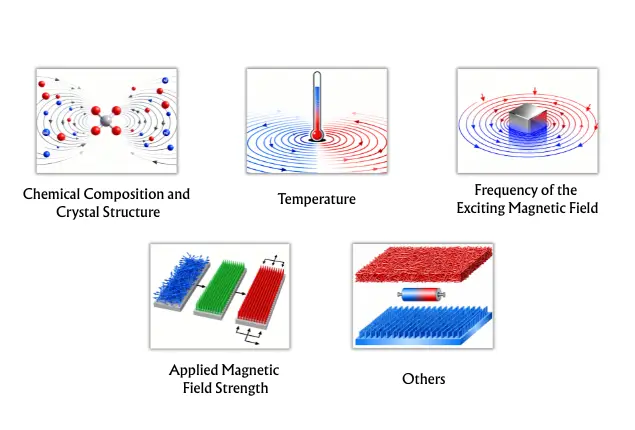
However, it is worth noting that relative permeability is not a fixed constant; it varies. For example, the permeability of a piece of pure iron is roughly between 200 and 5000, depending on the external magnetic field and the type of material.
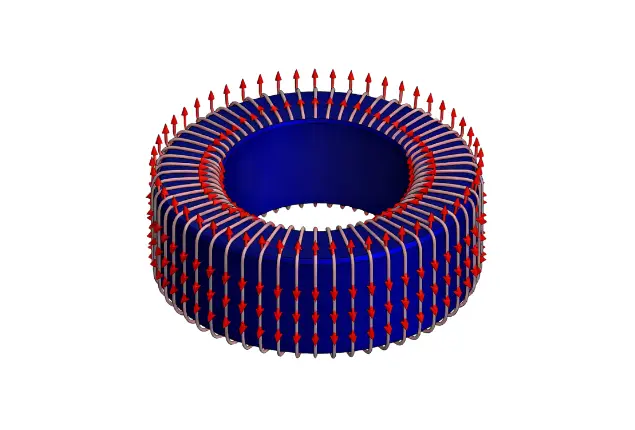 High magnetic permeability materials can “attract” and “confine” magnetic field lines within themselves, just as copper wire is a good pathway for electric current; it serves as an excellent pathway for magnetic flux. In transformers, a high-permeability iron core can produce the strongest magnetic field with minimal energy, thereby reducing energy waste. High magnetic permeability materials can conduct and concentrate magnetic fields with extremely high efficiency, making them ideal media for achieving efficient electromagnetic energy conversion.
