
 A uniform magnetic field is the main idea, in which the strength and the direction of the field are the same for every point in a certain space. This characteristic allows for a uniform magnetic field to be considered a perfect place to explore the interaction between the field and a charged particle’s movement, as well as various technological applications. Uniform magnetic fields are deeply involved in the areas of physics, engineering, and scientific research.
 Properties of a Uniform Magnetic Field: An essential feature of a uniform magnetic field is that the magnetic field strength should be the same point-wise or locally in space. This unification implies that the magnetic force in both magnitude and direction that acts on a charged particle or magnetic object is of the same strength regardless of the place in the field. Mathematically, the magnetic flux density (B) for the uniform magnetic field turns out to be a constant vector. Thus, the field has no spatial gradient. This greatly aids theoretical calculations. For example, when the particle’s path is being calculated, the Lorentz force equation can be simply used without having to think of the variation of the magnetic field.
Magnetic Flux Line Direction and Distribution: In a uniform magnetic field, the flux lines are parallel and equidistant. This means that the direction of the magnetic field is constant with respect to the position within the field, and thus the density of the flux lines does not vary. The flux lines go from the north magnetic pole to the south magnetic pole, and at any point, the tangent to the flux line gives the direction of the local magnetic field. Such a simple distribution of the field makes the uniform magnetic field an ideal model for studying electromagnetic phenomena.
Methods for Measuring Magnetic Field Homogeneity: Usually, the degree of uniformity of a magnetic field is defined through the concept of a magnetic field gradient. The magnetic field gradient is defined as the change of magnetic field strength per unit distance. For an ideally uniform magnetic field, the magnetic field gradient is zero. In practice, however, the uniformity of a magnetic field is tested by measuring its strength with highly sensitive magnetic field probes in different locations.
Magnetic flux and magnetic flux density: Magnetic flux density is the direct indicator of magnetic field strength, which shows the closeness of the magnetic field lines. In a uniform magnetic field, the magnetic lines of force are arranged evenly. Thus, the magnetic flux density at any point of the area does not change. This property allows uniform magnetic fields to be used in areas where a stable magnetic environment is needed. The latter is different from inhomogeneous magnetic fields, where local density variations might lead to position-dependent device performance or experimental errors.
 A uniform magnetic field is fundamental to the working principle of particle accelerators. In cyclotrons, a uniform magnetic field is constituted, in which charged particles move in circular orbits. An alternating electric field accelerates particles in a cyclotron. The Lorentz force governs the trajectory of particles. The uniform magnetic field stabilizes the trajectory of the particles and does not allow it to vary due to any internal inhomogeneity of the field.
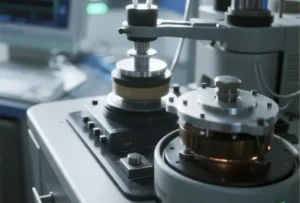 This instrument, designed to work under a uniform magnetic field, classifies masses by the mass-to-charge ratio of a substance, hence its chemical composition and isotopes. Charged species travel in a straight line in a magnetic field whose strength is such that the radius is proportionate to the species’ mass, charge, and velocity. In a mass spectrometer, the radius of deflection is measured. Therefore, ions of different masses may be separated.
 This technology of heating materials in a uniform magnetic field is referred to as uniform magnetic heating. It has been used in metalworking and semiconductor production. During the process of UMH, an alternating current is passed through a uniform magnetic field, which gives rise to eddy currents and hysteresis within the material. Compared to other heating methods, UMH allows significantly diminished temperature gradients, thereby drastically reducing the chance of internal stress or cracking within the heated material.
 A uniform magnetic field and a constant magnetic field are two different but related concepts. A uniform magnetic field refers to spatial uniformity: the strength and direction of the magnetic field do not change from point to point in some region of space. On the other hand, a constant magnetic field refers to temporal uniformity: the strength and direction of the magnetic field do not vary with time.


