
 Magnets, which are seemingly quite ordinary objects, go back to the times of human curiosity and knowledge. Even today, philosophers would admire the science behind the phenomenon of the Greek philosopher Thales’ natural lodestone, the astonishing invention of China’s Si Nan compass, and the revolutionary advances of modern electromagnetism. Besides the scientific progress that magnets have been a great source of, they have also deeply influenced navigation, culture, and industrial technology. The origin of magnets is a tale of intriguing stories and the marvels of science.
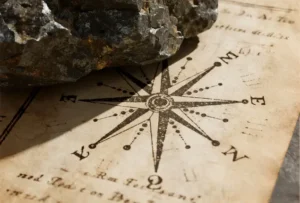 Two different names originally known as Magnet. One of them was Magnesia in Greece, the land of magnetite ore, where the people were called “Magnets”. The second one came from a Greek story about a shepherd named Magnes who had iron shoes and an iron cane tip stuck to a rock on Mount Ida, giving him the idea of the magnetic power of magnetite. Still unproven, the legend gives the magnets a mysterious and romantic charm.
Magnesia refers not only to the region in Thessaly, Greece, but possibly also to Manisa, Turkey, which was historically called Magnesia and is a significant magnetite source. Roman naturalist Pliny the Elder documented Magnes’ story in his 77 AD work Natural History, calling magnetite “lithos magnes” and attributing its attraction to supernatural forces. This geographical and mythological origin reflects ancient awe toward magnetite’s “invisible power.” In China, magnetite was called Cishi (compassionate stone), meaning “affectionate stone,” as it “attracted” iron—a unique cultural interpretation of magnetism.
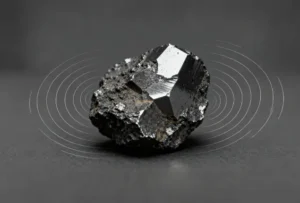 About 600 BC, Greek philosopher Thales of Miletus was the first to record the unusual characteristics of natural lodestone: it attracted iron and influenced other magnets. With this observation, Thales effectively opened the history of electromagnetism and the human philosophical inquiry into common things. Thales thought the attraction of magnetite came from a “soul” or life force, an ancient way of dealing with the unknown. Archaeological findings indicate that magnetite was used in Neolithic times for decoration or ceremonies, but its magnetism had not been recognized and studied until Thales.
The discovery made by Thales was not by any means an isolated case. People of the ancient Egyptian and Mesopotamian civilizations might have seen the magnetite, but there are no written records to confirm their knowledge. Magnetite is one of the most common natural iron oxides, and it can be found in volcanic and sedimentary rocks. The major part of Thales was that he made the philosophers recognize the phenomenon. He was the first to suggest an “animistic” worldview that would later lead to the investigation of the cause.
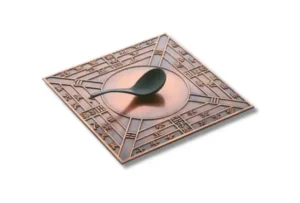 During the 2nd century BC, the Chinese came up with the Si Nan—an instrument that resembled a spoon, was made from magnetite, the most magnetic natural substance, was placed on a bronze plate with marked directions, and was the first to point south. The Si Nan embodied the ancient Chinese cosmology because it was the first to represent the Chinese view of the world. The Si Nan’s low precision made it hardly an acceptable navigation tool. Still, it indicated for the first time the use of magnetism by humans for orientation purposes. The Chinese constructed floating compasses for very simple navigation at sea around 800 AD. From there, magnetic technology was spread all over the world.
The Si Nan’s pointer, which was in the shape of a spoon, was the most precise one ever made from natural magnetite, and it was this one that showed the way to the south pole of the Earth, a very important thing in feng shui. It became one of the objects of the Song Dynasty (960-1279 AD), which was later transformed into a south-pointing fish and a south-pointing turtle, both artistic and precise. Such instruments reached the Arab world through the Silk Road, where the Arab navigators further distributed them to Western Europe with the help of Marco Polo and other explorers. The stars and Han Dynasty astrological tomb relics often accompany bronze Si Nan plates, confirming their societal importance.
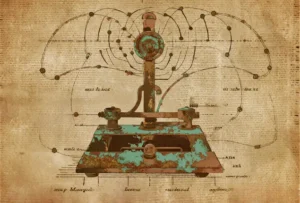 Between 460 and 370 BC, Hippocrates, the father of Greek medicine, proposed that magnets had curative powers, claiming their fields could “draw out” illness.
Magnet therapy is a very old practice that can be traced back to the times of ancient Egyptians. In the Ebers Papyrus, magnetic ores are indicated as a remedy for pain and inflammation in order to “disperse evil spirits.” According to the Indian Ayurveda texts of the first century BC, magnetite was used for the treatment of headaches and arthritis. The medieval European alchemists not only amplified the magnet therapy but also declared that it was able to bring a perfect harmony of “vital forces” or “magnetic fluids.” The popularity of magnetic therapy was mostly due to the fact that it mirrored an ancient people’s interest in the powers of nature and their habit of associating the physical phenomena with health. Even today, there are still some people who are attracted to modern magnetic bracelets and mats. Thus, this practice is maintained.
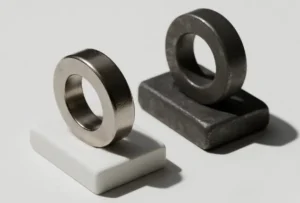 They are made of ferromagnetic materials and do not lose their fields even when they are without power. NdFeB magnets find their best use in the most advanced high-tech devices, while ferrite magnets are used in loudspeakers and as fridge magnets.
Permanent magnet magnetization originates from electron spin and orbital motion within the material. NdFeB fields reach 1.4 tesla, which is ideal for high-efficiency wind turbine generators. Ferrite magnets, though weaker, are noted for high stability and low cost, and are widely used in appliances and sensors.
 Current-driven fields enable adjustable force, which is crucial in automation, recycling, and research. Fields vanish when powered off, which is ideal for switching.
Electromagnets lift scrap metal tonnes. Enable maglev trains, and empower research. Superconducting electromagnets generate ultra-strong magnetic fields, Earth’s ultimate zero for fusion and particle physics. Field strength scales with current and coil density.
-300x203.webp) Formed by volcanism and geomagnetism. Earth itself acts as a giant magnet: its geodynamo field shields the planet from solar wind.
Formed by volcanism and geomagnetism. Earth itself acts as a giant magnet: its geodynamo field shields the planet from solar wind.
Earth has its field guides, such as compasses, besides animals for navigation. Scientists have experimented with magnetite from the past, which has remnant magnetism, to reconstruct plate tectonics and pole reversals. Magnetite bands from the Mid-Atlantic show field reversals every ~200 kyr. Field weakening can contribute to the increase of auroras and solar storm risks. Climate and planetary research may uncover these in the future.


