
What is Passivation for NdFeB Magnets?
- Итан
- База знаний
Магниты NdFeB have become the most widely used rare earth permanent magnets in modern industry due to their exceptional magnetic performance. However, because of the inherent characteristics of the material itself, NdFeB magnets are highly susceptible to oxidation and corrosion when exposed to humid environments, oxygen, acids, or alkalis.
To solve this corrosion issue, surface treatment technologies have become a critical part of magnet manufacturing. Among all protective solutions, Ni-Cu-Ni electroplating и epoxy coatings remain the most common surface systems. However, in specific applications, passivation has emerged as an important surface treatment method because of its unique advantages.
This article explains the working principles of NdFeB magnet passivation, major process classifications, complete processing procedures, differences between passivation and traditional electroplating, and the basis for selecting suitable surface treatments for different applications.
Содержание
Основные выводы
- Passivation improves the corrosion resistance of Магниты NdFeB by forming an ultra-thin chemical conversion film.
- Compared with electroplating, passivation has minimal dimensional impact and is ideal for precision magnetic components.
- Main process types include hexavalent chromium, trivalent chromium, и chromium-free passivation.
- Passivation is widely used for miniature magnets, high-precision assemblies, and temporary corrosion protection.
- For harsh environments, passivation is usually combined with coatings such as Ni-Cu-Ni plating or epoxy.
Why Do NdFeB Magnets Need Surface Protection?
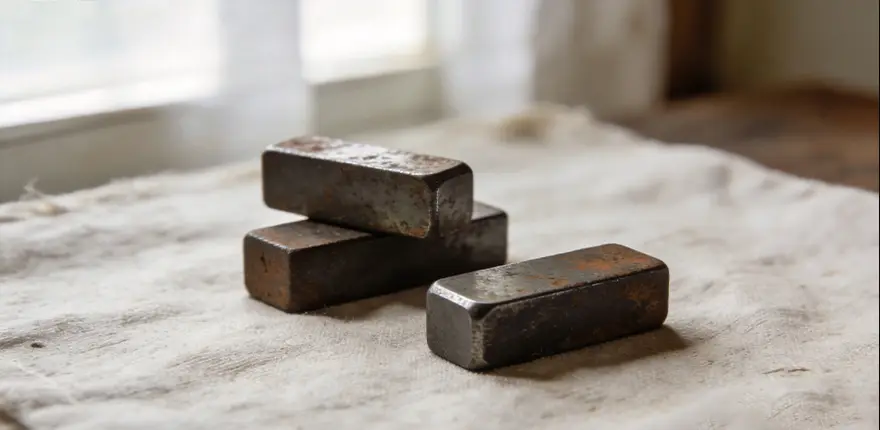
NdFeB magnets possess extremely high magnetic energy density, but their коррозионная стойкость is significantly lower than many conventional metal materials. Therefore, surface protection is usually necessary.
The main reason lies in the internal microstructure of the material. NdFeB magnets contain Nd-rich phases и grain boundary regions, both of which are chemically more active than the primary magnetic phase. In humid environments, these active regions can form microscopic electrochemical corrosion cells, leading to surface oxidation and corrosion.
At the same time, NdFeB materials naturally contain micro-pores and grain boundary defects. Once corrosive media penetrate into the interior, corrosion can rapidly propagate, eventually causing surface oxidation, magnetic flux loss, and even structural failure.
Therefore, reliable обработка поверхности technology is essential to ensure the long-term stability and service life of NdFeB magnets.
What is Passivation?
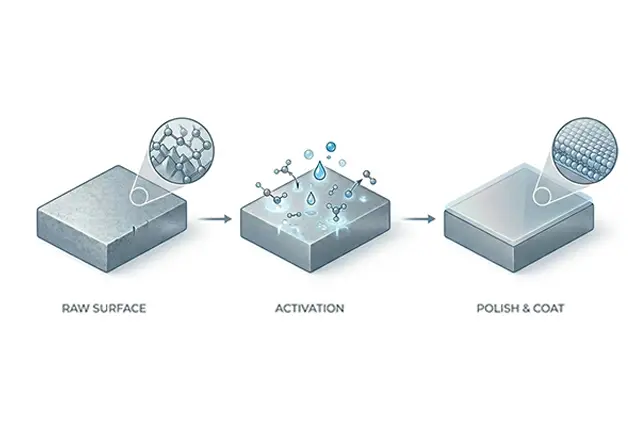
Principle of Passivation
Unlike electroplating, which creates a relatively thick physical coating, the passivation layer is extremely thin and has minimal impact on magnet dimensions. The process chemically modifies the surface state of the material, making it more stable and chemically inert, thereby reducing its reactivity with corrosive environments.
Depending on the chemical system used, the passivation film may consist of:
- Metal oxides
- Hydroxides
- Inorganic-organic composite films
- Ceramic-like conversion layers
Core Advantages of Passivation
Although nickel plating provides robust physical protection, passivation offers significant advantages in precision manufacturing, adhesive bonding applications, environmental compliance, and cost-sensitive products.
- Minimal Dimensional Impact:
In precision applications such as miniature sensors, micro motors, and micro actuators, additional plating thickness may affect assembly tolerances or magnetic air gaps. Since passivation films are typically less than 1 μm thick, dimensional changes are minimized. - Improved Adhesion:
Passivation layers can serve as excellent primer surfaces. If magnets require structural adhesive bonding or overmolding through injection molding, passivated surfaces generally provide better long-term adhesion than smooth electroplated surfaces. - Cost Efficiency:
For certain consumer electronics or industrial components with moderate environmental requirements but high cost sensitivity, passivation is faster and more economical than multi-layer electroplating. - Environmentally Friendly:
Many modern passivation processes use trivalent chromium or organic corrosion inhibitors. Compared with traditional electroplating systems, these technologies present lower environmental risks and reduce wastewater treatment burdens.
Types of NdFeB Magnet Passivation Processes
Currently, NdFeB passivation processes can be divided into three major categories based on chromium content.These categories clearly reflect the industry’s transition from traditional high-corrosion-resistance systems toward environmentally friendly technologies.
Hexavalent Chromium Passivation
Trivalent Chromium Passivation
Compared with hexavalent chromium, it has significantly lower toxicity while still providing sufficient corrosion resistance for most commercial applications.
Today, trivalent chromium passivation is the most widely used passivation technology in the NdFeB industry and is broadly applied in:
- General industrial motors
- Conventional electromechanical components
- Consumer magnetic products
Chromium-Free Passivation
Chromium-free passivation represents the latest direction in green surface treatment technology.
This process completely eliminates chromium and is considered a high-end environmentally friendly solution. It more easily complies with regulations such as EU RoHS и REACH and is increasingly used in:
- New energy vehicles
- Renewable energy equipment
- Medical devices
Compared with trivalent chromium systems, corrosion resistance under equivalent film thickness is slightly lower, and process control requirements are higher. Therefore, chromium-free passivation is often combined with additional coatings to form complete protection systems.
Passivation Process Flow for NdFeB Magnets
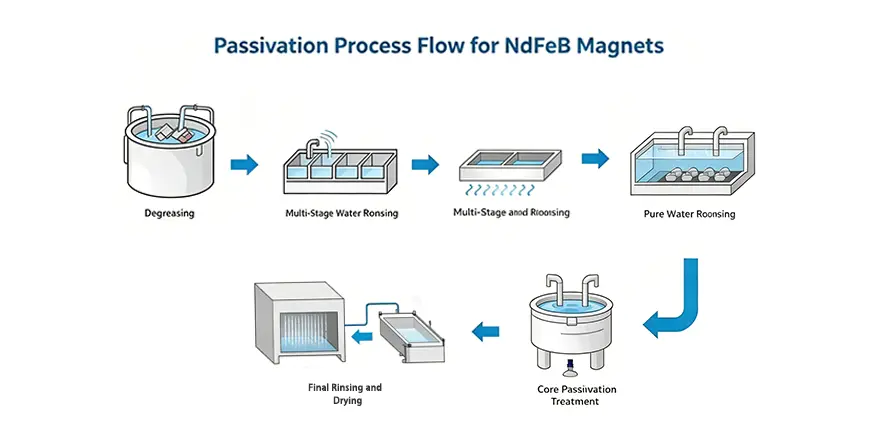
Degreasing:
After slicing, grinding, or machining, NdFeB magnet blanks typically contain oil, dust, and metal debris on the surface. Alkaline or neutral degreasing agents are used to clean the surface and prepare it for uniform film formation.
Multi-Stage Water Rinsing:
After degreasing, multi-stage rinsing and ultrasonic cleaning are used to remove residual contaminants. Ultrasonic cleaning can penetrate micro-pores and remove fine surface impurities.
Acid Pickling and Activation:
Diluted acid solutions are used for short-term treatment to remove oxide layers, rust spots, and degraded passive films while activating the surface to improve film adhesion.
Pure Water Rinsing:
After acid treatment, multiple pure water rinses remove acid residues and ionic contaminants, preventing localized corrosion and uneven film formation.
Core Passivation Treatment:
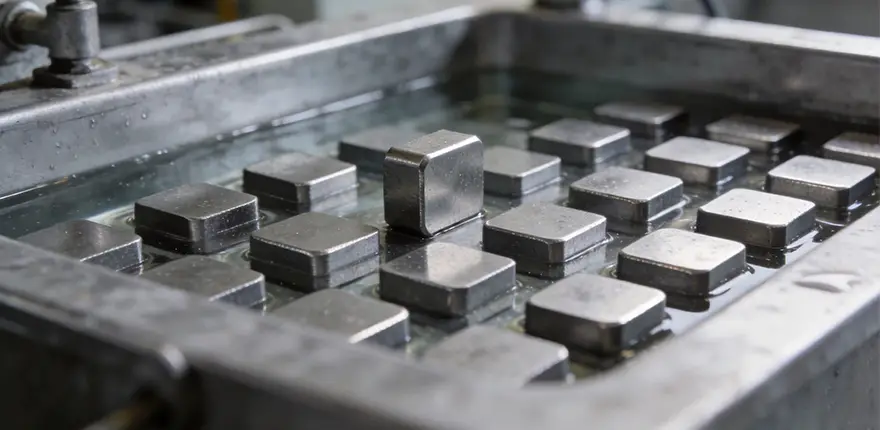
Magnets are immersed in specialized passivation solutions. Depending on the process type, temperature, immersion time, pH value, and solution concentration are carefully controlled to generate a dense and stable protective film on the magnet surface.
Final Rinsing and Drying:
After passivation, magnets are thoroughly rinsed and dried under controlled temperatures. Complete drying prevents secondary corrosion caused by residual moisture and ensures stable film performance.
Comparison Between Passivation and Traditional Plating Processes
| Недвижимость | Ni-Cu-Ni Plating | Chemical Passivation |
|---|---|---|
| Coating Thickness | 10–20 μm | <1 μm |
| Устойчивость к коррозии | Высокий | Умеренный |
| Electrical Conductivity | Conductive | Semi-conductive / Weakly Insulating |
| Dimensional Impact | Significant | Minimal |
| Hydrogen Evolution Risk | Baking may be required | No electrochemical deposition, reducing microcrack risk |
| Стоимость | Выше | Нижний |
When Should Passivation Be Used?
Passivation is not suitable for all magnet protection scenarios. Magnets used in high-humidity environments, acidic or alkaline conditions, underwater applications, or engine systems are generally not recommended to rely solely on passivation.
Passivation is more suitable for the following applications.
- Miniature Magnets:
For magnets thinner than 1 mm, conventional plating layers may crack or excessively alter dimensions. Passivation provides protection without affecting strict tolerances. - High-Precision Components:
In magnetic encoders or laser alignment tools, the air gap between the magnet and sensor is critical. Thick metal coatings may affect the original magnetic circuit design, whereas passivation minimizes dimensional influence. - Temporary Corrosion Protection:
Manufacturers sometimes use passivation as temporary anti-corrosion protection during storage, transportation, or before final coating processes. - Specialized Magnetic Circuit Designs:
Nickel coatings exhibit weak ferromagnetism. In highly sensitive magnetic assemblies, nickel layers may slightly influence local magnetic field distribution. Therefore, ultra-thin passivation systems are sometimes preferred.
Limitations of Passivation
- Limited long-term corrosion resistance
- Unsuitable for severe corrosive environments
- Vulnerable to mechanical wear
- Reduced protection after surface damage
Заключение
Некоторые часто задаваемые вопросы
Is the passivation layer conductive?
The passivation layer is usually semi-conductive или weakly insulating. Compared with nickel coatings, its conductivity is significantly lower, which can help reduce short-circuit risks in certain electronic components.
Can passivated magnets still rust?
Yes.
Passivation can delay corrosion, but unlike thick electroplated coatings, it does not form a completely sealed physical barrier. In highly corrosive environments, oxidation and rust may still occur over time.
Will the passivation film peel off?
Passivation films are chemical conversion layers formed directly on the substrate surface. They do not peel off like traditional coatings, but localized failure may still occur under mechanical wear or chemical attack.
Does passivation affect the magnetic performance of NdFeB magnets?
The impact is typically minimal.
Since passivation films are usually thinner than 1 μm, their influence on magnetic flux and magnetic field distribution is extremely limited, making them highly suitable for precision magnetic assemblies.
Can passivated magnets be directly soldered?
Generally, direct soldering is not recommended.
Because the passivation layer is a chemical conversion film with relatively high electrical resistance, it can interfere with solderability. If electrical connections are required, local film removal or alternative connection methods are usually necessary.
Чтобы узнать больше, ознакомьтесь с этими блогами:
How Segmented Magnets Reduce Eddy Current Loss
Ultimate Guide to Coating Selection for NdFeB Magnets 2026
Arc Magnet vs Block Magnet: Key Differences in Motor Applications
Injection Molded Magnets – All You Need to Know
2026 Magnet Report: Rare Earths & Supply Chain Truths Prices
Готовы обновить свой проект? Ознакомьтесь с полным ассортиментом продукции на сайте TOPMAG!🧲

Я занимаюсь научно-популярной литературой о магнитах. Мои статьи в основном посвящены принципам их действия, применению и анекдотам. Наша цель - предоставить читателям ценную информацию, помочь каждому лучше понять очарование и значение магнитов. В то же время мы будем рады услышать ваши мнения о потребностях, связанных с магнитами. Не стесняйтесь следовать за нами и сотрудничать с нами, ведь мы вместе исследуем бесконечные возможности магнитов!