
How to Customize High-Quality Neodymium Magnets
- Итан
- База знаний
Standard neodymium magnets can meet most general-purpose requirements, but they often fail to precisely match the diverse demands of modern industrial applications. Custom neodymium magnets are designed according to specific application requirements, allowing optimization of the magnet grade, dimensions, shape, magnetization direction, coating, and machining tolerance. This helps improve product performance, reduce overall costs, and ensure reliable operation under demanding working conditions.
This guide explains the key factors to consider when customizing neodymium magnets, the customization process, and how to choose the right magnet supplier, helping you quickly identify the most suitable solution for your application.
Содержание
Основные выводы
- Custom neodymium magnets can be optimized for your specific application requirements.
- Selecting the right класс магнитности, coating, tolerance, и magnetization direction is essential for achieving optimal performance.
- Operating environment should always be considered during magnet selection.
- A structured customization process helps improve quality, reduce costs, and shorten development time.
- Working with an experienced magnet manufacturer ensures reliable products and professional engineering support.
What Are Neodymium Magnets?
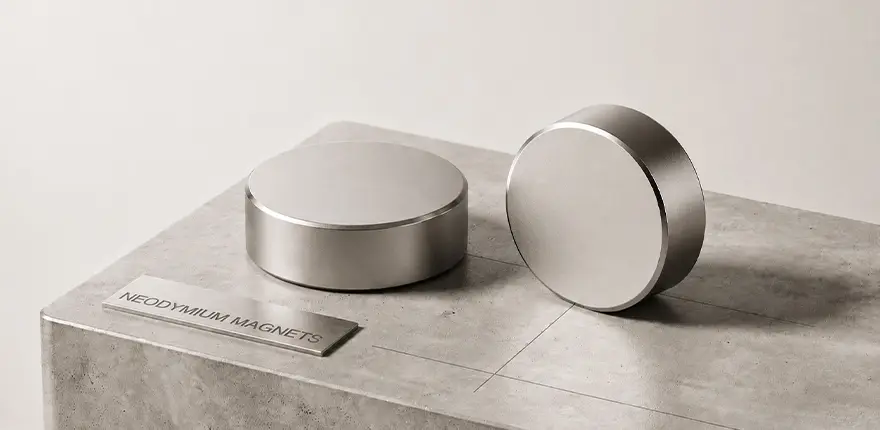
Неодимовые магниты are the strongest commercially available постоянные магниты and are widely used in electric motors, sensors, medical devices, industrial automation, new energy vehicles, and various magnetic assemblies.
Есть two main types of neodymium magnets used in industry:
- Спеченные магниты NdFeB – Offer superior magnetic performance and excellent stability, making them the preferred choice for most industrial applications.
- Bonded NdFeB Magnets – Can be molded into complex shapes but provide lower magnetic performance than sintered magnets, making them suitable for compact precision electronic products.
Why Choose Custom Neodymium Magnets?
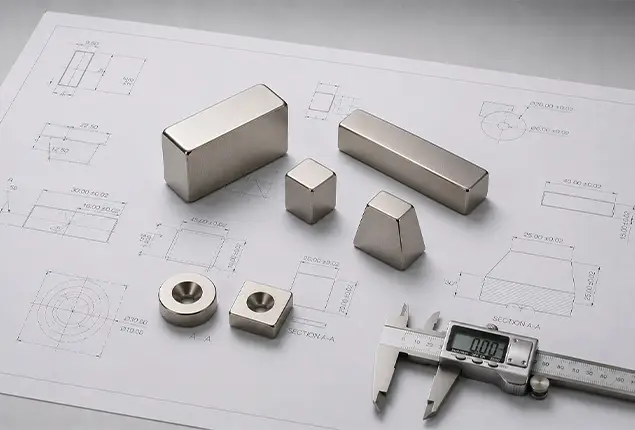
Compared with standard magnets, custom neodymium magnets provide a better balance between performance, reliability, and cost by meeting the specific requirements of your application.
Precisely Match Your Product Design
Improve Magnetic Circuit Efficiency and Reduce Overall Costs
The strongest magnet is not always the best solution. Instead, the appropriate magnet grade, dimensions, and magnetization direction should be selected based on the magnetic circuit design.
A well-designed custom NdFeB magnet improves magnetic field utilization while avoiding unnecessary material costs, delivering the required performance at the most cost-effective solution.
Meet Demanding Operating Conditions
Applications exposed to high temperatures, humidity, salt spray, or chemical corrosion require magnets specifically designed for these environments.
By selecting the appropriate temperature-resistant grade, surface coating, and protective treatment, custom neodymium magnets can provide excellent corrosion resistance, improved demagnetization resistance, and long-term operational reliability.
What Should You Consider When Customizing Neodymium Magnets?
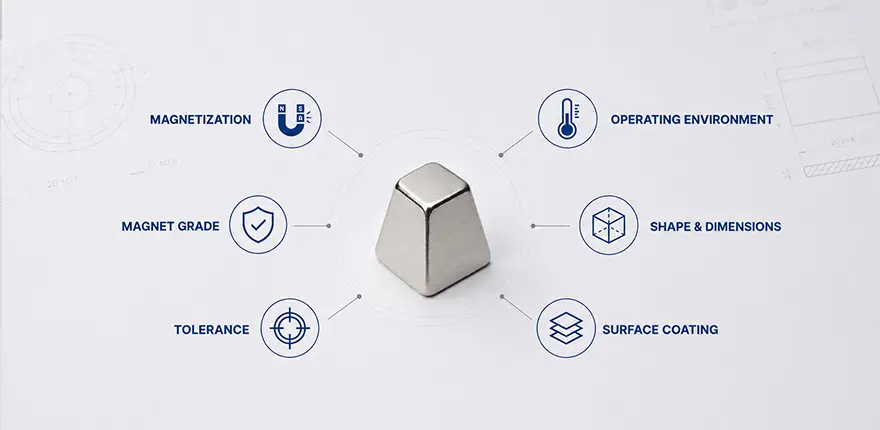
To achieve the best performance, reliability, and manufacturing efficiency, six key factors should be considered during the customization process.
Класс магнита
Magnet grade is the most important specification because it determines the magnetic performance, temperature resistance, and resistance to demagnetization.
Neodymium magnet grades typically consist of a number followed by an optional letter designation, such as N35, N42, N52, N35SH, и N42UH.
Specifically:
- The number represents the Максимальный энергетический продукт (BHmax), measured in MGOe. Higher numbers generally indicate stronger magnetic performance. Among commercially mass-produced neodymium magnets, N52 offers one of the highest magnetic performance levels.
- The letter designation indicates the magnet’s Внутренняя коэрцитивная сила (Hcj) and maximum recommended operating temperature, reflecting its resistance to demagnetization at elevated temperatures.
Common temperature ratings are shown below.
| Класс | N | M | H | SH | UH | EH | TH |
|---|---|---|---|---|---|---|---|
| Max Recommended Operating Temperature | 80°C | 100°C | 120°C | 150°C | 180°C | 200°C | 220°C |
For example, N52H combines high magnetic performance with a recommended maximum operating temperature of approximately 120°C.
It is important to note that a higher magnet grade is not always the best choice. The optimal grade should be selected by considering operating temperature, magnetic circuit design, available installation space, and overall project cost.
Tip: If the operating temperature exceeds 80°C, consult your magnet supplier to select a grade with higher intrinsic coercivity (Hcj) to reduce the risk of irreversible demagnetization.
Shape and Dimensions
Neodymium magnets can be customized into a wide variety of standard and complex geometries, including:
- Магниты для блоков
- Магниты для цилиндров
- Кольцевые магниты
- Дуговые магниты
- Tile magnets
- Trapezoidal magnets
- U-shaped magnets
- Потайные магниты
- Сферические магниты
- Custom-shaped magnets
Custom-shaped magnets require more advanced machining capabilities because they often involve dedicated tooling and specialized machining processes.
For the most accurate quotation and manufacturing evaluation, it is recommended to provide detailed engineering drawings whenever possible. If drawings are unavailable, key dimensions such as length, width, height, inner diameter, and outer diameter should be provided.
Направление намагничивания
Magnetization direction determines the magnetic field distribution of a magnet and is one of the most important factors affecting its performance. It should be clearly specified during the design or quotation stage, as an incorrect magnetization direction may result in poor product performance or increased manufacturing costs.
Common magnetization methods include:
- Axial Magnetization – The magnetic field runs along the axis of the magnet, with the north and south poles located on the two end faces. This is commonly used for cylindrical and ring magnets.
- Diametrical Magnetization – The magnetic field runs across the diameter of the magnet, with the poles located on the curved surface. It is commonly used in motors, rotary encoders, and certain sensor applications.
- Multi-Pole Magnetization – Multiple alternating north and south poles are magnetized on the same surface, making it ideal for encoders, sensors, and other precision applications.
To ensure the magnet meets your application requirements, the magnetization direction should always be specified on the engineering drawing or clearly communicated during the inquiry stage.
Tolerance
Dimensional tolerance directly affects assembly accuracy, product consistency, and manufacturing quality, making it an important consideration when customizing neodymium magnets.
Typical machining tolerances include:
| Tolerance Level | Typical Accuracy | Типовые применения |
|---|---|---|
| Standard | ±0.10 mm | General industrial applications |
| Precision | ±0.05 mm | Most custom magnets |
| High Precision | ±0.02 mm | Motors, magnetic assemblies, precision sensors |
| Ultra Precision | ±0.01 mm | Medical, optical, and other high-precision equipment |
Keep in mind that tighter tolerances generally increase machining complexity and manufacturing costs. Therefore, the recommended approach is to specify only the tolerance required for your application to achieve the best balance between performance and cost.
Surface Coating
Neodymium magnets have relatively poor corrosion resistance and therefore require protective surface coatings to prevent oxidation and corrosion.
Different magnet coatings are suitable for different operating environments.
| Покрытие | Характеристики | Recommended Applications |
|---|---|---|
| Никель (Ni-Cu-Ni) | Most widely used; good appearance and balanced corrosion resistance | General industrial applications |
| Цинк (Zn) | Economical | Dry, non-humid environments |
| Эпоксидная смола | Excellent corrosion resistance and electrical insulation | High humidity, salt spray, and outdoor environments |
| Золото (Au) | Excellent biocompatibility and electrical conductivity | Medical devices and precision electronics |
| Silver (Ag) | High electrical conductivity | Specialized electronic applications |
| Phosphate / Passivation | Thin protective coating | Special industrial requirements |
If you are unsure which coating to select, simply provide your operating environment to the supplier. An experienced engineering team can recommend the most suitable surface treatment based on your application.
For projects requiring enhanced corrosion resistance, you may also request salt spray test reports to verify coating performance.
Operating Environment
In addition to magnet grade, dimensions, and coating, the operating environment plays a critical role in selecting the most suitable neodymium magnet.
If your application involves any of the following conditions, be sure to inform your magnet supplier during the inquiry stage:
- High operating temperatures
- High humidity
- Salt spray or chemical corrosion
- High-speed rotation
- Mechanical shock or vibration
- Product service life requirements
Providing complete application information allows engineers to recommend the most appropriate combination of magnet grade, magnetization direction, coating, and manufacturing process, ensuring better reliability, longer service life, and improved cost-effectiveness.
How to Customize High-Quality Neodymium Magnets
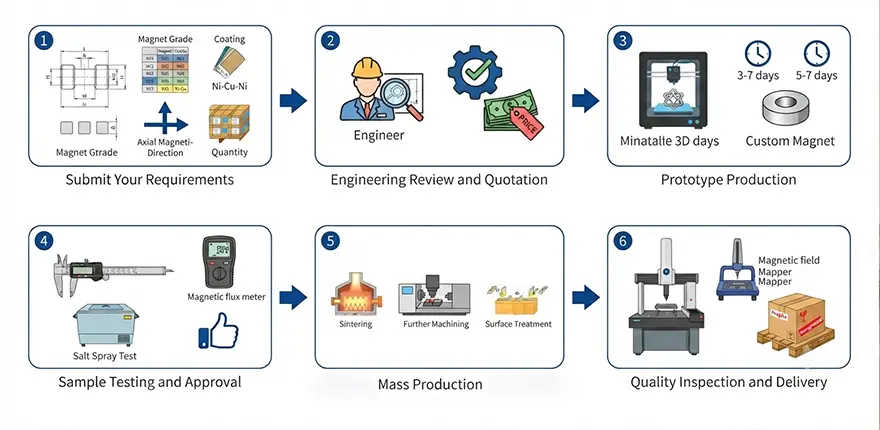
The customization process for neodymium magnets typically includes the following six steps.
1. Submit Your Requirements
Provide your supplier with as much information as possible, including engineering drawings (dimensions, tolerances, magnet grade, coating, magnetization direction, and quantity), as well as your application and operating environment.
2. Engineering Review and Quotation
Based on your requirements, the supplier evaluates the project’s manufacturability, recommends the most suitable magnet grade, coating, and manufacturing process, and provides a quotation and lead time.
If you are unfamiliar with magnet specifications, experienced engineers can also recommend the most suitable solution based on your application.
3. Prototype Production
Once the order is confirmed, prototype samples are produced. Typical lead times are”3–7 business days“ for standard magnets and “5–7 business days”for custom-shaped magnets.
4. Sample Testing and Approval
After receiving the samples, customers typically verify dimensions, magnetic performance, coating adhesion, and other key specifications. Once the samples are approved, mass production begins.
5. Mass Production
Production typically takes “5–15 business days”, depending on product complexity and order quantity.
The standard manufacturing process includes:
Sintering → Precision Machining → Surface Treatment → Magnetization → Inspection
6. Quality Inspection and Delivery
Before shipment, magnets undergo comprehensive quality inspections, including dimensional inspection, magnetic flux testing, coating thickness measurement, and salt spray testing when required.
Inspection reports can be provided upon request, and magnets can be supplied with demagnetized packaging for air shipment.
Почему стоит выбрать TOPMAG?
TOPMAG specializes in custom NdFeB magnets and magnetic assemblies, providing one-stop solutions from magnetic circuit design and engineering support to mass production. Our engineering team helps optimize performance, cost, and manufacturability for your application.
Our capabilities include:
- Full customization of magnet grade, dimensions, shape, coating, and magnetization direction
- Precision machining up to ±0.01 mm
- Magnetic circuit design and FEA simulation support
- In-house manufacturing with strict quality control
- ISO 9001 & ISO 14001 certified
- RoHS & REACH compliant
- Rapid prototyping and complete inspection reports
Whether you need prototypes or high-volume production, TOPMAG is ready to support your next custom magnet project.
Заключение
Choosing the right custom neodymium magnet starts with understanding your application requirements. By selecting the appropriate magnet specifications and partnering with an experienced manufacturer, you can achieve better performance, greater reliability, and lower overall project costs.
Некоторые часто задаваемые вопросы
Can I customize neodymium magnets without engineering drawings?
Yes. If engineering drawings are not available, simply provide your application, basic dimensions, and operating environment. Our engineers can recommend suitable specifications and assist with product selection.
What is the minimum order quantity (MOQ) for custom neodymium magnets?
The minimum order quantity depends on the magnet size, shape, and manufacturing process. Please contact us for project-specific requirements.
Can the magnetization direction be customized?
Yes. Neodymium magnets can be customized with axial, diametrical, or multi-pole magnetization, depending on your application requirements.
What are the limitations of custom neodymium magnets?
Neodymium magnets offer exceptional magnetic strength but are relatively brittle and may chip or crack if subjected to impact or improper handling. They also have limited corrosion resistance and typically require protective surface coatings.
What information is required to customize neodymium magnets?
For the most accurate quotation, please provide engineering drawings, dimensions, tolerances, magnet grade, magnetization direction, coating requirements, quantity, and application details. If drawings are unavailable, simply describe your application, and our engineers will help determine the appropriate specifications.
Чтобы узнать больше, ознакомьтесь с этими блогами:
Rare Earth Magnets vs Ferrite Magnets: Key Differences
Magnetic Separator Magnets: Types and Applications
How Segmented Magnets Reduce Eddy Current Loss
Arc Magnet vs Block Magnet: Key Differences in Motor Applications
2026 Magnet Report: Rare Earths & Supply Chain Truths
Готовы обновить свой проект? Ознакомьтесь с полным ассортиментом продукции на сайте TOPMAG!🧲

Я занимаюсь научно-популярной литературой о магнитах. Мои статьи в основном посвящены принципам их действия, применению и анекдотам. Наша цель - предоставить читателям ценную информацию, помочь каждому лучше понять очарование и значение магнитов. В то же время мы будем рады услышать ваши мнения о потребностях, связанных с магнитами. Не стесняйтесь следовать за нами и сотрудничать с нами, ведь мы вместе исследуем бесконечные возможности магнитов!