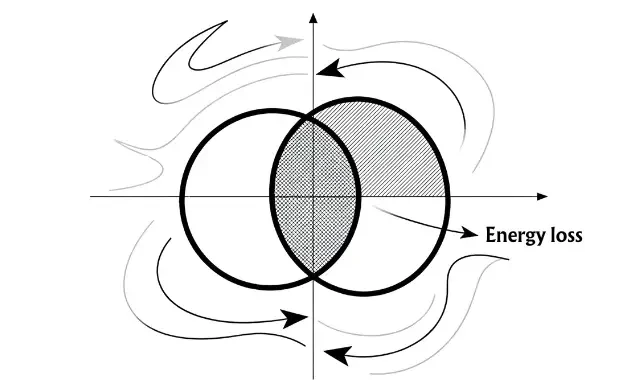
When we experimentally test a piece of NdFeB material and repeatedly change its magnetization direction to the completely opposite state using an external magnetic field, after the external magnetic field disappears, the material does not fully return to a non-magnetic state but retains a certain magnetism. This phenomenon originates from tiny magnetic regions within the material called magnetic domains. These domains resist changes in the direction of the magnetic field. All this resistance primarily stems from the internal resistance of the domains flipping. The work done to overcome this is consumed within the material and converted into heat, leading to an increase in the material’s temperature—this is the ultimate manifestation of hysteresis loss, and this heating effect is known as hysteresis loss.
 In electrical equipment, heat dissipation is an eternal challenge. Continuous hysteresis loss causes the iron core temperature to rise, accelerating the aging of insulation materials and shortening the equipment’s lifespan.
 In operating equipment, not 100% of the energy is used for useful work; instead, a portion is wasted as useless heat. In a city’s power system, these losses accumulate to form an astronomically large energy waste. Improving efficiency is a key topic in global energy conservation and emission reduction efforts.
 Transformers and most electric motors use alternating current. Alternating current generates a magnetic field that periodically changes in both direction and magnitude, causing the magnetic materials in the motor’s stator/rotor to undergo high-frequency magnetization-demagnetization cycles. This results in extremely significant hysteresis loss. Designers must use special materials and cooling systems to manage it and prevent the machine from overheating.
 In many DC motors, the armature iron core rotates such that, although the external excitation magnetic field is produced by direct current and remains constant in direction, for any point on the armature iron core, the effective magnetic field direction it experiences is constantly changing. In DC motors, hysteresis loss mainly occurs in the armature iron core because it rotates in a constant magnetic field, leading to periodic changes in the effective magnetic field direction experienced internally. In contrast, the stator yoke experiences a constant magnetic field, so its hysteresis loss is typically very small.
 The advantages of soft magnetic materials are low coercivity and low remanence, allowing for a smaller hysteresis loop area. This is the most fundamental measure.
 The area of the hysteresis loop is equivalent to the energy loss. Adding silicon to silicon steel optimizes the magnetic properties of iron, making it easier to magnetize and demagnetize.
 Through processes such as refining and heat treatment, internal stresses and crystal defects in the material are reduced, thereby decreasing coercivity and hysteresis loss.