
Why Ferrite Magnets Are Still Used in Motors?
- Ethan
- Base de conhecimento
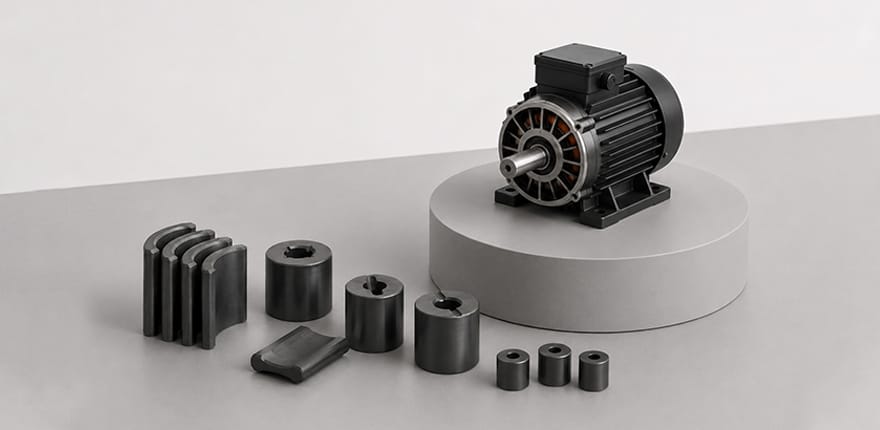
Among ímã permanente materials, compared to ímãs de ferrite, neodymium magnets havehave superior magnetic performance, and enable lighter motor designs at the same time. However, for motors such as fans, condicionadores de ar e water pumps, the ferrite magnets still hold a large market share.
Why can’t higher-performance ímãs de neodímio completely replace ferrite magnets? This is not only a cost issue, ferrite delivers more banlanced overall performance in practical motor applications. The article will explain why the ferrite magnet remain the important choice for many motor applications.
Conteúdo
Principais conclusões
- Ímãs de ferrite offers a strong balance of cost, reliability, and durability.
- Ímãs de NdFeB are preferred for compact, high-power-density motors.
- Ferrite magnets have advantages in corrosion resistance, electrical insulatione supply stability.
- Improved ferrite magnets continue to expand their motor applications.
Basic Comparison Between Ferrite and NdFeB Magnets
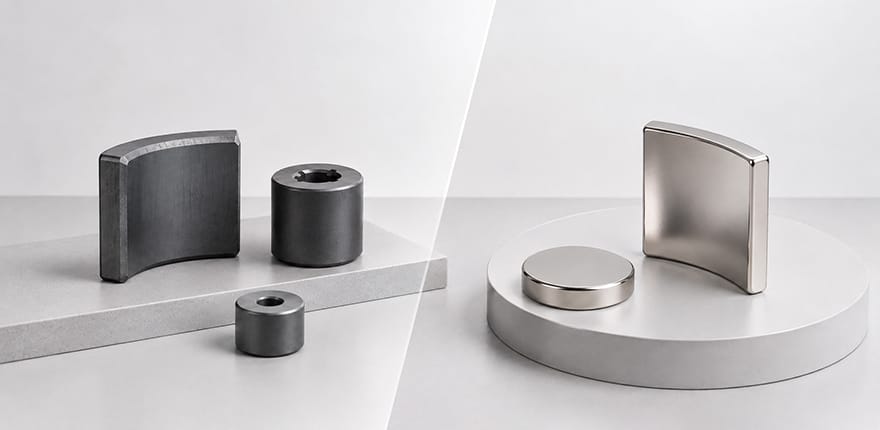
Ímãs de ferrite are a type of ceramic compounds, sintered from iron oxide and carbonates of strontium or barium. Compared with neodymium magnets, the main parameters as follows:
| Parâmetro | Ímãs de ferrite | Ímãs NdFeB | Significance for Motor Selection |
|---|---|---|---|
| Produto energético máximo (BHmax) | About 3.5–4.5 MGOe | About 35–52 MGOe | Determines motor power density and magnet volume |
| Remanescência (Br) | About 0.2–0.4 T | About 1.0–1.4 T | Affects air-gap flux density and motor size |
| Coercividade (Hcj) | Relatively high | Depends on the grade | Affects resistance to demagnetization and operating reliability |
| Electrical Resistivity | High, insulating | Low, electrically conductive | Affects eddy current losses at high operating speeds |
| Resistência à corrosão | Excellent, no coating required | Relatively poor, usually requires surface treatment | Affects long-term reliability and protection costs |
In short, although ferrite magnets have lower magnetic performance per unit volume, their low cost, high electrical resistivity, and excellent corrosion resistance make them advantageous in motors where cost and reliability are priorities.
Why Are Ferrite Magnets Still Chosen?
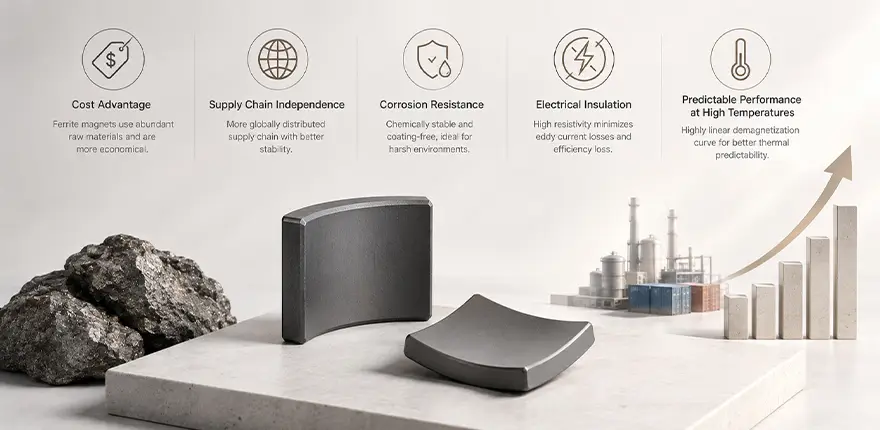
Cost Advantage
Supply Chain Independence
Rare earth elements carry obvious geopolitical sensitivity. Global rare earth processing capacity is highly concentrated in a small number of countries. The export conrtols and tariff adjustment in the past decades, have repeatedly impacted on the supply and price of NdFeB magnets for many times. In comparison, the ferrite magnet supply chain is more globally distributed and relatively stable, with price fluctuations generally lower than those of rare earth permanent magnet materials.
Resistência à corrosão
NdFeB magnets are highly susceptible to oxidation and usually require additional surface coatings. This not only increases cost but can also create a potential failure point if the coating is damaged. Ferrite magnets are chemically stable and do not require coatings, making them more suitable for humid and harsh environments.
Electrical Insulation
NdFeB magnets are electrically conductive metals. When exposed to alternating magnetic fields, they can generate significant perdas por correntes parasitas, causing the magnets themselves to heat up, leading to demagnetization and even reducing motor efficiency. Ferrite magnets are essentially ceramic insulators. Their high electrical resistivity makes eddy current losses almost negligible. In some high-frequency drive systems or specific motor topologies, ferrite magnets naturally avoid this heating issue.
More Predictable Performance at High Temperatures
Although standard NdFeB magnets have a relatively high Temperatura de Curie, they can experience a demagnetization knee at higher operating temperatures unless heavy rare earth elements such as dysprosium or terbium are added. In comparison, the demagnetization curve of ferrite magnets is highly linear and tolerant within the designed temperature range. This means there is less need to upgrade the magnet grade excessively for safety margins, simplifying thermal design.
Typical Motor Applications of Ferrite Magnets
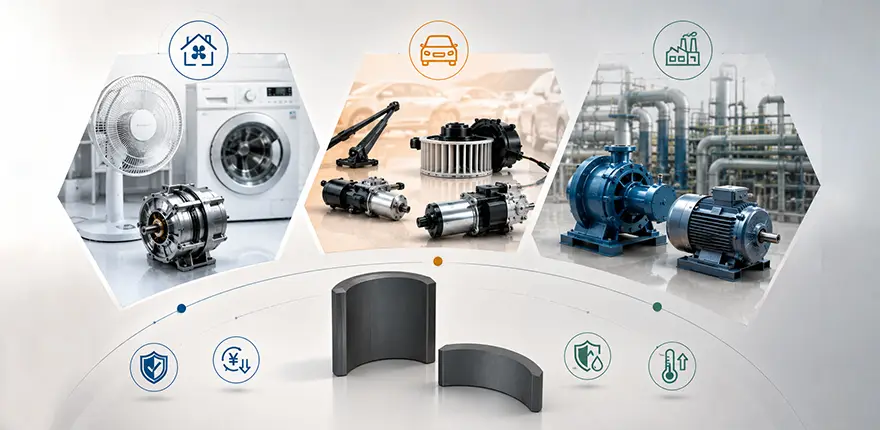
Because of these characteristics, ferrite magnets remain widely used in the following motor segments.
| Aplicativo | Aplicações típicas | Why Ferrite Magnets Are Suitable |
|---|---|---|
| Eletrodomésticos | Washing machines, fans, small appliances | Low unit cost is important, while high torque density is not critical |
| Automotive Auxiliary Motors | Wiper motors, power window and seat adjustment motors, air-conditioning blowers | High production volume and cost-driven design; extreme power density is not required |
| Motores industriais | Water pumps, conveyor drives | Durability and cost-effectiveness are prioritized over compact size |
Limitations and Development Trends of Ferrite Motors
In applications with strict requirements for power density, lightweight design, and extreme miniaturization, such as new energy vehicle traction motors, high-end industrial servo motors, and robot motors, Ímãs de NdFeB são usually more suitable.
However, ferrite magnet technology has not remained static. In recent years, improvements in sintering processes, microstructure grain refinement, and anisotropic ferrite magnets have continued to improve the remanence and coercivity of ferrite magnets. These developments are further narrowing the performance gap between ferrite magnets and lower-end rare earth magnets.
Conclusão
Ímãs de ferrite have remained in motor design because, for a considerable number of real-world applications, they offer an excellent engineering balance between cost efficiency, supply chain security, demagnetization resistance, and eddy current heating. For motor applications that prioritize cost-effectiveness and long-term reliability, ferrite magnets will remain the right and dependable engineering choice for a long time to come.
Algumas perguntas frequentes
What types of ferrite magnets are commonly used in motors?
Sintered ferrite magnets are the most common choice in motors, especially for applications that require stable magnetic performance and high-volume production.
What shapes of ferrite magnets are commonly used in motors?
Arc magnets are widely used in motors. Their curved structure can match the geometry of the rotor or stator and create the required magnetic field.
What is the difference between isotropic and anisotropic ferrite magnets?
Isotropic ferrite magnets can be magnetized in different directions, while anisotropic ferrite magnets have a specific easy magnetization direction and usually provide higher magnetic performance.
What is the difference between wet-pressed and dry-pressed ferrite magnets?
Wet pressing can usually achieve higher magnetic performance, while dry pressing offers higher production efficiency and is suitable for many products with relatively simple structures.
Can damaged ferrite magnets still be used?
Minor appearance defects do not necessarily affect performance, but magnets with cracks, severe chipping, or structural damage should be evaluated before use.
Para obter mais informações, consulte estes blogs relacionados:
Magnet Temperature Limits:Maximum Operating Temperature vs Curie Temperature
Multipole Ring Magnet: Complete Guide
sCan Magnetized Magnets Be Machined? Risks and Solutions
How Segmented Magnets Reduce Eddy Current Loss
2026 Magnet Report: Rare Earths & Supply Chain Truths
Pronto para atualizar seu projeto? Navegue por nossa linha completa de produtos em TOPMAG!🧲

Dedico-me a escrever artigos científicos populares sobre ímãs. Meus artigos se concentram principalmente em seus princípios, aplicações e anedotas do setor. Nosso objetivo é fornecer aos leitores informações valiosas, ajudando todos a entender melhor o encanto e a importância dos ímãs. Ao mesmo tempo, estamos ansiosos para ouvir suas opiniões sobre as necessidades relacionadas aos ímãs. Fique à vontade para nos seguir e interagir conosco enquanto exploramos juntos as infinitas possibilidades dos ímãs!