
Magnet Temperature Limits:Maximum Operating Temperature vs Curie Temperature
- Ethan
- Base de conhecimento
Temperature is one of the key factors affecting the performance and reliability of ímãs permanentes. Beyond a certain temperature threshold, magnets may even undergo irreversible demagnetization. Therefore, understanding the temperature limitations of magnets is crucial when selecting suitable magnet materials for specific applications.
When evaluating the temperature resistance of permanent magnets, two important parameters are often considered: maximum operating temperature e Temperatura de Curie. This article will explain these two parameters in detail and introduce how temperature affects different permanent magnets. It will help you choose the right magnet according to your application requirements.
Conteúdo
Principais conclusões
- Maximum operating temperature defines the safe working range of magnets, while Temperatura de Curie indicates the point of complete magnetic loss.
- Different materiais magnéticos, including NdFeB, Ferrite, SmCo, and Alnico, have different temperature resistance capabilities.
- Actual magnet temperature performance depends on material grade, magnet size, magnetic circuit design, and operating conditions.
- Proper magnet selection helps reduce irreversible demagnetization and ensures long-term reliability.
- TOPMAG provides customized permanent magnet solutions for standard and high.
Difference Between Maximum Operating Temperature and Curie Temperature
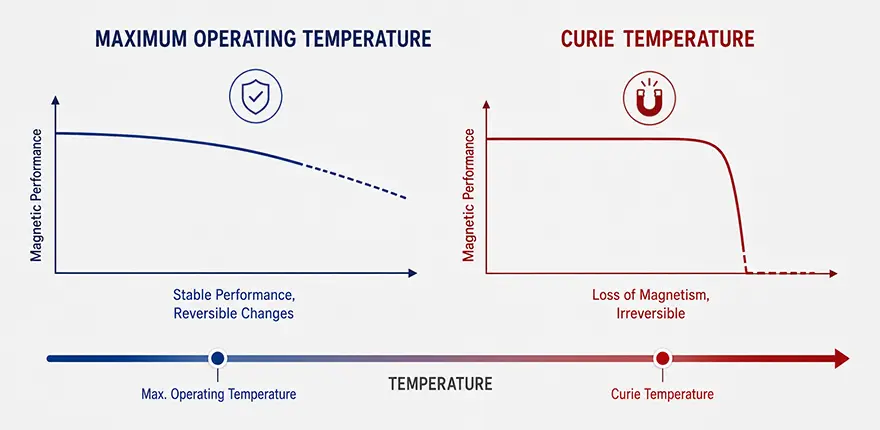
Although both maximum operating temperature and Curie temperature are related to temperature, they have completely different meanings in practical magnet applications.
What Is Maximum Operating Temperature?
The maximum operating temperature refers to the highest temperature at which a permanent magnet can operate stably under specified working conditions while maintaining acceptable magnetic performance loss.
Within this temperature range, the magnetic properties of the magnet may change with temperature. However, after cooling down, the magnet can usually recover its original performance without significant irreversible demagnetization.
Maximum operating temperature is an important parameter for engineering applications. It usually varies significantly depending on the magnet material, grade, size, and shape.
What Is Curie Temperature?
O Temperatura de Curie of permanent magnets is usually higher than the maximum operating temperature.
Curie temperature is the critical temperature at which a magnet changes from a ferromagnetic state to a paramagnetic state. When the temperature reaches the Curie temperature, the magnetic domain structure is destroyed, and the material permanently loses its magnetism. Even after cooling, the original magnetic properties cannot be restored.This value is mainly determined by the magnet material itself.
Operating Temperature of Different Permanent Magnets
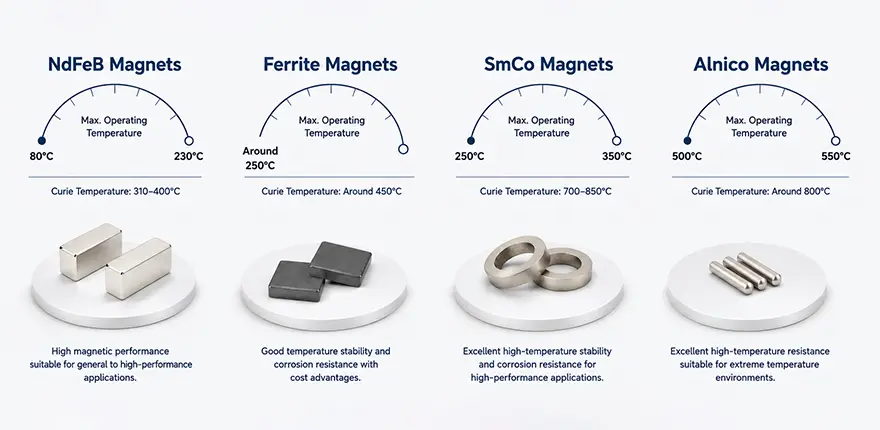
Different permanent magnet materials have different temperature resistance capabilities. Magnet selection should consider not only magnetic performance but also the actual operating temperature environment.
Ímãs NdFeB
Ímãs de neodímio are one of the strongest commercially available permanent magnet materials. Standard NdFeB magnets have relatively limited temperature resistance.
For high-temperature applications, high coercivity grades such as SH, UH, and EH are usually selected to improve resistance to thermal demagnetization.
| NdFeB Grade | Temperatura máxima de operação | Curie Temperature |
|---|---|---|
| N Series | 80°C | 310–400°C |
| M Series | 100°C | 310–400°C |
| H Series | 120°C | 310–400°C |
| SH Series | 150°C | 310–400°C |
| UH Series | 180°C | 310–400°C |
| EH Series | 200°C | 310–400°C |
| AH Series | 230°C | 310–400°C |
Ímãs de ferrite
Ímãs de ferrite have excellent corrosion resistance and good temperature stability. Their magnetic performance is usually lower than NdFeB magnets, but they offer better temperature resistance and cost advantages.
| Parâmetro | Ímã de ferrite |
|---|---|
| Temperatura máxima de operação | Around 250°C |
| Curie Temperature | Around 450°C |
SmCo Magnets
SmCo magnets have excellent high-temperature stability and corrosion resistance. They are an ideal choice for high-temperature applications that require high magnetic performance.
| Parâmetro | SmCo Magnet |
|---|---|
| Temperatura máxima de operação | 250-350°C |
| Curie Temperature | 700–850°C |
Ímãs de alnico
Ímãs de alnico have excellent high-temperature resistance. However, they have relatively low coercivity, so proper magnetic circuit design is required to reduce the risk of demagnetization.
| Parâmetro | Alnico Magnet |
|---|---|
| Temperatura máxima de operação | 500-550°C |
| Curie Temperature | Around 800°C |
Factors Affecting Maximum Operating Temperature
The maximum operating temperature of a permanent magnet is affected by several factors, including material grade, magnet size, magnetic circuit design, and operating environment. Even magnets with the same grade may have different temperature performance under different application conditions.
Magnet Material and Grade
The magnet material and grade are the main factors that determine the temperature resistance of permanent magnets. Different materials have different thermal stability.
For example, NdFeB magnets with high coercivity grades such as SH, UH, and EH provide better resistance to thermal demagnetization than standard grades. SmCo and Alnico magnets are more suitable for high-temperature applications due to their excellent temperature stability.
Magnet Size and Shape
The size and shape of a magnet affect its resistance to irreversible demagnetization.
Magnets with unfavorable dimensional ratios usually have lower permeance coefficients (Pc), making their operating points closer to the knee point of the demagnetization curve. As a result, they are more sensitive to temperature increases and external magnetic fields.
Magnetic Circuit Design
The magnetic circuit design directly affects the working point and stability of a magnet.
A higher permeance coefficient (Pc) means the magnet operates in a more stable region of the demagnetization curve and has better resistance to high-temperature demagnetization.
Proper magnetic circuit design can help reduce the risk of irreversible demagnetization during operation.
Operating Environment and Heat Generation
The actual magnet temperature is not only determined by ambient temperature but also by heat generated during equipment operation.
For example, in motor applications, copper loss, iron loss, and eddy current loss can increase magnet temperature. External reverse magnetic fields may also reduce the magnet’s resistance to demagnetization.
Therefore, magnet selection should consider operating temperature, cooling conditions, and actual application requirements.
Conclusão
During permanent magnet selection, both Curie temperature and maximum operating temperature are important parameters for evaluating temperature resistance.The operating temperature of the selected magnet should remain below its maximum operating temperature. This should be evaluated based on magnet material, grade, size, magnetic circuit design, and cooling conditions to prevent irreversible demagnetization and ensure long-term reliable operation.
TOPMAG has extensive experience in permanent magnet manufacturing and application solutions. We provide customized services for different shapes, sizes, and performance requirements.Whether for standard applications or high-temperature environments, we can provide suitable material selection and technical support according to customer requirements. If you are interested in our products, please send us your drawings for a quotation.
Algumas perguntas frequentes
If a magnet does not exceed its Curie temperature, will it never lose magnetism?
No. Curie temperature is the critical point where magnetic properties completely disappear. To determine whether a magnet can operate safely, the maximum operating temperature should be considered instead of the Curie temperature.
Can a magnet recover after irreversible demagnetization?
Usually, it cannot fully recover. The magnet needs to be remagnetized or replaced.
How can the actual working temperature of a magnet be estimated? Is the ambient temperature the same as the magnet temperature?
No. The actual magnet temperature is also affected by motor temperature rise, cooling conditions, installation structure, and other factors.
Is it safe for a magnet to operate near its maximum operating temperature for a long time?
It is not recommended. Long-term operation close to the temperature limit increases the risk of magnetic performance loss and demagnetization. A certain temperature margin should be maintained.
Does the coating affect the temperature resistance of magnets?
Yes. Different coatings have different temperature resistance capabilities. High-temperature applications require suitable surface treatments.
Para obter mais informações, consulte estes blogs relacionados:
HRE-Free Magnets Explained: Technology and Manufacturing Innovations
How to Customize High-Quality Neodymium Magnets
Rare Earth Magnets vs Ferrite Magnets: Key Differences
Multipole Ring Magnet: Complete Guide
Pronto para atualizar seu projeto? Navegue por nossa linha completa de produtos em TOPMAG!🧲

Dedico-me a escrever artigos científicos populares sobre ímãs. Meus artigos se concentram principalmente em seus princípios, aplicações e anedotas do setor. Nosso objetivo é fornecer aos leitores informações valiosas, ajudando todos a entender melhor o encanto e a importância dos ímãs. Ao mesmo tempo, estamos ansiosos para ouvir suas opiniões sobre as necessidades relacionadas aos ímãs. Fique à vontade para nos seguir e interagir conosco enquanto exploramos juntos as infinitas possibilidades dos ímãs!