
Multipole Ring Magnet: Complete Guide
- Ethan
- Base de conhecimento

Em motores, sensores e automation equipment, the choice of magnets plays a critical role on performance and stability. With the increasing number of equipment operation requirements, how to choose a suitable magnetic scheme becomes an important consideritions during designing.
As a common magnetic component, multi-pole ring magnet has been applied to many feilds. There are many differences under different ring magnets structure, magnetization method and performance requirements. It can help to make more informed decisions in the process of engineering design and product selection when understanding the features of multi-pole ring magnet.
Whether you are looking to purchase multi pole magnet ring or want to learn more about this magnetic component, this guide provides a complete overview and useful reference.
Conteúdo
Principais conclusões
- Multi pole ring magnets feature multiple alternating N/S poles, providing continuous magnetic signals for precise motion control and position detection.
- Compared with standard ring magnets, multi pole magnetic rings offer higher accuracy and better magnetic field uniformity.
- Magnetization direction, material, and pole number are key factors when selecting the right multi pole ring magnet.
- Multi pole ring magnets are widely used in motors, encoders, sensors, and automation equipment.
- Customized design and experienced manufacturing support help ensure reliable performance and application success.
What Is a Multi Pole Magnet Ring?
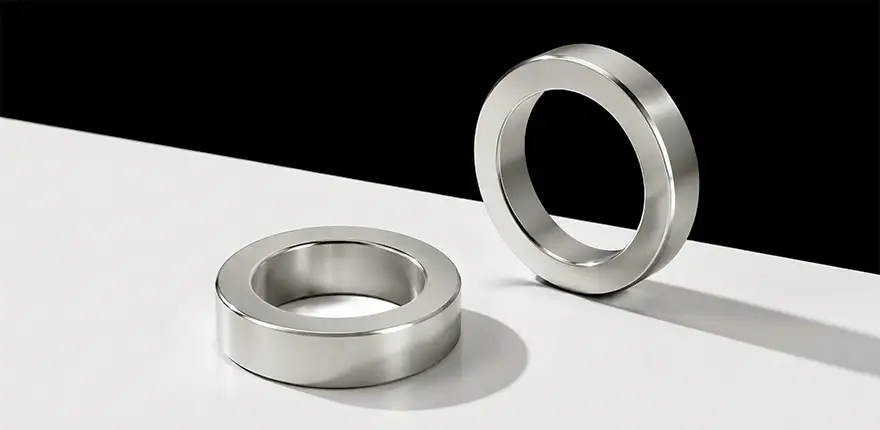
Multipole ring magnet is a ring-shaped permanent magnet that has been specially magnetized. And multiple N poles and S poles are arranged alternately around the circumference of the ring.
Due to the continuous change along the whole circumference of the magnetic field, multipole ring magnet can generate multiple cycles of magnetic field variation during rotation, so it especially suitable for the equipements that requires continuous position detection or precise motion control.
At present, multipole ring magnets are mainly manufactured using materials such as NdFeB, Ferritese Bonded neodymium. Different magnetic materials are suitable for varying performance requirements and operating environments.
Multi-Pole Ring Magnet vs Standard Ring Magnet
Although both if them are belong to ring magnets, there are obviously difference in their magnetic field structure and application scenarios.
| Comparison | Standard Ring Magnet | Multi Pole Ring Magnet |
|---|---|---|
| Magnetic Poles | One N pole and one S pole | Multiple alternating N/S poles |
| Magnetic Distribution | Simple magnetic field structure | Uniform magnetic field distribution around the circumference |
| Position Signal | Lower resolution | Higher resolution |
| Motor Control Performance | Suitable for simple magnetic circuits | Better for precision control systems |
| Aplicações típicas | Magnetic holding, magnetic coupling | Motors, encoders, automation equipment |
Compared with standard ring magnets, multi pole magnetic rings can generate multiple magnetic field cycles. This enables smoother operation and more accurate control.
Multipole Ring Magnets classified by magnetization direction
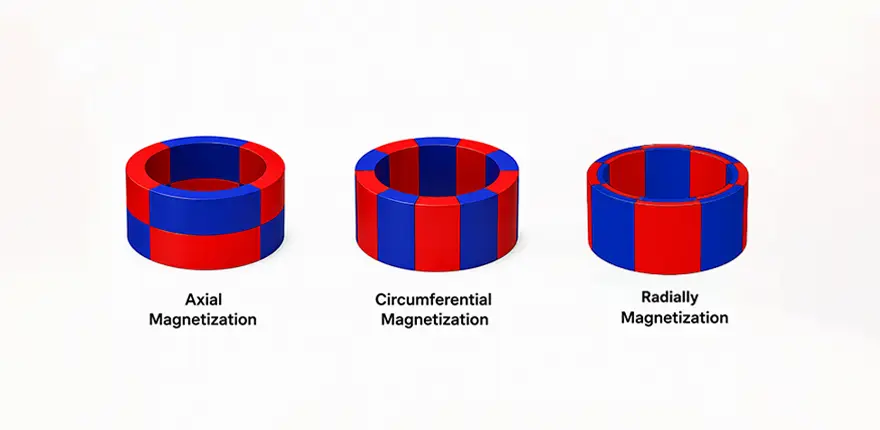
The output method of magnetic field was dicided by magnetization direction, it is also the improtant parameter should be ensured when customer designing magnetic circuit.
Radial Magnetization
Ímãs de anel radial are the most widely applied magnetization method nowadays. Magnet poles alternate distribute along the circumferential direction, and it is highly suitable for rotating equipment.
Typical applications include brushless Motores BLDC, Water pump motors, Automotive auxiliary motors, etc.
Due to its uniform magnetic field distribution, radial magnetization can meet the requirements of most motors for electronic commutation and stable magnetic performance.
Axial Magnetization
Em axially magnetized ring magnet, the magnetic poles are located on the two end faces of the ring.
This magnetization method is primarily used in applications requiring axial magnetic fields, such as Magnetic sensors, Magnetic holding devices, and Magnetic couplers.
Compared to radial magnetization, axial magnetization is more suitable for non-rotating magnetic circuits ou special structural designs.
Circumferential Magnetization
Circumferential magnetization refers to a magnetic structure, where multiple N/S poles are arranged along the circumference of the ring at specific angles.
This creates a periodic multi pole magnetic field distribution around the surface of the ring.
Applications of Multi Pole Magnet Rings
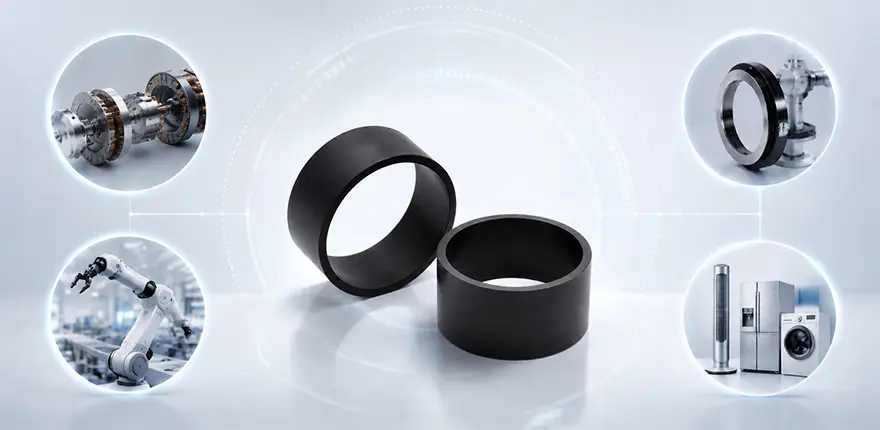
Because their uniform magnetic field distribution and excellent motion control capability, multi pole magnet rings are widely used in motors, sensors, and automation equipment.
Motor Applications:Motors are one of the main application areas for multi pole magnetic rings.Through alternating N/S pole arrangements, multipole ring magnets can provide accurate commutation and stable operation.
Typical applications include:BLDC motors, Servo motors, New energy vehicle drive motors, Water pump motors,ect.
Magnetic Encoders and Position Sensors:The multi pole encoder ring can generate continuous changing magnetic signals for rotation angle detection and position feedback.
It is commonly used in Magnetic encoders, Angle sensors, Robot joint feedback systems,ect.
Industrial Automation:In robots, actuators, conveyor systems, and various automation drive systems also widely use multi pole magnet rings to achieve accurate and stable motion control.
Home Appliances:Among home appliances, such as, Air conditioners, Refrigerators and Circulation fans,ferrite multi pole magnet ring are widely used, ensuring performance while also achieving cost advantages.
How to Select the Right Multi Pole Magnet Ring
Because their uniform magnetic field distribution and excellent motion control capability, multi pole magnet rings are widely used in motors, sensors, and automation equipment.
Material:Common materials include, NdFeB magnet, Ferrite magnets and Bonded magnets.The choice of different materials has a significant impact on performance and cost.
Size:Outer diameter, inner diameter, thickness, and dimensional accuracy must match the equipment structure.
The dimensional accuracy is especially important for motor assembly, rotation balance, and operating stability.
Number of Magnetic Poles:The number of poles is usually determined by the customer’s equipment or motor design.
Common pole numbers include 4 poles, 8 poles, 12 poles, 16 poles, 24 poles and 32 poles,ect
The pole number should be selected according to motor structure, detection accuracy, and control requirements.
Magnetization Method:The magnetization method should be selected according to the magnetic circuit design requirements.Common options include:Radial magnetization, Axial magnetization, Circumferential magnetization.
Operating Temperature: The magnet grade should be selected according to the operating temperature of the equipment.
Conclusão
With multiple alternating magnetic poles and uniform magnetic field distribution, multipole ring magnets have become essential magnetic components in modern motors and precision motion control systems.
In practical applications, parameters such as material, size, pole number, magnetization direction, and operating temperature must be considered together according to equipment requirements.
Choosing an experienced magnet manufacturer with strong customization capabilities can ensure product quality, consistency, and reliable technical support during product development.
Algumas perguntas frequentes
Does a Multi Pole Magnet Ring Require Dynamic Balancing?
For high-speed rotating applications, dynamic balancing should be considered.
Uneven weight distribution of the magnet ring may cause: Increased vibration, Higher noise levels and Reduced bearing lifetime.
Does the Number of Magnetic Poles Affect the Cost?
Yes.
Increasing the number of magnetic poles usually increases manufacturing complexity.
Therefore, the pole number should be selected according to actual requirements instead of simply increasing the number of poles.
What Factors Affect the Performance of Multi Pole Ring Magnets?
The main factors affecting multi pole ring magnet performance include: Magnet material, Number of magnetic poles, Magnetization method, Dimensional accuracy, Operating temperature, Surface treatment and Magnetic circuit design
What Should Be Considered During Transportation?
Because multi pole magnet rings are magnetic products, transportation requires attention to:
Magnetic shielding
Protective packaging
Safe transportation requirements
What Is the Difference Between a Multi Pole Ring Magnet and a Magnetic Encoder Disc?
Both multi pole ring magnet and magnetic encoder discs can be used for rotary position detection, but their applications are different.
A multi pole magnet ring usually uses a ring structure and can work as a motor rotor magnet or position detection component.
A magnetic encoder disc is more commonly used as an independent position detection component.
The final selection depends on equipment structure, installation method, and required detection accuracy.
Para obter mais informações, consulte estes blogs relacionados:
How to Identify the North and South Poles of Arc Magnets? A Complete Guide
Ferrite Magnet Grades Explained
Neodymium Magnets for Industrial Automation
Rare Earth Magnets vs Ferrite Magnets: Key Differences
Can Magnetized Magnets Be Machined? Risks and Solutions
Pronto para atualizar seu projeto? Navegue por nossa linha completa de produtos em TOPMAG!🧲

Dedico-me a escrever artigos científicos populares sobre ímãs. Meus artigos se concentram principalmente em seus princípios, aplicações e anedotas do setor. Nosso objetivo é fornecer aos leitores informações valiosas, ajudando todos a entender melhor o encanto e a importância dos ímãs. Ao mesmo tempo, estamos ansiosos para ouvir suas opiniões sobre as necessidades relacionadas aos ímãs. Fique à vontade para nos seguir e interagir conosco enquanto exploramos juntos as infinitas possibilidades dos ímãs!
Amazing! This website has the greatest deep anal porn!
The girls take it so deep and the quality
is perfect.
Finally found a place with real hardcore anal action. Ass stretching and messy
creampies.
Greatest anal Free Russian Porn collection I’ve come across.
The scenes are so brutal and the girls look sexy as hell.
These anal sex porn videos are next level. Hard and extremely hot.
Streaming works perfectly.
Unbelievable anal action! Tight asses getting railed in the filthiest way.
Strongly recommended! My go-to site!