
Ferrite Ring Magnets: Injection Molded vs. Sintered | TOPMAG
- Ethan
- Base de conhecimento
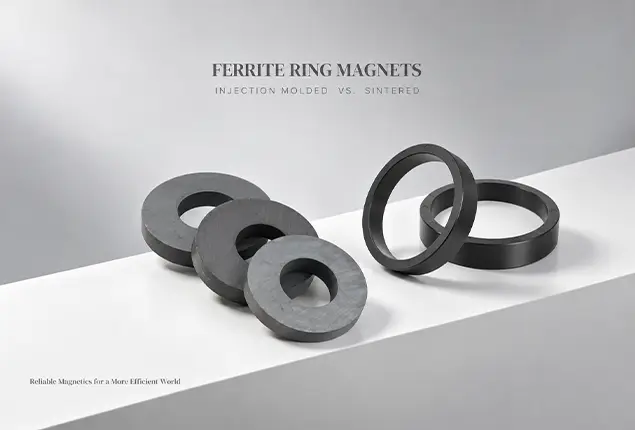
Injection molded ferrite ring magnets e sintered ferrite ring magnets are both commonly used permanent magnet components in motors. However, they have clear differences due to their different manufacturing processes and material structures. In comparison, injection molded ferrite ring magnets focus more on design flexibility and production efficiency, while sintered ferrite ring magnets usually offer higher magnetic performance and better high-temperature stability.
If you are deciding which type of ferrite ring magnet to use, the real question is not which one is “better,” but which one is more suitable for your motor design and production requirements.
Conteúdo
Principais conclusões
- Injection molded ferrite ring magnets offer greater design flexibility, better toughness, and higher production efficiency.
- Sintered ferrite ring magnets generally provide higher magnetic performance and better high-temperature stability.
- Injection molding is well suited to thin-wall, complex, and integrated ring magnet designs, while sintered ferrite is more suitable for established and regular structures.
- Para large-volume production, injection molded ring magnets can offer cost advantages by reducing secondary processing and spreading mold costs.
- The right choice depends on motor structure, magnetic performance, air gap, operating temperature, pole design, and production volume—not simply on which magnet has higher magnetic performance.
Injection Molded vs. Sintered Ferrite Ring Magnets

The most fundamental difference comes from their manufacturing processes.
- Injection molded ferrite ring magnets: Ferrite magnetic powder is mixed with thermoplastic resin, such as nylon or PPS, and then injected into a mold under high temperature and pressure to form an integrated ring magnet.
- Sintered ferrite ring magnets: Ferrite magnetic powder is first pressed into shape and then sintered at high temperature to form a ceramic magnet. Necessary grinding or machining can then be carried out according to the required dimensions and accuracy.
Why Does the Manufacturing Process Affect the Final Ring Magnet?
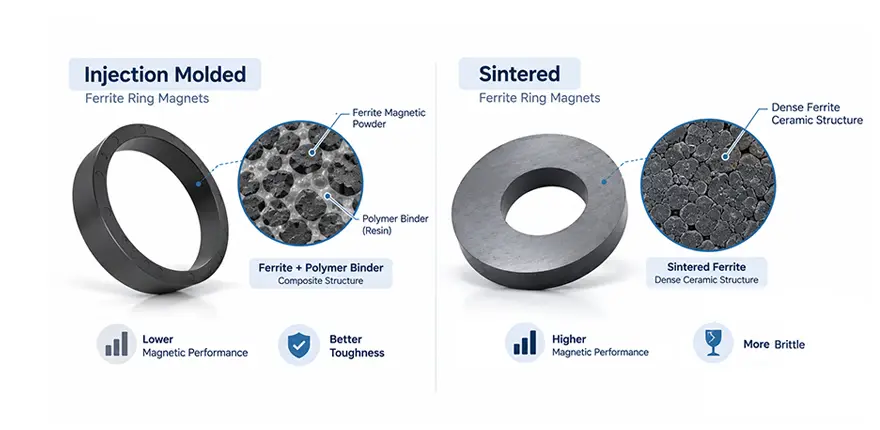
The manufacturing process determines the internal material composition and structure of the ring magnet, which directly affects its final performance.
- Injection molded ferrite ring magnets: They contain a certain amount of polymer binder, so the proportion of ferrite magnetic material per unit volume is limited, resulting in a relatively lower magnetic performance limit. However, the resin matrix also provides better toughness and structural flexibility.
- Sintered ferrite ring magnets: The ferrite magnetic powder is pressed into shape and then sintered at high temperature to form a ceramic structure, which usually provides higher magnetic performance. However, the ceramic structure itself is relatively brittle. For some large-size or special-structure ring magnets, segmented magnet designs may also be used.
Magnetic Performance: Which One Is Stronger?
Sintered ferrite ring magnets usually have an advantage in magnetic performance. Because injection molded ferrite ring magnets contain a polymer binder, the amount of ferrite material per unit volume is affected, so their magnetic performance is often lower than that of sintered ferrite ring magnets.
However, this does not mean that choosing sintered ferrite ring magnets will always result in a better motor. Actual motor performance is affected by multiple factors, such as the espaço de ar, rotor structure, stator designe magnet dimensions. When selecting ring magnets, the actual performance of the magnet within the complete motor should be considered.
How Do Shape, Size, and Structural Design Differ?
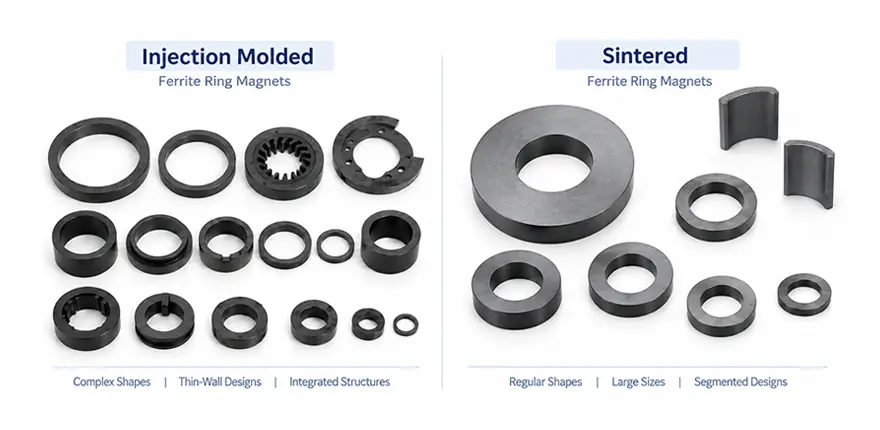
This is an important difference between injection molded ferrite ring magnets and sintered ferrite ring magnets.
Injection molded ferrite ring magnets: They are more suitable for complex structures. The injection molding process uses a mold to form the magnet, making it possible to produce thin-wall, flat, and other customized shapes. Insert molding can also be used to integrate the ring magnet with components such as a plastic rotor hub, reducing the number of assembly steps.
For some motor designs with limited space or a large number of components, injection molded ring magnets can be redesigned at the product structure level. However, the molding of very large-diameter ring magnets becomes more difficult and costly due to the limitations of injection molding machine capacity and mold size.
Sintered ferrite ring magnets: They are more suitable for established and regular magnet structures. Complex shapes and thin-wall structures are more difficult to produce with sintered ferrite ring magnets. However, for large-size ring magnets, especially when a segmented magnet design is used, there are relatively fewer limitations. This is also one reason why some large motors still use sintered ferrite ring magnets.
How Do Mechanical Performance and Temperature Resistance Differ?
Mechanical Performance
Because injection molded ferrite ring magnets contain a resin matrix, they generally have better mechanical toughness and stronger impact resistance. Sintered ferrite ring magnets are ceramic materials and are relatively brittle. They are more likely to develop cracks or edge chipping when exposed to external impact during transportation, assembly, or accidental drops.
Resistência à temperatura
The difference between the two becomes more noticeable in high-temperature environments. Sintered ferrite ring magnets do not contain a resin binder, so they generally have better high-temperature stability.
O resistência à temperatura of injection molded ferrite ring magnets is affected not only by the ferrite material itself, but also by the type of binder and the overall material system. In extreme high-temperature environments, the resin binder may experience performance degradation before the ferrite material itself. Therefore, when selecting ring magnets, it is important to verify whether the material’s temperature resistance matches the actual operating conditions.
How Do Production Efficiency and Cost Differ?
Injection molded ferrite ring magnets are close to their final dimensions after molding and require almost no secondary processing. They are more suitable for efficient, high-volume automated production.
After pressing and sintering, sintered ferrite ring magnets usually experience shrinkage and deformation. They often require secondary grinding or machining to achieve higher dimensional accuracy. This results in more processing steps and relatively lower production efficiency for high-volume production.
In terms of cost, for small batches or simple shapes, the initial cost of sintered ferrite can be lower when no mold is required. The cost advantage of injection molding usually becomes more noticeable when the production volume is large and the structure is more complex, because the mold cost can be spread across more products while some post-processing and assembly costs can also be reduced.
| Aplicativo | Aplicações típicas | Why Ferrite Magnets Are Suitable |
|---|---|---|
| Eletrodomésticos | Washing machines, fans, small appliances | Low unit cost is important, while high torque density is not critical |
| Automotive Auxiliary Motors | Wiper motors, power window and seat adjustment motors, air-conditioning blowers | High production volume and cost-driven design; extreme power density is not required |
| Motores industriais | Water pumps, conveyor drives | Durability and cost-effectiveness are prioritized over compact size |
Need Help Choosing the Right Ferrite Ring Magnet?
Injection molded ferrite ring magnets and sintered ferrite ring magnets each have their own advantages. The final choice depends not only on the magnet material, but also on the motor structure, air gap, magnetic performance requirements, operating temperature, number of magnetic poles, and production volume.
TOPMAG can evaluate the more suitable manufacturing solution based on your existing ring magnet, product drawings, or motor parameters.
Algumas perguntas frequentes
Which process provides better consistency for high-volume production, injection molding or sintering?
Both processes can achieve stable high-volume production. Injection molding has advantages in dimensional, structural, and batch-to-batch consistency, while sintering requires control of pressing, sintering shrinkage, and post-processing.
Can injection molded ferrite ring magnets be used in BLDC motors?
Yes. As long as the magnetic performance, dimensions, magnetization method, and operating temperature meet the motor requirements, injection molded ferrite ring magnets can be used in different BLDC motor designs.
Can injection molded ferrite ring magnets replace sintered ferrite ring magnets?
They can in some applications, but redesign and motor-level validation are required. Whether one ring magnet can replace another cannot be determined based only on the magnetic material parameters.
Can the number of magnetic poles be changed by re-magnetizing injection molded and sintered ferrite ring magnets?
Usually not. The number of magnetic poles is related to the ring magnet structure, magnetization method, and magnetizing fixture. Re-magnetization is normally used to restore the original pole configuration.
Are there differences in recycling between injection molded and sintered ferrite ring magnets?
There are some differences. Sintered ferrite ring magnets mainly consist of ceramic magnetic material, while injection molded ferrite ring magnets also contain a polymer binder. Therefore, their waste handling and material recycling methods are different. The specific recycling method depends on the material composition and local waste-handling requirements.
Para obter mais informações, consulte estes blogs relacionados:
Wet Press vs Dry Press Ferrite Magnets: Key Differences
Why Ferrite Magnets Are Still Used in Motors?
Rare Earth Magnets vs Ferrite Magnets: Key Differences
Injection Molded Ferrite Ring Magnets for Fan Motors | TOPMAG
Multipole Ring Magnet: Complete Guide
Pronto para atualizar seu projeto? Navegue por nossa linha completa de produtos em TOPMAG!🧲

Dedico-me a escrever artigos científicos populares sobre ímãs. Meus artigos se concentram principalmente em seus princípios, aplicações e anedotas do setor. Nosso objetivo é fornecer aos leitores informações valiosas, ajudando todos a entender melhor o encanto e a importância dos ímãs. Ao mesmo tempo, estamos ansiosos para ouvir suas opiniões sobre as necessidades relacionadas aos ímãs. Fique à vontade para nos seguir e interagir conosco enquanto exploramos juntos as infinitas possibilidades dos ímãs!
I like this