
 Ocean shipping is the most common mode of transport for bulk cargo, typically taking several months to reach its destination. This places extremely high demands on vessel safety. To prevent accidents, regular inspections of ships enable the early detection of potential failure risks.
Currently, automated inspection systems using climbing robots have made significant progress. Among them, magnetic wheels, a common wheel design for climbing robots equipped with powerful magnets, can easily adhere to metal surfaces, ensuring safe movement of the robot on the ship hull walls. By transmitting video information in real time, remote assessments can determine if there are safety hazards on the vessel. This technological advancement not only improves inspection efficiency but also significantly reduces the operational risks for workers in hazardous environments.
 Magnetic wheels are a critical component in the field of climbing robots, primarily used to achieve stable adhesion and movement on complex metal surfaces. Their core principle involves utilising the magnetic field generated by powerful magnets to create mutual attraction with the metal surface.
Magnetic wheels typically employ high-performance permanent magnet materials capable of generating intense magnetic fields, thereby producing powerful magnetic forces. Depending on the robot’s weight and surface inclination angle, the magnetic force can be adjusted to hundreds of newtons, sufficient to support the robot’s load under gravitational forces. During ship hull inspections, this magnetic force enables the robot to effortlessly withstand vibrations caused by waves or surface corrosion, ensuring continuous operation.
Companies like TOPMAG, professional manufacturers, have developed a series of magnetic wheel products optimised for non-destructive testing (NDT) equipment and crawlers, offering customizable magnetic strength levels and sizes. These systems are not only suitable for routine ship hull inspections but also widely extended to oil and gas pipelines, large metal storage tanks, and other industrial metal structures, helping to detect cracks, corrosion, and other potential failures early, significantly enhancing safety and maintenance efficiency.
 Magnetic wheels can be classified into various types based on the method of magnetic field generation and adaptability:
Permanent Magnetic Wheels: Utilise high-performance permanent magnetic materials like neodymium magnets to produce a constant magnetic field, providing high-intensity adhesion without external power. The magnetic force is stable and long-lasting but cannot be dynamically adjusted, making it suitable for low-power scenarios. The wheel body often employs a Halbach array design to further concentrate the magnetic field and improve adhesion efficiency.
Electromagnetic Wheels: Generate a controllable magnetic field through electromagnetic coils; the current intensity directly determines the adhesion strength. The advantage is a real-time adjustable magnetic force, but it requires a continuous power supply and has higher energy consumption. The wheel body integrates sensor feedback for precise control.
Electro-Permanent Magnetic Wheels: Combine the advantages of permanent and electromagnetic types, using electro-permanent magnets where the magnetic field switches instantly upon energisation, without needing continuous power. The adhesion is strong and controllable with fast response speed, offering the best balance in hybrid types.
Hybrid Excitation Wheels: Integrate permanent magnets, electromagnets, and other excitation methods through multi-layer magnetic circuit designs to achieve adaptive adjustment. They feature low friction and high efficiency, particularly suitable for complex terrains, and can automatically optimise magnetic force based on surface rust or inclination.
Adaptive Magnetic Wheels: Integrate sensors and AI algorithms to dynamically adjust magnetic force and wheel pressure based on environmental changes. They often use segmented magnetic surface designs to reduce friction and enhance obstacle-crossing capabilities.
 As a core component of climbing robots, the magnetic wheel features an intricate structural design where multiple key parts work synergistically to ensure stable adhesion and efficient movement on metal surfaces. The selection of these components depends not only on magnetic strength but also on weight, durability, and environmental adaptability. Magnetic wheels primarily consist of the following four parts: magnetic materials, wheel body materials, wheel shell protective materials, and wheel contact surface materials.
 Magnetic wheels are widely used in detection and maintenance scenarios requiring adhesion to ferromagnetic material surfaces, including:
- Pipeline inner wall inspection and repair.
- Ship surface inspections, particularly for identifying structural failures in hulls.
- Non-destructive testing of large steel bridges.
- Maintenance of oil and natural gas pipelines.
- Crawling operations on large metal storage tanks and other metal structures.
 Yes, during climbing operations, magnetic wheels are primarily responsible for adhesion, providing sufficient stability, while external power systems drive the wheel rotation to provide propulsion. The two work synergistically and are indispensable. Some advanced robots employ adaptive systems to reduce unnecessary friction resistance, thereby saving drive energy consumption.
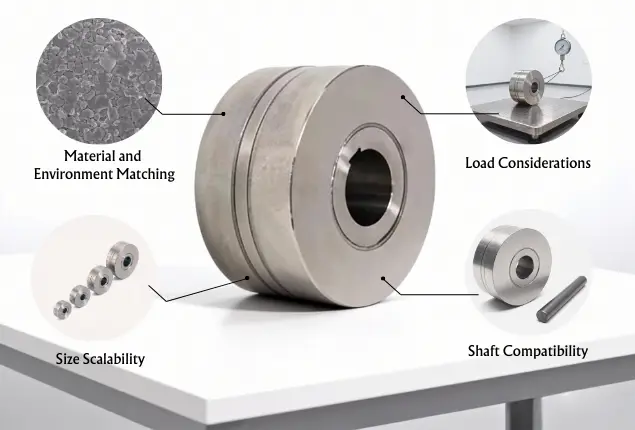 Please refer to the following guide for common size selection:
- Material and Environment Matching: For short-term exposure to corrosive environments, neodymium magnet materials are recommended. for harsh environments, subsea conditions, or high temperatures, samarium-cobalt is the ideal choice.
- Size Scalability: Magnetic wheel designs are scalable to various sizes and adjustable based on application needs.
- Load Considerations: When selecting sizes, assess adhesion requirements.
- Shaft Compatibility: Wheels can be equipped with bearings for non-ferrous shafts to ensure compatibility.
 TOPMAG is a professional provider of magnetic materials and solutions, relying on advanced modern production facilities and an experienced R&D team to offer customers one-stop magnetic technology solutions from concept to mass production. Our core product, magnetic wheels, is specially designed for climbing and wall-moving robots, enabling stable adhesion and flexible movement on various ferromagnetic surfaces.
We provide comprehensive customisation services. If you have specific requirements for magnetic wheels, please tell us about your application scenarios, load requirements, motion conditions, and other technical parameters, and we will arrange our team to provide you with matching magnetic wheel designs and supporting solutions.
