
Why Do Neodymium Magnets Need Edge Treatment?
- Ethan
- 지식 기반
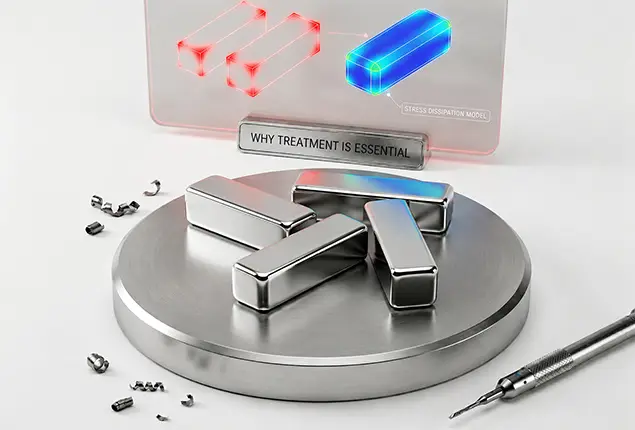
네오디뮴 자석 are hard and brittle materials. Sharp right-angle edges create stress concentration under mechanical load, making them highly susceptible to edge chipping, coating damage, and localized magnetic surface degradation.
Proper edge treatment significantly improves durability, enhances coating adhesion, increases operational safety, and extends product service life. Therefore, edge treatment has become an essential and standard process in modern NdFeB magnet manufacturing.
콘텐츠
주요 내용
- Neodymium magnet edge treatment improves mechanical reliability, not magnetic performance.
- Chamfer 그리고 radius edges reduce stress concentration, helping prevent edge chipping 그리고 cracking.
- Proper edge treatment improves coating adhesion and enhances long-term 내식성.
- Optimized edge geometry design improves handling safety and extends product service life.
- In most industrial applications, reliability benefits outweigh additional processing costs.
What Is Neodymium Magnet Edge Treatment?
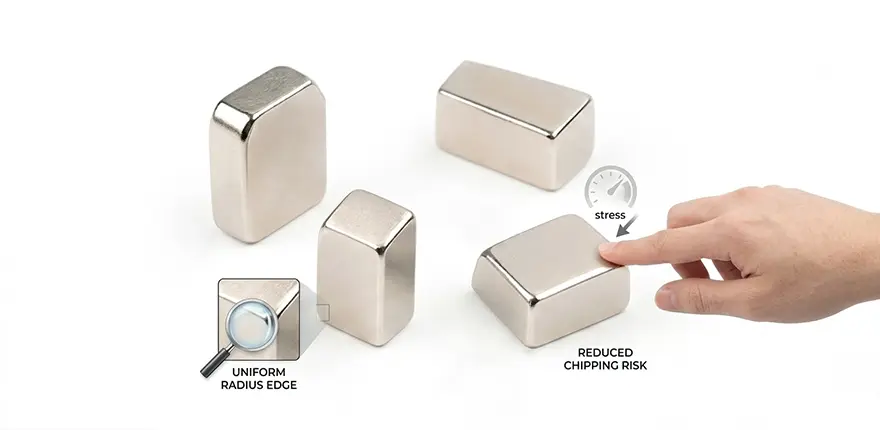
Neodymium magnet edge treatment refers to the process of refining or removing sharp edges after forming, slicing, and grinding.The purpose is not to improve magnetic performance, but to enhance mechanical reliability and long-term service stability.
Common Edge Treatment Types
| Status | Edge Shape | Characteristics |
|---|---|---|
| C-Chamfer | 45° beveled edge | Stress dispersion, uniform coating |
| R-Radius | Rounded transition | Optimal stress distribution, highest safety |
| Barrel Tumbling | Random rounded edges | Batch processing, smooth finish, low cost |
Benefits of Neodymium Magnet Edge Treatment
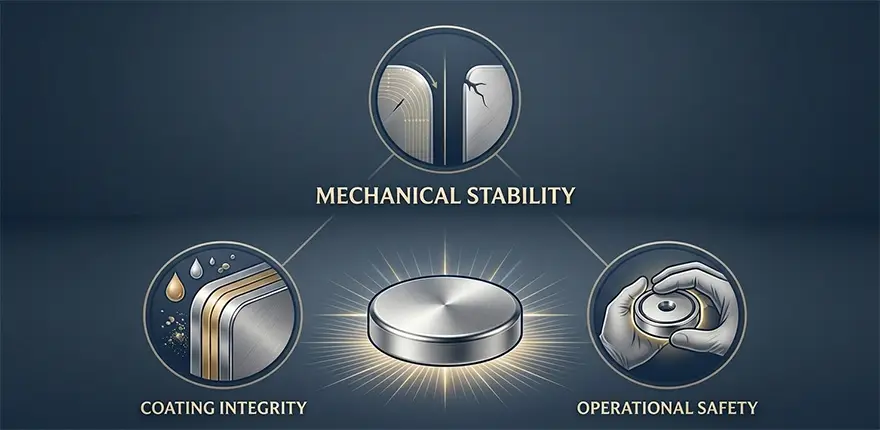
Prevent Edge Chipping and Cracking
In classical mechanics, sharp corners are typical stress concentration zones. Under impact or vibration, stress naturally accumulates at these edges.
Through chamfering or rounding, stress distribution is improved, significantly reducing the risk of edge damage.
Protect Coating Integrity
Neodymium magnets are highly susceptible to oxidation and corrosion. Therefore, coatings such as NiCuNi, epoxy resin, or other protective layers are applied to isolate the material from air and moisture.
없이 edge treatment, coating defects may occur during deposition:
- Uneven coating thickness
- Stress concentration at sharp edges
- Reduced coating adhesion
- Higher probability of microcracks
For NdFeB magnets, edges are not only mechanically vulnerable regions but also the primary initiation points for coating failure and corrosion.
Proper edge treatment improves coating integrity and long-term corrosion resistance.
Improve Operational Safety
After cutting and grinding, neodymium magnets often have sharp edges. These edges can easily cause injury during handling.
In high-strength magnets, accidental attraction between two magnets can result in:
- High-impact collisions
- Edge chipping and fragment generation
- Operator injury risks
- Damage to precision instruments
Edge treatment such as chamfering or rounding significantly improves handling safety, assembly safety, and operational reliability.
Impact of Edge Treatment on Performance and Cost

Edge treatment mainly affects reliability and surface quality, while its impact on magnetic performance is minimal. However, it does introduce changes in manufacturing cost and yield.
Impact on Magnetic Performance
From a 자속 밀도 perspective, the volume removed by edge treatment is very small, typically less than 1%–3% of total magnet volume.
Therefore:
- Flux density remains stable
- Magnetic field distribution is unaffected
- Performance impact is negligible
Edge treatment is considered an acceptable structural optimization.
Impact on Manufacturing Cost
Edge treatment adds additional machining or tumbling steps, increasing unit cost slightly:
- Additional chamfering or tumbling processes
- Increased machine processing time
- Higher inspection requirements
However, from a system-level perspective, it:
- Reduces edge chipping defect rate
- Reduces coating failures
- Reduces transportation damage
- Improves assembly yield
Therefore, in mass production, edge treatment is generally a cost-reducing process rather than a cost-increasing one.
How to Choose Edge Treatment Methods
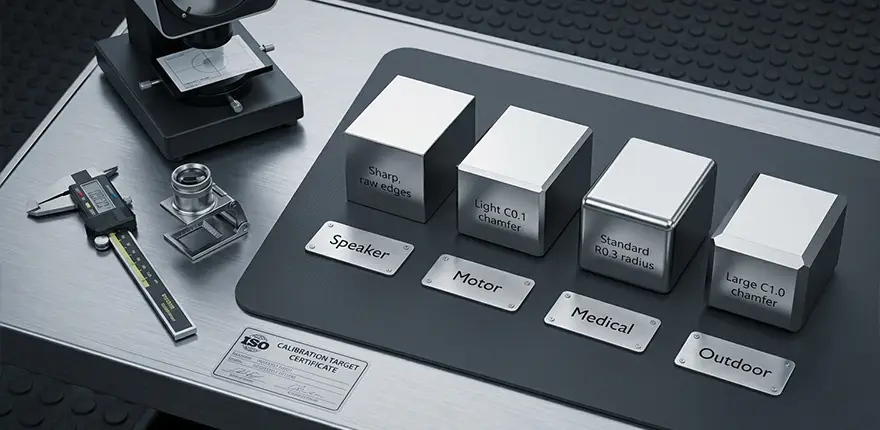
Edge treatment selection varies significantly by 애플리케이션 and cannot follow a universal standard.
Key Selection Factors:
- Magnet size
- Surface coating type
- Assembly method
- Working environment
- Reliability requirements
만약 magnet is small, used in a simple environment, and exposed to low mechanical stress, basic deburring or light chamfering is sufficient.However, for large magnets, high-speed assembly, or harsh environments, standard chamfering or full radius design is required.
Proper edge geometry selection ensures maximum system reliability at minimal processing cost without affecting magnetic performance.
Edge Treatment Recommendations by Application
| 애플리케이션 | Recommended Process | Recommended Parameters | Not Recommended |
|---|---|---|---|
| Brushless Motor Magnet Tiles | R or C Edge | R0.3 / C0.3 | No treatment |
| Miniature Speakers | C-Chamfer | C0.1–C0.2 | Barrel tumbling |
| Medical Anastomosis Rings | R-Radius | R0.2, Ra ≤ 0.4 | C-Chamfer |
| 자석 후크 | Barrel Tumbling | 20–40 minutes | No treatment |
| Outdoor Equipment | R-Radius + Thick Coating | R0.3, coating ≥ 15 μm | No treatment |
Does Edge Treatment Affect Design Limits?
In engineering design, chamfer size must be controlled to avoid reducing effective magnetic area.
Typical ranges include:
- Standard chamfer: C0.2–C0.5
- Maximum chamfer: ≤ C1.0 (special cases)
- Excessive chamfer reduces effective flux area
Edge geometry must balance reliability and magnetic efficiency, depending on magnet size and application. High-precision systems may require tighter tolerances.
결론
Neodymium magnet edge treatment is a critical process for improving product reliability. Its value lies in structural safety, coating stability, and long-term service life.
In modern magnet manufacturing, edge treatment is an essential process, especially in high-reliability applications where it is almost indispensable.
몇 가지 자주 묻는 질문
Do all neodymium magnets require edge treatment?
Not necessarily. If the magnet is fully encapsulated in plastic, rubber, or a housing (such as injection-molded magnets), the requirement is lower. However, exposed magnets are strongly recommended to undergo edge treatment.
Why is R-radius preferred for high-performance magnets?
High-performance magnets generate stronger magnetic forces, resulting in higher impact during attraction. R-radius distributes impact forces more evenly, reducing peak stress at edges and lowering fracture risk.
Which is better, R-radius or C-chamfer?
There is no absolute superiority:
- C-chamfer: lower cost, suitable for standard applications
- R-radius: more uniform stress distribution, suitable for high-reliability applications
Which is more important, edge treatment or coating?
They are complementary. Edge treatment is the foundation for proper coating adhesion. Without proper edge geometry, even high-quality coatings may fail starting from edge regions.
Does edge treatment apply to all magnetic materials?
Yes. It applies not only to NdFeB magnets but also to ferrite and SmCo magnets. However, parameters vary depending on material brittleness and application requirements.
더 자세한 내용은 관련 블로그에서 확인하세요:
What is Passivation for NdFeB Magnets?
How Segmented Magnets Reduce Eddy Current Loss
Arc Magnet vs Block Magnet: Key Differences in Motor Applications
2026 Magnet Report: Rare Earths & Supply Chain Truths
프로젝트를 업그레이드할 준비가 되셨나요? TOPMAG에서 전체 제품군을 살펴보세요!🧲

저는 자석에 관한 대중 과학 글을 쓰고 있습니다. 제 기사는 주로 자석의 원리, 응용 분야, 업계 일화에 초점을 맞추고 있습니다. 제 목표는 독자들에게 유용한 정보를 제공하여 모든 사람이 자석의 매력과 중요성을 더 잘 이해할 수 있도록 돕는 것입니다. 동시에 자석과 관련된 여러분의 의견을 듣고 싶습니다. 자석의 무한한 가능성을 함께 탐구하는 동안 자유롭게 팔로우하고 참여해 주세요!