How Segmented Magnets Reduce Eddy Current Loss
Magnet segmentation is one of the most effective solutions to suppress eddy current loss in high-speed permanent magnet motors. As modern motors continue trending toward higher rotating speeds and higher operating frequencies, eddy current loss has become a critical bottleneck restricting motor efficiency, thermal stability, and service life.
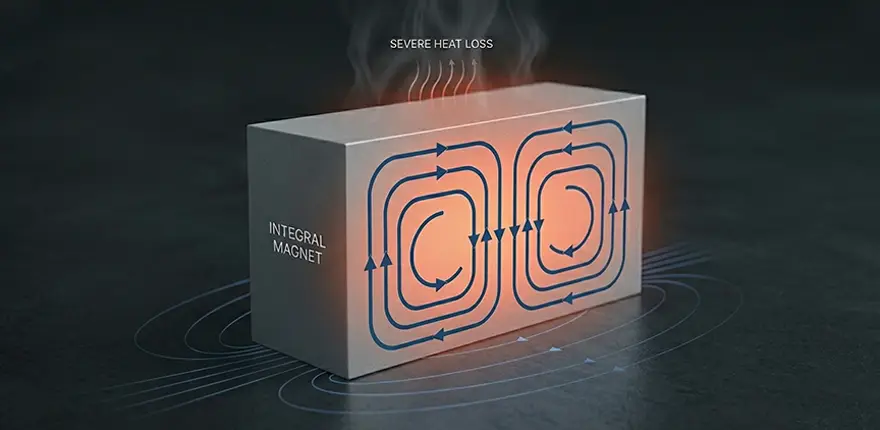
Conventional integral magnets feature a simple structure but suffer from severe internal circulating currents under high-frequency alternating magnetic fields. These closed-loop eddy currents generate excessive heat, cause irreversible demagnetization, and reduce overall motor performance. For high-performance motor applications, segmented magnet design has become a standard and necessary optimization strategy.
콘텐츠
주요 내용
- Segmented magnets reduce eddy current loss by breaking conductive current loops.
- Smaller segment size significantly lowers heat generation and demagnetization risk.
- High-speed motors benefit most because eddy loss rises rapidly with frequency.
- Circumferential, axial, and laminated designs suit different performance requirements.
- Laminated magnets are preferred for ultra-high-speed, high-power-density motors.
Why Do Integral Magnets Generate Severe Eddy Current Loss?

Eddy current loss is a typical electromagnetic energy loss caused by alternating magnetic flux. When a permanent magnet operates in a periodically changing or high-speed varying magnetic field, alternating magnetic flux penetrates the magnet body. According to Faraday’s law of electromagnetic induction, closed circulating eddy currents form inside conductive magnet materials such as 네오디뮴 iron boron (NdFeB).
NdFeB magnets, the most widely used high-performance rare-earth magnets, have obvious 전기 전도성. The internal eddy currents convert electromagnetic energy into thermal energy, leading to two major operational problems:
- Energy waste and reduced efficiency: Excessive eddy current loss lowers the motor’s energy conversion efficiency and increases continuous operating power consumption.
- Thermal demagnetization and shortened lifespan: Accumulated heat rapidly raises magnet temperature. The coercivity of NdFeB decreases by approximately 0.55–0.65% per 1°C temperature rise. Once the temperature exceeds the material threshold, irreversible demagnetization occurs, continuously degrading motor performance and shortening equipment service life.
Integral solid magnets have large, continuous cross-sectional areas, providing low-resistance closed current loops. This results in strong induced eddy currents and significantly higher energy loss under high-frequency operating conditions.
How Segmented Magnets Reduce Eddy Current Loss
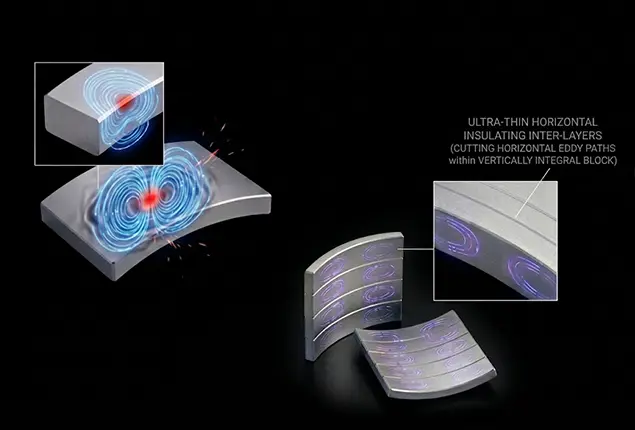
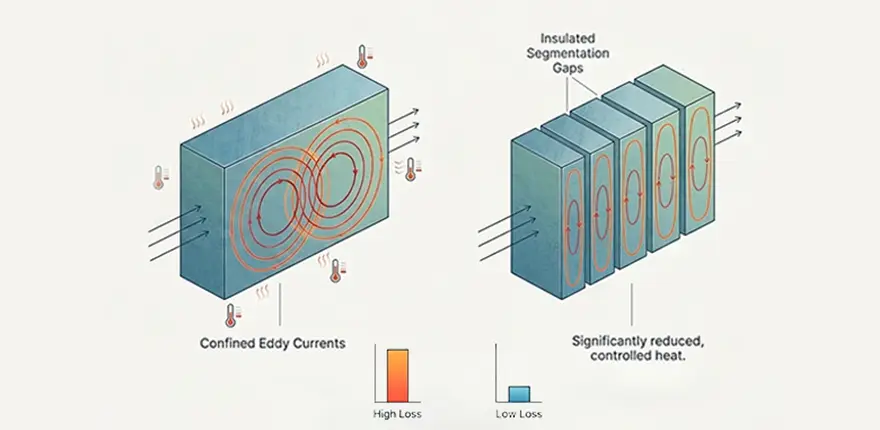
Segmented magnet technology solves the inherent eddy current problem of integral magnets through structural optimization. A single whole magnet is divided into multiple independent small magnet segments, isolated by insulating gaps or high-temperature insulating adhesive layers. This structure fundamentally breaks continuous conductive paths and suppresss eddy current generation and propagation.
The loss-reduction mechanism can be explained through four core engineering principles:
Shorten eddy current path size
Eddy current loss follows a squared proportional relationship with the magnet’s characteristic dimension, described by the classic engineering formula:
Pe∝B²f²w²
어디 B = 자속 밀도, f = electrical frequency related to motor speed및 w = eddy current characteristic path width.
Reducing the segment width dramatically lowers eddy loss. When the characteristic size is halved, eddy current loss drops to roughly one-quarter of the original value, proving that even limited segmentation delivers significant loss reduction.
Increase circuit resistance
Insulating gaps and adhesive layers between segmented magnets greatly increase overall internal resistance. The discontinuous structure blocks large-scale circulating current loops, making stable eddy current formation extremely difficult inside the rotor magnet.
Reduce total heat generation and eliminate hotspots
By minimizing the eddy path dimension w, segmentation directly reduces total eddy loss and lowers overall operating temperature. Meanwhile, concentrated hotspots at magnet edges are dispersed, effectively reducing peak temperature and eliminating high-temperature demagnetization risks.
Improve high-speed operational stability
High rotating speeds sharply increase magnetic field alternating frequency and amplify eddy loss in integral magnets. Segmented structures suppress high-frequency eddy accumulation, maintaining stable torque output, lower operating temperature, and stronger anti-demagnetization capability under extreme high-speed working conditions.
Common Segmented Magnet Structure Types
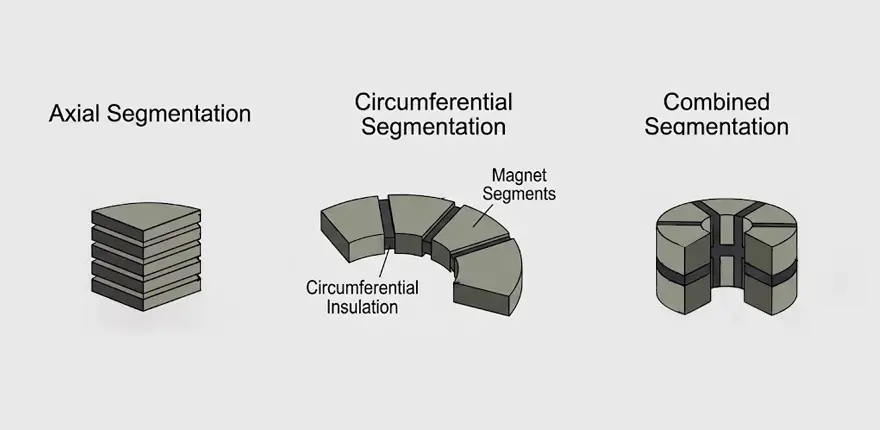
Magnet segmentation designs are mainly classified into three categories according to different cutting directions, each tailored for specific motor working conditions:
Circumferential Segmentation
As the most widely adopted structure, circumferential segmentation cuts one arc magnet into 2 to 4 segments along the rotor rotating direction. It effectively breaks large circumferential eddy loops and optimizes magnetic field uniformity. Balancing excellent performance and moderate manufacturing cost, circumferential segmentation dominates mass-produced new energy vehicle drive motors.
Axial Segmentation
Axial segmentation slices magnets along the rotor axial direction and isolates each layer with insulation. It targets axial eddy current paths and greatly reduces heat accumulation. This design delivers outstanding cooling performance and is highly suitable for ultra-high-speed motors and high-frequency loss-intensive scenarios.
Combined Segmentation
Combined segmentation applies both circumferential and axial cutting to form a 3D insulated structure. It blocks eddy current paths in all directions and achieves maximum loss suppression under extreme working conditions. It is widely used in high-end electric vehicle drive systems and high-power eVTOL motors that require ultra-high power density and thermal stability.
Eddy Loss Reduction Data by Segmentation Quantity
The loss reduction effect follows the law of diminishing marginal returns. As segment numbers increase, eddy current loss continuously decreases, while the improvement gradient gradually converges. The below table shows typical engineering performance benchmarks:
| Segments per Pole | Relative Eddy Current Loss (Integral = 100%) | Engineering Performance Features |
|---|---|---|
| 1 (Integral Magnet) | 100% | Maximum eddy loop, highest heat and loss |
| 2 Segments | 30%-40% | Most significant performance improvement stage |
| 4 Segments | 10%–25% | Entering high-efficiency optimal range |
| 6 Segments | 5%–15% | Ideal for high-frequency high-speed motors |
| 8+ Segments | <10% (Stable) | Marginal benefit decreases obviously |
Note: The data is for engineering reference. Actual performance varies according to motor structure, rotating speed, winding design, and inverter switching frequency.
Segmented Magnets vs Laminated Magnets

Segmentation and lamination are essentially the same eddy-suppression principle applied at different dimensional scales.
Segmented magnets divide whole magnets into several large insulated pieces and are delivered as individual segments. Motor assemblers position and fix each piece during rotor assembly. This method allows flexible production with standard arc magnet blanks and suits medium-loss conventional high-speed motors.
Laminated magnets slice magnets into ultra-thin sheets (approximately 0.5 mm per layer) bonded with ultra-thin insulating adhesive (<20 μm). Suppliers finish lamination and insulation in advance and deliver them as a single integrated component. Laminated magnets eliminate assembly alignment errors but carry higher material and processing costs.
Engineering selection rule: If more than 6 segments per pole are required for loss control, laminated magnets become more 비용 효율적. For motors equipped with SiC inverters and rotating speed over 14,000 RPM, laminated magnet design is the mainstream optimal solution.
Core Application Fields of Segmented Magnets
Segmented magnet technology is primarily applied to high-speed, high-frequency, and high-efficiency motor scenarios with strict thermal and stability requirements:
- New Energy Vehicle Drive Motors: Most passenger car motors run at 8,000–15,000 RPM, adopting 2–4 circumferential segments with SH or EH grade NdFeB magnets. This configuration balances low eddy loss and anti-demagnetization performance, stabilizing power output and improving vehicle endurance.
- Wind Turbine Generators: Direct-drive PMSG turbines consume 500–1000 kg magnets per megawatt with long-term continuous operation. Offshore wind turbines commonly adopt axial segmentation plus high-corrosion-resistance coatings to ensure high efficiency and salt spray durability.
- Industrial Servo Motors: Frequent variable-speed operation generates rich harmonic interference. Segmented structures suppress harmonic eddy loss, guaranteeing consistent torque output and high-precision positioning accuracy for automated equipment.
- Aerospace & eVTOL High-Speed Motors: These motors feature ultra-high power density and rotating speed over 15,000 RPM. Combined segmentation or laminated magnet structures are widely used, with extreme working conditions adopting Samarium-Cobalt magnets for superior high-temperature stability.
결론
Magnet segmentation has evolved from a simple loss-reduction method to a fundamental structural design for high-performance permanent magnet motors. From basic circumferential segmentation to advanced axial segmentation, combined segmentation, and lamination, magnet optimization technology continuously improves motor thermal stability and energy efficiency.
With the widespread adoption of SiC inverters 그리고 high-speed motor platforms, the combination of segmented magnet structures, low-loss magnetic materials, high-grade insulation, and electromagnetic optimization will become increasingly essential. Future motor design will focus on balancing low eddy loss, high mechanical strength, controlled manufacturing cost, and simplified assembly for next-generation high-efficiency electric drive systems.
몇 가지 자주 묻는 질문
Does magnet segmentation weaken magnetic force and performance?
Proper segmented design barely affects effective magnetic flux. Non-magnetic insulation adhesive accounts for less than 1% of total magnet volume, causing less than 0.5% remanence fluctuation.
On the contrary, segmentation eliminates performance degradation caused by thermal demagnetization, delivering far better long-term magnetic stability than integral magnets.
What happens if the insulation layer between segmented magnets fails?
Failed insulation reconnects discrete magnet segments into a conductive whole, rebuilding large-scale eddy current loops. This leads to severe local overheating, reduced motor efficiency, and even irreversible magnet demagnetization or rotor thermal runaway.
Industrial-grade insulation adhesive must withstand −40°C to +150°C thermal cycles with a minimum shear strength of 50 MPa for full-lifecycle reliability.
Segmented magnet vs laminated magnet, which is more common in mass-production EV motors?
Circumferential segmented magnets dominate mainstream mass-produced vehicle motors due to mature craftsmanship and balanced cost performance. Laminated or combined segmented structures are reserved for high-speed, high-power-density premium electric drive platforms due to higher manufacturing costs and complexity.
What is stepped skew pole? How is it different from regular segmentation?
A stepped skew pole is an upgraded segmented design that arranges magnet segments in a staggered oblique angle. Compared with ordinary segmentation that only reduces eddy loss, stepped skewing further suppresses cogging torque and torque ripple, lowering electromagnetic vibration and noise for smoother motor operation.
How to judge whether a motor has excessive eddy current loss?
The most intuitive feature is abnormal magnet temperature rise under high-speed and light-load conditions. If the rotor magnet temperature rises much faster than the stator and coolant temperature, rotor eddy current loss is the primary cause. Thermal imaging inspection after motor disassembly and finite element loss simulation can further verify the exact eddy loss level.
더 자세한 내용은 관련 블로그에서 확인하세요:
Arc Magnet vs Block Magnet: Key Differences in Motor Applications
Why do Permanent Magnet Motors Demagnetize?
Injection Molded Magnets – All You Need to Know
2026 Magnet Report: Rare Earths & Supply Chain Truths Prices
프로젝트를 업그레이드할 준비가 되셨나요? TOPMAG에서 전체 제품군을 살펴보세요!🧲

Ethan Huang
저는 자석에 관한 대중 과학 글을 쓰고 있습니다. 제 기사는 주로 자석의 원리, 응용 분야, 업계 일화에 초점을 맞추고 있습니다. 제 목표는 독자들에게 유용한 정보를 제공하여 모든 사람이 자석의 매력과 중요성을 더 잘 이해할 수 있도록 돕는 것입니다. 동시에 자석과 관련된 여러분의 의견을 듣고 싶습니다. 자석의 무한한 가능성을 함께 탐구하는 동안 자유롭게 팔로우하고 참여해 주세요!
엘리트 뉴스레터: 최고 수준의 콘텐츠 독점 제공