
Arc Magnet vs Block Magnet: Key Differences in Motor Applications
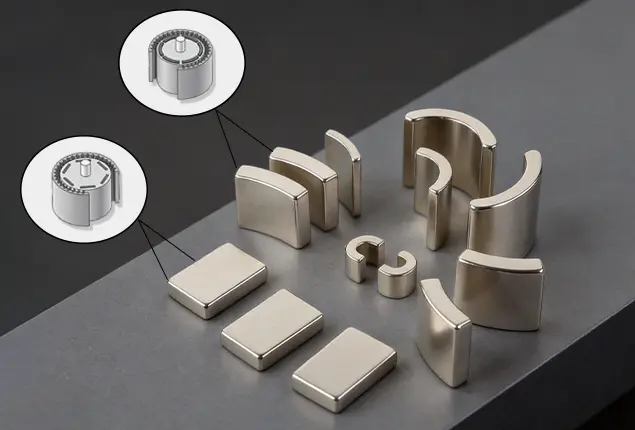
In permanent magnet motor design, magnet shape directly affects motor efficiency, torque performance and manufacturing cost. 아크 자석 그리고 block magnets are the two most widely used magnet types for motors. They can be manufactured from identical magnetic materials. However, differences in air gap, magnetic field distribution and structural compatibility will lead to obvious distinctions in actual operating performance.
Understanding their differences is essential for proper magnet selection. This article illustrates their core features and helps you make accurate choices according to your practical working conditions.
콘텐츠
주요 내용
- Core difference between arc magnets 그리고 block magnets is geometry, which determines their magnetic field traits and motor compatibility.
- 아크 자석 have a smooth magnetic field, ideal for high-performance rotating motors (SPM motors, servo motors) to boost efficiency.
- 블록 자석 are cost-effective and versatile, suitable for IPM motors, linear motors, and low-cost small motors.
- Selection of arc magnets vs block magnets depends on motor structure, performance needs, and budget—no universal superiority.
- Hybrid magnetic circuits combine arc magnet 그리고 block magnet advantages for high-performance motor applications.
Core Differences Between Arc Magnets and Block Magnets
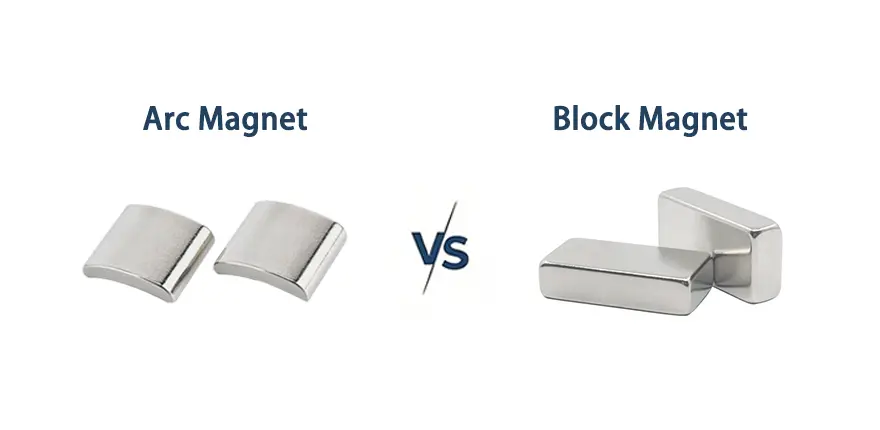
The biggest differences come down to geometry. This single factor creates big gaps in appearance, magnetic field behavior및 use cases.
| 기능 | Arc Magnet | Block Magnet |
|---|---|---|
| Shape | Curved segment (part of ring) | Rectangular / cubic |
| Magnetic Field Fit | Matches motor air gap | Less natural fit |
| 자화 | Mostly radial | Mostly axial (through thickness) |
| Magnetic Field Quality | Smooth, continuous | More discrete / angular |
| Manufacturing Complexity | 높음 | 낮음 |
| 비용 | 더 높음 | Lower |
| Typical Use | SPM motors, outer rotor | IPM, linear, small motors |
Outline & Structural Features
- Arc Magnet: Also called a segment or tile magnet, it’s a slice of a full circular ring. We define it by its inner arc, outer arc, chord length, and thickness. You can combine several arc magnets to make a full circular magnetic ring.
- Block Magnet: A regular cube or rectangular magnet, measured by length × width × thickness. It has a standard shape, making it easy to use in mass production.
Magnetization & Magnetic Circuit Traits
- Arc Magnet: Most arc magnets use 방사형 자화. This lines up magnetic poles around the circumference, matching the motor’s air gap perfectly. It creates a smooth, continuous magnetic field. Special designs can also use parallel magnetization to improve the magnetic field waveform.
- Block Magnet: Most block magnets magnetize through their thickness. Magnetic flux passes straight through the two pole faces, creating a linear magnetic field. This works well for embedded magnetic circuits and modular assembly.
Manufacturing Process & Cost
- Arc Magnet: Arc magnets need tight precision on their curve during sintering and after-processing. Different motors need different pole arc parameters. This means higher mold costs, more complex machining, and a higher chance of defects. That’s why arc magnets usually cost more per piece.
- Block Magnet: Block magnets have a simpler production process. You can slice and grind them from large magnetic blanks to get the final shape. They use material efficiently and cost less to make. This makes them perfect for large-scale, standardized production.
Why Do Motors Prefer Arc Magnets?
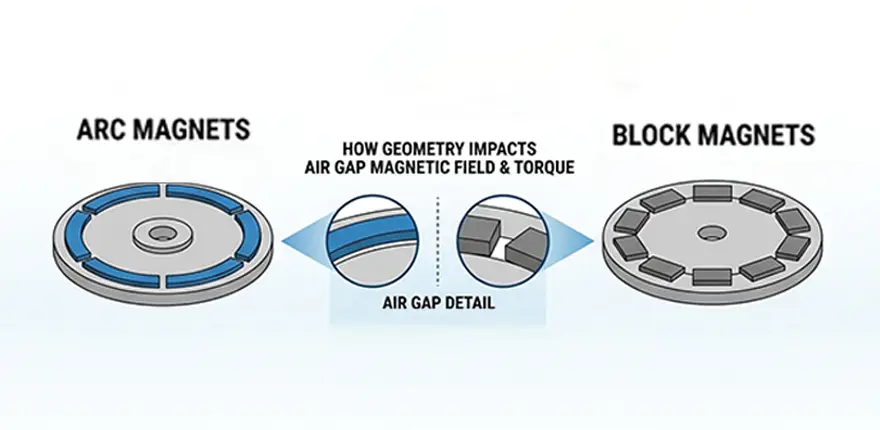
More Ideal Air Gap and Magnetic Field Waveform
The ideal air gap magnetic field in a permanent magnet motor is as close to a sine wave as possible. A smooth sine wave magnetic field keeps energy conversion stable, cuts down on unwanted harmonics, and boosts overall efficiency.
Arc magnets sit flush with the rotor’s surface. They create a continuous magnetic field around the circumference. This reduces sudden magnetic field changes and edge flux leakage.
In comparison, the right-angle shape of block magnets leads to uneven magnetic flux transition between magnetic poles. This distorts the air-gap flux density waveform and raises higher-order harmonic components.
Lower Torque Ripple
A smooth, uniform air gap magnetic field creates steady torque output. It also reduces torque ripple and cogging torque. Arc magnets make the motor run smoother and more accurately. They also clearly reduce vibration and noise.
This benefit is especially important for new energy vehicle drive motors, high-precision servo motors, and high-speed brushless motors. These applications need smooth, stable operation and precise control.
Higher Space Utilization
Arc magnets sit tight against the rotor. They cover more area with magnet and deliver more effective flux in the same space. To get the same magnetic coverage, block magnets need more room or more complex structural fixes. This makes the whole motor bigger, heavier, and harder to build.
So arc magnets work best in applications where size, weight, and power density matter most.
Are Arc Magnets Always Better Than Block Magnets?
No. Arc magnets only outperform block magnets in specific use cases.
Arc magnets are highly customized parts made only for cylindrical rotating structures. Their strengths become weaknesses when you use them in the wrong situation:
- Higher total cost: They need tight control over inner/outer diameter and central angle. This leads to long mold lead times. In small orders, they can cost several times more than standard block magnets.
- Poor versatility: Each arc magnet is made for a specific motor model. You can’t reuse them easily, so inventory costs are higher.
- Limited installation options: They only work at their best in cylindrical structures. On flat or linear equipment, they don’t perform better — but they still cost more.
- More fragile: The curved shape makes NdFeB arc magnets more likely to crack along the curve. They’re easier to damage when you handle or install them.
At the end of the day, arc magnets and block magnets each have their own strengths. They solve different engineering problems in their own fields.
Real-World Motor Applications for Arc & Block Magnets
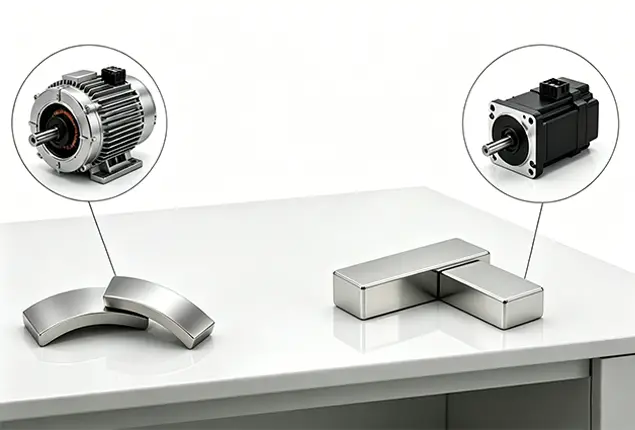
Where Arc Magnets Are Used
- Hub motors: In electric two-wheelers, EVs, and high-efficiency outer rotor drives, to boost flux use and running stability.
- Home appliance motors: In fans, pumps, and inverter compressors, for quiet, efficient operation.
- High-speed motors: In aerospace, medical tools, and precision manufacturing machines, to keep magnetic fields stable at high speeds.
- Outer rotor motors: In HVAC fans and power tools, to make the air gap magnetic field more uniform.
- Servo & industrial motors: In robots and CNC machines, to reduce cogging torque and improve control precision.
Where Block Magnets Are Used
- IPM (Interior Permanent Magnet) Motors: The main choice for new energy vehicles and industrial drives, to build high power density designs.
- Stepper motors: In automation equipment and 3D printers, for accurate step-by-step control.
- Linear motors: In semiconductor tools and precision motion platforms, for high-precision linear movement.
- Small & micro motors: In toy motors, mini fans, and phone vibration motors, where low cost and easy assembly are key.
- Auxiliary motors: In braking, damping, and low-load actuators, to meet basic drive needs.
A Simple Guide to Choosing the Right Magnet
When designing a motor, you need to balance the motor structure, performance goals, and cost. Ask these three questions to make a quick decision:
What’s your motor structure?
For SPM (Surface Permanent Magnet) motors, arc magnets fit cylindrical rotors perfectly. They’re usually the best choice.For IPM embedded permanent magnet motors and linear motors, standard block magnets are easier to embed and assemble.
What’s your motor structure?
If you care most about high efficiency, low vibration, and uniform magnetic fields (like in high-speed motors or high-precision servo systems), choose arc magnets.If you care more about keeping costs low, simplifying the design, or scaling up production, block magnets or segmented magnetic steel designs are more affordable.
What are your budget and production volume requirements?
Standard block magnets use material efficiently. They work great for large-batch, cost-sensitive projects.Arc magnets cost more upfront for molds. But in high-volume production of high-performance motors, their long-term efficiency and performance benefits usually make up for the extra cost.
Hybrid Magnetic Circuits: Combining Arc & Block Magnets
As motor performance needs keep rising, using just one magnet shape often makes it hard to balance efficiency, cost, and ease of production. So engineers now use several optimized hybrid magnetic circuit designs. These balance performance and cost by using segmented magnets and better magnetic circuit layouts.
Here are the most common solutions:
- Segmented arc-style magnets: Flat on the bottom, curved on top. You combine square or trapezoidal magnets to make a shape close to an arc. This improves the air gap magnetic field continuity while cutting costs. It’s the most common solution for mid-to-high-end motors.
- Halbach Array: Magnets with different magnetization directions arranged at specific angles. This strengthens the magnetic field on the air gap side and weakens it on the back side. The result is higher air gap magnetic density and power density.This advanced magnetic circuit optimization works mainly in aerospace and high-performance direct-drive motors. It’s too complex for most mass-produced civilian products.
- Pole shoe-assisted design: Add pole shoes outside the magnets. These guide and shape the magnetic flux paths. This improves the air gap magnetic field distribution at low cost. It’s often used to improve performance and lower costs in large and medium-sized industrial motors.
The point of these hybrid designs is to take the best parts of both magnet types. You improve the air gap magnetic field continuity while keeping costs low and assembly flexible. This has become a key trend in high-performance motor design.
결론
The essential difference between arc magnets and block magnets lies not in intrinsic magnetic performance, but in how their geometric structures adapt to motor magnetic circuits.
In motor design, arc magnets excel at forming smooth and continuous air-gap magnetic fields for high-performance operation. Block magnets are better suited for designs with limited space or strict cost control. They serve different engineering purposes, and neither is universally superior.
When one magnet shape cannot balance performance and cost, a hybrid magnetic circuit design is a practical solution.
No matter which solution you choose, understanding the magnetic circuit logic behind each shape is key. It helps you balance performance, cost, and operational reliability.
몇 가지 자주 묻는 질문
Which has stronger magnetic force, arc magnet or block magnet?
Same material has equal magnetism. Strength depends on grade and magnetization. Arc magnets offer higher effective flux utilization with uniform air-gap magnetic field.
What is pole arc coefficient of arc magnet and how to select it?
Ratio of magnet central angle to total pole angle, range 0.6-0.85. Higher value means bigger flux yet stronger cogging effect. Confirm optimal value with motor design parameters.
Why are block magnets widely used in IPM motors?
IPM magnets are embedded in rotor slots with limited shape space. Block magnets are easier to install, and ideal magnetic field is realized via magnetic circuit design.
Are arc magnets always suitable for high-speed motors?
No. High-speed motors focus on stability and mechanical strength. Segmented magnets are often used to avoid centrifugal stress instead of full arc magnets.
Does magnet shape affect motor service life?
Yes. It influences torque ripple, vibration, heat dissipation and bearing load, further affecting motor reliability and service life.
더 자세한 내용은 관련 블로그에서 확인하세요:
Why do Permanent Magnet Motors Demagnetize?
2026 Magnet Report: Rare Earths & Supply Chain Truths
프로젝트를 업그레이드할 준비가 되셨나요? TOPMAG에서 전체 제품군을 살펴보세요!🧲

저는 자석에 관한 대중 과학 글을 쓰고 있습니다. 제 기사는 주로 자석의 원리, 응용 분야, 업계 일화에 초점을 맞추고 있습니다. 제 목표는 독자들에게 유용한 정보를 제공하여 모든 사람이 자석의 매력과 중요성을 더 잘 이해할 수 있도록 돕는 것입니다. 동시에 자석과 관련된 여러분의 의견을 듣고 싶습니다. 자석의 무한한 가능성을 함께 탐구하는 동안 자유롭게 팔로우하고 참여해 주세요!