
Why do Permanent Magnet Motors Demagnetize?
- Ethan
- 지식 기반
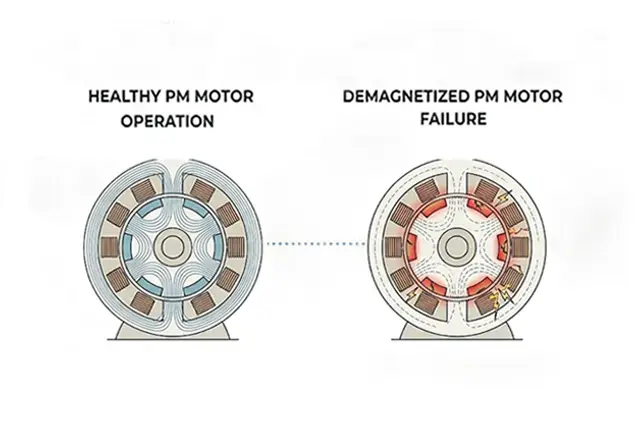
콘텐츠
주요 내용
- Focus on preventing irreversible demagnetization of permanent magnet motors; conduct back EMF sampling quarterly.
- Five core causes of demagnetization: high temperature, reverse magnetic field, overload/start-stop, mechanical impact, design & manufacturing defects.
- Select magnetic steel matching working conditions.
- Judge demagnetization by symptoms and back EMF/gaussmeter testing.
- Prevention keys: reserve 20% load margin, control temperature, standardize parameters, thicken magnetic steel.
What is Demagnetization?
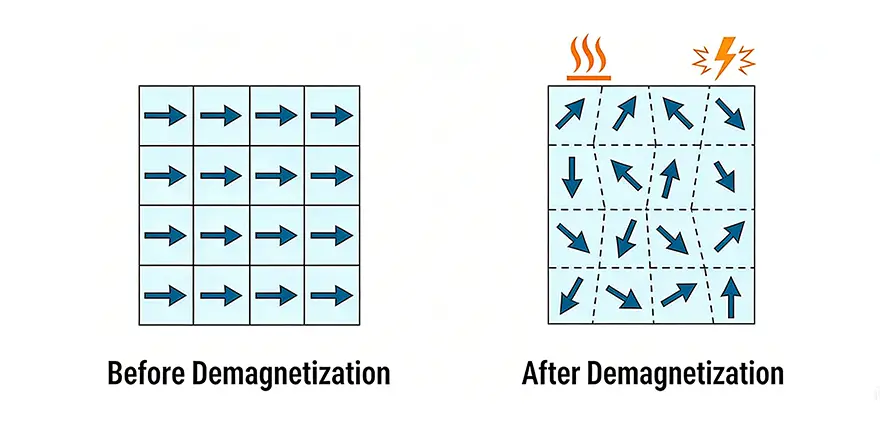
- Reversible Demagnetization:As the name suggests, the magnet can recover on its own. Once the external problem is removed (like when temperature returns to normal), the flux density goes back to normal. No permanent damage occurs.
- Irreversible Demagnetization:This is true failure. Once the magnetic domains stay permanently disordered, magnetism cannot come back even after the problem is fixed. You need to remagnetize the magnet, or more often, replace the whole motor.
Core Causes of Demagnetization
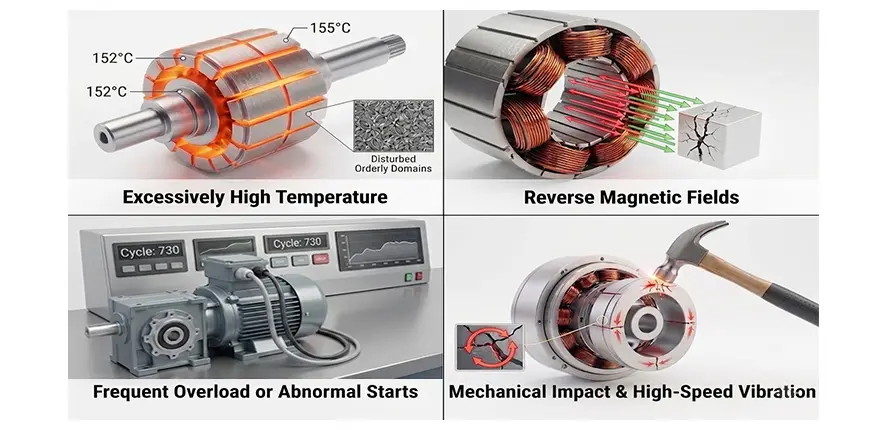
Excessively High Temperature
Reverse Magnetic Fields
Frequent Overload or Abnormal Starts
Mechanical Impact and Vibration
Design and Manufacturing Defects
Magnet Grade Temperature Reference Table
| Material Series | Grade Examples | 최대 작동 온도 | Curie Temperature | Application Scenarios |
|---|---|---|---|---|
| NdFeB — N Series | N35, N42, N52 | 60~80°C | ~310°C | Room temperature equipment, consumer electronics |
| NdFeB — M Series | 35M, 42M | 100°C | ~340°C | General industrial motors |
| NdFeB — H Series | 35H, 42H | 120°C | ~340°C | Variable frequency air compressors, servo motors |
| NdFeB — SH Series | 30SH, 35SH | 150°C | ~350°C | High-temperature industrial equipment |
| NdFeB — UH/EH Series | 28UH, 28EH | 180~200°C | ~350°C | New energy vehicles, aviation |
| SmCo — Samarium Cobalt | SmCo5, Sm2Co17 | 250~350°C | ~750°C | High temperature, military industry, aerospace |
| 페라이트 | Y30, Y35 | 250°C+ | ~450°C | Low-cost general occasions |
Selection Advice: For industrial VFD air compressors, use H series as a minimum (120°C). For continuous full-load or high-ambient conditions, upgrade to SH series.
How to Diagnose a Demagnetized Motor
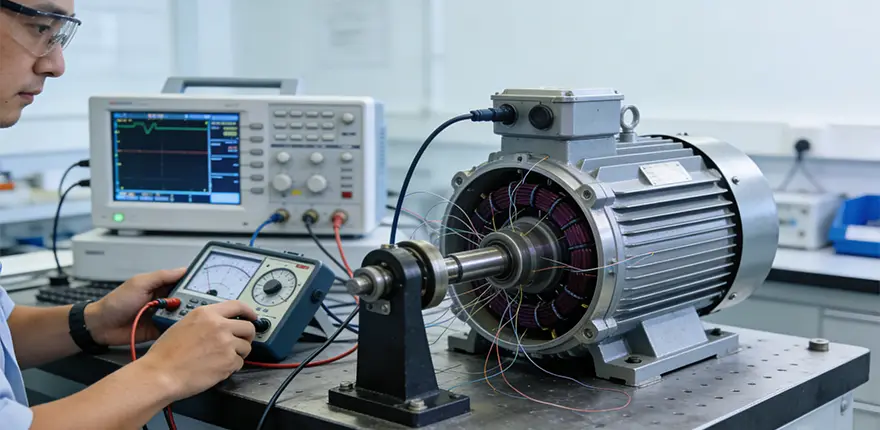
Typical Symptoms
- Current runs 10%~30% higher than rated during normal operation.
- Energy use per unit output rises sharply, and 효율성 drops.
- The frequency converter has overload alarms more often.
- Torque fluctuation increases, along with abnormal vibration and noise.
Back EMF Detection Method
- Disconnect: Completely decouple the motor from the load (air end).
- Run: Use the inverter to run the motor at its rated speed (no-load).
- Measure: Record the output line voltage.
- Standard: If the measured voltage is ≥ 50V lower than the Back EMF value on the nameplate, the motor is demagnetized.
Direct Measurement via Gaussmeter/Tesla Meter: This method is intended for scheduled maintenance involving disassembly. By sampling magnetic flux density across the rotor surface, demagnetization is confirmed if there is an overall drop of >15% or a localized deviation of >20%.
Preventive Measures Against Demagnetization

Correct Sizing and Selection
- Motor power margin: If you choose a motor with too little margin, it will run in overload when fully loaded. Long-term heat buildup makes demagnetization inevitable. In practice, pick a motor with ~20% margin above your expected load — do not size based on ideal conditions.
- Magnet temperature rating: Choose based on the real environment, not just the cheapest option. If the machine room is hot year-round or the equipment runs continuously, low-temperature-rated magnets will fail early.
Strict Temperature Control
- Current limit parameters: Setting these too high heats the magnets and adds extra demagnetizing stress. Engineers familiar with these motors should set parameters — do not change factory defaults casually.
- Flux-weakening control: For speeds above the rated value, poorly set d-axis current parameters can create strong demagnetizing force. Be extra careful when tuning these parameters.
- Starting method: Use soft starting whenever possible. Reduce the number of start-stop cycles to lower cumulative damage from starting impacts.
Increasing Magnet Thickness During Design
결론
- Build safety margins during selection.
- Control temperature during operation.
몇 가지 자주 묻는 질문
Can a demagnetized motor be re-magnetized?
Theoretically yes, but the labor of disassembly and the inconsistency of results usually make it more expensive than simply replacing the motor or rotor.
How long does demagnetization take to show up?
In extreme overheat scenarios, it can happen in hours. In gradual cases, it usually takes 6 months to 2 years to progress from a slight current increase to frequent system failures.
Which magnet grade is best for air compressors?
35SH, 38SH, or 40SH are the industry standards due to their balance of magnetic strength and thermal stability. For heavy-duty models, UH grades provide even higher safety margins.
How long does it take for demagnetization to become apparent?
It depends on the severity:
Extreme Cases: Under severe overheating, demagnetization can occur within a few hours.
Progressive Demagnetization: This typically takes months or even 1 to 2 years to evolve from a “slight increase in current” to “frequent inverter overload alarms.” This inherent stealthiness is precisely why demagnetization is so often overlooked. Therefore, it is highly recommended to perform a Back EMF spot check every quarter.
What is the appropriate increase for magnet thickness?
For standard PM motors, increasing the magnet thickness by 10% to 20% is ideal. This enhancement improves anti-demagnetization capability and output torque without causing air-gap imbalances or magnetic saturation overload.
For high-load or high-temperature applications, an increase of 20% to 25% is suggested; however, this must be coupled with a redesign of the stator-rotor air gap for proper matching.
더 자세한 내용은 관련 블로그에서 확인하세요:
Injection Molded Magnets – All You Need to Know
2026 Magnet Report: Rare Earths & Supply Chain Truths Prices
프로젝트를 업그레이드할 준비가 되셨나요? TOPMAG에서 전체 제품군을 살펴보세요!🧲

저는 자석에 관한 대중 과학 글을 쓰고 있습니다. 제 기사는 주로 자석의 원리, 응용 분야, 업계 일화에 초점을 맞추고 있습니다. 제 목표는 독자들에게 유용한 정보를 제공하여 모든 사람이 자석의 매력과 중요성을 더 잘 이해할 수 있도록 돕는 것입니다. 동시에 자석과 관련된 여러분의 의견을 듣고 싶습니다. 자석의 무한한 가능성을 함께 탐구하는 동안 자유롭게 팔로우하고 참여해 주세요!