
Magnetic Yoke vs. Keeper vs. Magnetic Shielding
- イーサン
- 知識ベース
で 永久磁石 design, magnetic circuit optimization, and magnetic field protection, three terms often appear: magnetic yoke, keeperそして magnetic shielding. All three relate to controlling magnetic flux or magnetic fields, but their design purposes, working principles, and applications are different. This article explains their differences and when to use each one.
内容
要点
Magnetic Yoke: Guides magnetic flux, improves magnetic circuit efficiency, and helps reduce unwanted leakage.
Keeper: Closes the magnetic circuit during storage or handling and may help reduce demagnetization risk.
Magnetic Shielding: Redirects magnetic flux to protect sensitive equipment from unwanted magnetic fields.
Material Selection Matters: Permeability, saturation, and operating conditions determine performance.
Choose by Function: The right solution depends on the magnetic circuit, protection requirements, and application—not every magnet needs all three.
Magnetic Yoke: A Path for Magnetic Flux
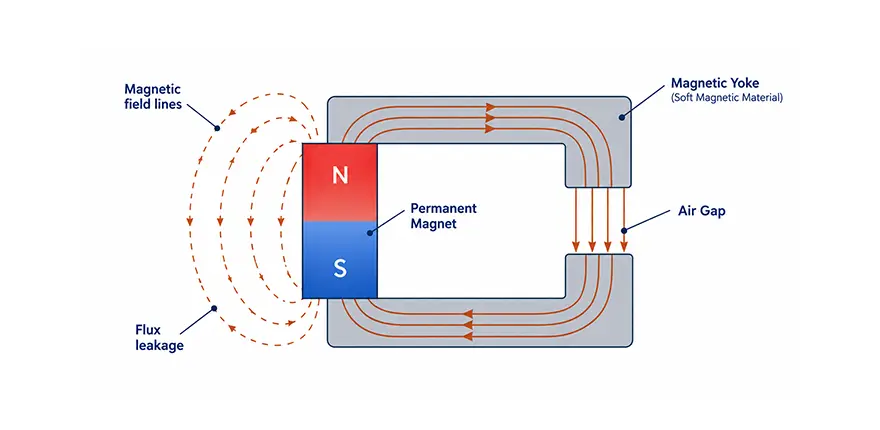
A magnetic yoke is a soft magnetic component in a magnetic circuit. It guides, concentrates, and transfers magnetic flux along a designed path toward the working area. It is not an independent accessory but part of the product’s magnetic circuit structure. Magnetic yokes are commonly found in speakers, motors, and sensors.
How Does a Magnetic Yoke Work?
軟磁性材料 have much higher permeability than air, so magnetic flux tends to pass through them more easily. When a magnetic yoke is connected to the poles of a magnet, it guides the flux toward the required area. Its main functions include:
Flux concentration: Concentrates magnetic flux in the air gap or working surface to increase magnetic field strength and attraction force in the working area.
Flux guidance: Provides a low-reluctance path and reduces unwanted magnetic leakage.
Field shaping: Controls the direction and distribution of the magnetic field through its geometry.
A magnetic yoke must have a sufficient cross-sectional area to avoid local magnetic saturation. When the yoke approaches saturation, its incremental permeability decreases. This may prevent the magnetic field in the working area from reaching the target level and increase the risk of magnetic leakage.
Common Magnetic Yoke Materials and Applications
Common materials include:
Low-carbon steel: Low cost, easy to machine, and high saturation flux density. It is one of the most widely used materials.
Electrical pure iron: Offers relatively high permeability and low coercivity. It is suitable for applications where residual magnetism is a concern.
Silicon steel: Used in alternating magnetic fields to reduce eddy current losses.
Iron-cobalt alloys and other high-saturation materials: Used in space-limited designs that require higher magnetic flux density.
Keeper: A Closed Magnetic Circuit for Storage
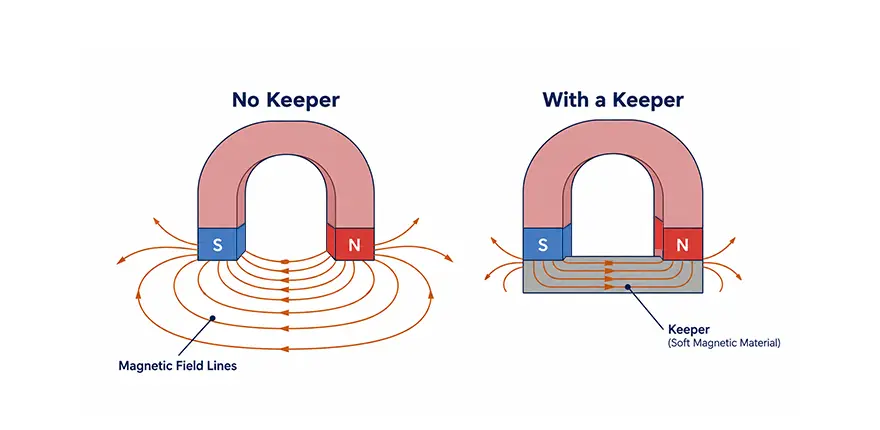
A keeper is a piece of soft magnetic material placed across the poles of a permanent magnet. It allows magnetic flux to travel from one pole to the other, forming a closed magnetic circuit. Keepers are commonly found on horseshoe magnets and in some Alnico magnet applications.
A keeper is often used to close the magnetic circuit during magnet storage and handling. In many applications, it is removed before the magnet enters normal operation.
How Does a Keeper Work?
When a magnet operates in an open-circuit condition, it experiences a relatively large self-demagnetizing field and may produce significant external magnetic leakage. Adding a keeper can:
Provide a low-reluctance path for magnetic flux and help close the magnetic circuit.
Reduce demagnetization risk and external magnetic leakage in suitable magnet structures.
Do NdFeB, SmCo, and Ferrite Magnets Need a Keeper?
The answer depends on the specific magnet grade and application.
| マグネットタイプ | Keeper Requirement | Main Reason |
|---|---|---|
| アルニコ | May be required in some cases | Lower coercivity makes it more susceptible to demagnetizing fields. |
| ネオジム(NdFeB) | Usually not required | Higher resistance to demagnetization, but temperature and external magnetic fields must still be considered. |
| サマリウムコバルト(SmCo) | Usually not required | Good resistance to demagnetization, although the specific grade and operating conditions still matter. |
| フェライト | Depends on the application | Requirements depend on magnet properties, magnetic circuit design, and operating environment. |
Magnetic Shielding: Protecting Other Components from Magnetic Fields
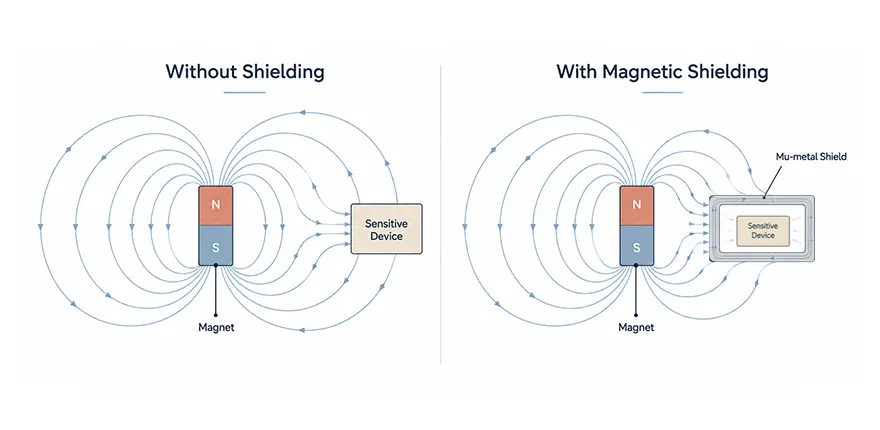
Magnetic shielding uses high-permeability materials to surround an area and reduce the magnetic field within it. It protects sensitive equipment or areas outside the magnet itself.
How Does Magnetic Shielding Work?
Magnetic shielding does not simply block a magnetic field. Instead, it provides a path that magnetic flux can follow more easily than air, allowing the flux to flow around the protected space through the shielding material.
Think of it like water encountering a channel with lower flow resistance: the water follows the easier path.
Common Magnetic Shielding Materials
Permalloy: Has very high initial permeability and is suitable for shielding weak magnetic fields and protecting highly sensitive equipment. Its saturation flux density is relatively low, so it can saturate under strong magnetic fields.
Electrical pure iron and low-carbon steel: Offer high saturation flux density and relatively low cost. They can be useful near stronger magnetic fields, although their permeability may be lower than that of Permalloy.
Silicon steel: Can offer a balance between magnetic performance and cost in certain applications.
Amorphous and nanocrystalline ribbons: Thin and flexible materials suitable for localized shielding where space is limited.
Multilayer composites: Different materials with complementary magnetic properties can be combined to improve shielding performance under specific operating conditions.
When Is Magnetic Shielding Needed?
Magnetic shielding may be required in the following situations:
Hall sensors, magnetoresistive sensors, encoders, and other magnetic-sensitive components are located near permanent magnets.
Precision instruments, microscopes, and medical equipment require a low-magnetic-field environment.
Air or sea transportation of magnetic products requires external magnetic fields to remain within applicable regulatory limits.
Multiple magnetic circuits within the same device interfere with each other.
How to Choose the Right Magnetic Solution
The most suitable solution depends on what the magnetic system needs to achieve.
Choose a magnetic yoke when magnetic flux needs to be guided.
Choose a keeper when the magnetic circuit needs to be closed during storage or handling.
Choose magnetic shielding when a sensitive area needs protection from magnetic fields.
Before selecting materials or determining dimensions, define the magnetic field to be shielded, the frequency range, the protected area, and the required level of magnetic field attenuation.
For demanding applications, magnetic field simulation and actual measurements may be needed to verify the design performance.
結論
Magnetic yokes, keepers, and magnetic shielding serve different but related functions in permanent magnet systems. However, not every permanent magnet application requires additional components. A magnetic yoke may be essential to meeting magnetic circuit performance requirements, while the use of a keeper or magnetic shielding should be evaluated based on operating conditions, storage requirements, or magnetic interference risks.
について custom permanent magnets そして 磁気アセンブリ, evaluating the complete magnetic circuit early in the design process helps optimize magnetic performance, control unwanted magnetic leakage, and avoid unnecessary structural complexity and manufacturing costs.
よくある質問
Can a Magnetic Yoke Reduce Magnetic Leakage?
A properly designed magnetic yoke can guide magnetic flux along the intended path and may reduce unwanted magnetic leakage.
Can the Same Magnetic Component Function as Both a Yoke and a Keeper?
Yes. A component may form part of the working magnetic circuit during operation and also provide a return path between the poles when the assembly is idle.
What Is the Difference Between a Magnetic Yoke and a Keeper if Both Are Made of Iron?
They may use the same material, but their roles are different. A magnetic yoke is part of the product’s magnetic circuit and guides flux during operation. A keeper is generally used temporarily during storage or transportation and is removed before normal operation.
Can a Keeper Increase Magnetic Force?
No. A keeper does not increase the intrinsic magnetic properties of a magnet. In suitable magnetic circuit designs, it can help close the magnetic circuit and reduce the risk of demagnetization.
What Should Be Considered When Transporting Strong Magnets?
External magnetic fields and packaging requirements must be evaluated according to the applicable transportation regulations. Magnetic shielding packaging and magnetic field measurements may be necessary. A keeper cannot replace a transportation compliance assessment.
さらに詳しい洞察については、以下の関連ブログをご覧いただきたい:
Ferrite Ring Magnets: Injection Molded vs. Sintered | TOPMAG
Why Ferrite Magnets Are Still Used in Motors?
Wet Press vs Dry Press Ferrite Magnets: Key Differences
Injection Molded Ferrite Ring Magnets for Fan Motors | TOPMAG
Injection Molded NdFeB Magnets Complete Guide
プロジェクトをアップグレードする準備はできていますか?TOPMAGの全製品をご覧ください!🧲。

私は磁石に関するポピュラー・サイエンスの執筆に専念している。私の記事は主に、磁石の原理、応用、業界の逸話に焦点を当てています。読者の皆様に価値ある情報を提供し、磁石の魅力や意義をより深く理解していただくことが目標です。同時に、磁石にまつわる皆さんのご意見もお待ちしています。磁石の無限の可能性を一緒に探っていきましょう!