
How Does Air Gap Affect Permanent Magnet Motor Performance?
- イーサン
- 知識ベース
で 永久磁石 motors, the エアギャップ is one of the most sensitive design parameters. The air gap affects magnetic coupling between the stator and rotor. It can also influence output torque, back EMF, losses, and operating stability.
For motor manufacturers and magnet buyers, it is important to determine the correct air gap. The permanent magnet specifications and manufacturing tolerances must also match the motor design.
内容
要点
Air gap affects motor torque, back EMF, efficiency, and operating stability.
A larger air gap usually reduces magnetic flux density and torque capability.
Copper losses and magnet eddy current losses can affect motor efficiency and temperature.
Magnet thickness, shape, magnetization direction, and retaining structures influence the air gap magnetic field.
An uneven air gap can increase unbalanced magnetic pull, vibration, and noise.
What Is an Air Gap in an Electric Motor?
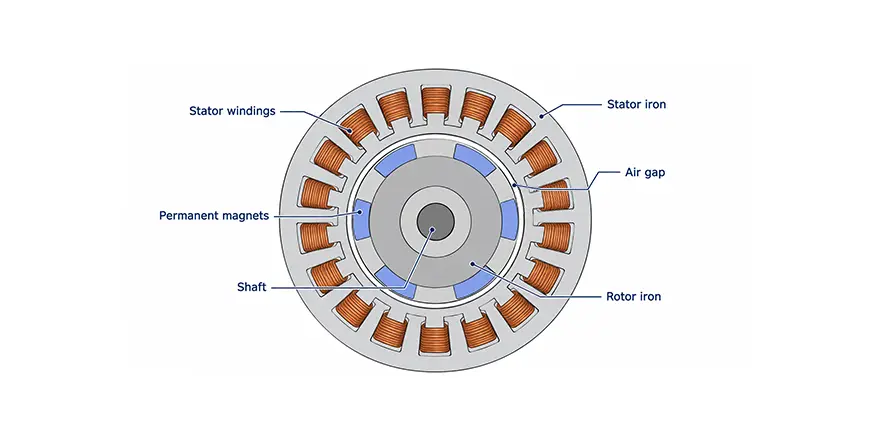
In a typical radial flux permanent magnet motor, the エアギャップ is the radial clearance between the inner surface of the stator and the outer side of the rotor. In a surface-mounted permanent magnet motor, the エアギャップ is usually located between the outer surface of the rotor magnets and the inner surface of the stator.
The designed air gap may differ from the actual air gap during operation. Bearing clearance, rotor eccentricity, manufacturing tolerances, and deformation caused by temperature changes can all affect the actual air gap and its uniformity.
How Does Air Gap Affect Motor Performance?
について エアギャップ affects the magnetic reluctance of the magnetic circuit and the distribution of the air gap magnetic field. These changes influence the electromagnetic performance of a permanent magnet motor. The main effects include the following.
Air Gap and Output Torque
When other design conditions remain largely unchanged, a larger air gap usually reduces air gap flux density. This weakens the motor’s torque capability.
If the motor needs to maintain the same output torque, it may require higher current. This can increase winding copper losses.
Air Gap, Efficiency, and Losses
A larger air gap may require more current to produce the same output torque. As a result, winding copper losses increase, and motor efficiency typically decreases.
In addition, air gap harmonics in high-speed motors can induce eddy current losses in the magnets. These losses can cause magnet temperature to rise. This is one reason why segmented magnets are commonly used in high-speed rotors.
Air Gap, Back EMF, and Operating Stability
Changes in the air gap affect the air gap magnetic field. This, in turn, influences the motor’s back electromotive force (back EMF) and voltage requirements.
An uneven air gap can also cause an asymmetric magnetic field distribution. This may increase unbalanced magnetic pull, leading to vibration and noise.
For rotors that use multiple arc magnets, magnet dimensional consistency, installation position, and rotor concentricity all affect air gap uniformity.
Air Gap and High-Temperature Demagnetization
The air gap and magnet thickness affect the magnet’s operating point. However, demagnetization risk also depends on the magnet’s coercivity, operating temperature, and the motor’s armature reaction.
Under high-temperature or high-current conditions, magnets with insufficient resistance to demagnetization may suffer irreversible demagnetization. This can reduce motor performance.
How Does Magnet Design Relate to the Air Gap?
For surface-mounted permanent magnet motors, air gap design must also account for non-magnetic structures outside the magnets.
For example, high-speed rotors may use non-magnetic retaining sleeves to secure the magnets. These sleeves are located between the magnets and the stator. They add a non-magnetic path for magnetic flux, effectively increasing the effective air gap and affecting the air gap magnetic field.
The adhesive layer behind the magnets mainly affects bonding, positioning, and assembly dimensions. It should not be treated as equivalent to the air gap outside the magnets.
Magnet thickness, arc profile, and magnetization direction also affect the strength and distribution of the air gap magnetic field. Therefore, magnet design must be coordinated with the rotor structure and air gap requirements. These parameters should not be determined independently.
結論
Proper motor design requires a combined assessment of air gap dimensions, permanent magnet properties, and other design parameters. This helps optimize overall motor performance.
TOPMAG provides ネオジム磁石, フェライト磁石そして magnetic assembly solutions. We can help evaluate magnet selection and magnetic circuit design based on your motor’s air gap requirements and target performance. Contact us to discuss your motor magnetic circuit design needs.
よくある質問
Is a Smaller Air Gap Always Better for Motor Performance?
Not necessarily. A smaller air gap generally improves magnetic coupling. However, an air gap that is too small increases the risk of mechanical contact between the rotor and stator. A suitable air gap must balance electromagnetic performance and mechanical safety clearance.
How Does Air Gap Uniformity Affect Motor Performance?
An uneven air gap may cause an asymmetric magnetic field distribution. This can increase the risk of unbalanced magnetic pull, vibration, and noise.
How Can the Air Gap Be Verified After Magnet Assembly?
Mechanical measurements can be used to check the air gap. The assessment should also consider rotor runout, concentricity, and assembly dimensions.
Do Magnet Coatings Affect Air Gap Performance?
Thin coatings are generally not the main factor affecting the air gap magnetic field. However, coating thickness and its effect on final assembly dimensions must still be considered.
Can Air Gap Changes Cause Motor Noise?
An uneven air gap may cause an asymmetric electromagnetic force distribution, which can increase vibration and noise. However, noise may also come from bearings, rotor imbalance, or the motor control system.
さらに詳しい洞察については、以下の関連ブログをご覧いただきたい:
Magnetic Yoke vs. Keeper vs. Magnetic Shielding
Why Ferrite Magnets Are Still Used in Motors?
Injection Molded Ferrite Ring Magnets for Fan Motors | TOPMAG
Injection Molded NdFeB Magnets Complete Guide
プロジェクトをアップグレードする準備はできていますか?TOPMAGの全製品をご覧ください!🧲。

私は磁石に関するポピュラー・サイエンスの執筆に専念している。私の記事は主に、磁石の原理、応用、業界の逸話に焦点を当てています。読者の皆様に価値ある情報を提供し、磁石の魅力や意義をより深く理解していただくことが目標です。同時に、磁石にまつわる皆さんのご意見もお待ちしています。磁石の無限の可能性を一緒に探っていきましょう!