
Ferrite Magnet Grades Explained
- Ethan
- Knowledge base
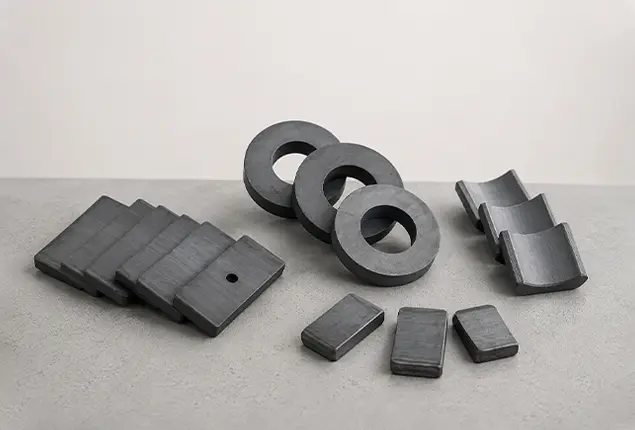
Ferrite magnets, also known as ceramic magnets, are one of the most widely used permanent magnet materials. Although their magnetic performance is lower than neodymium magnets, ferrite magnets offer advantages such as low cost, excellent corrosion resistance, and good thermal stability. Therefore, they are widely used in motors, speakers, magnetic separators, household appliances, and various industrial magnetic components.
Ferrite magnets use different grades to meet various magnetic performance requirements and operating conditions. Different ferrite magnet grades show significant differences in Br, Hcb, Hcj, BHmax, and temperature stability. Understanding these ferrite magnet grade classifications helps engineers and purchasing professionals select more suitable magnetic materials according to actual application requirements.
Contents
Key Takeaways
- Ferrite magnets offer excellent cost efficiency, corrosion resistance, and thermal stability for various industrial applications.
- Ferrite magnet grades are classified by key properties such as Br, Hcb, Hcj, and BHmax.
- Y Series, C Series, and IEC standards are the main grade systems for sintered ferrite magnets.
- Y30 ferrite magnets provide an excellent balance between magnetic performance and cost.
- Choosing the right ferrite grade depends on magnetic requirements, operating conditions, structure, and cost.
Key Magnetic Properties of Ferrite Magnets
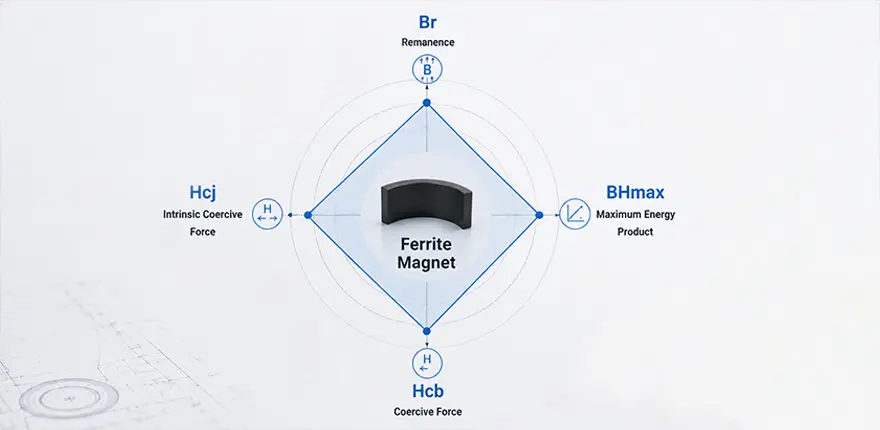
When selecting ferrite magnet grades, several key magnetic parameters need to be understood.
Remanence (Br)
Residual induction represents the magnetic flux density that a magnet can maintain after the external magnetic field is removed.Generally, a higher Br value indicates stronger magnetic force and higher magnetic output capability.
Coercive Force (Hcb)
Coercive force represents the ability of a magnet to resist demagnetization caused by an external reverse magnetic field.A higher Hcb value can reduce the risk of demagnetization caused by external magnetic fields.
Intrinsic Coercive Force (Hcj)
Intrinsic coercive force represents the internal resistance of a magnet against demagnetization.
Generally, the higher the Hcj value, the less likely the magnet is to experience irreversible demagnetization. This is the key parameter that determines demagnetization resistance and high-temperature stability.
Maximum Energy Product (BHmax)
Maximum energy product is an important indicator for evaluating the overall magnetic performance of permanent magnet materials.
A higher BHmax value represents higher magnetic energy output and greater magnetic performance density.
Sintered Ferrite vs Bonded Ferrite Magnets
Sintered Ferrite Magnets
Sintered ferrite magnets are manufactured by pressing ferrite powder into a specific shape and then sintering it at high temperatures.
They represent the high-performance category of ferrite magnets, and almost all standardized ferrite magnet grade charts are developed based on this type of magnet.
Bonded Ferrite Magnets
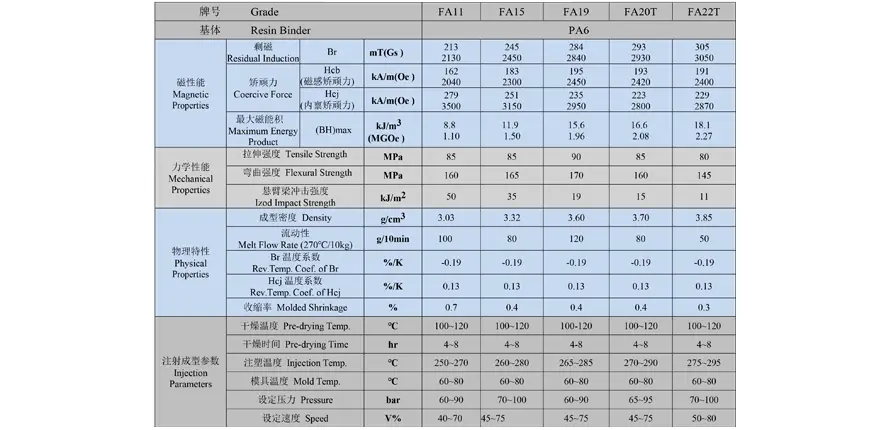
Bonded ferrite magnets are produced by mixing ferrite powder with polymer binders and forming them through injection molding.
They are often integrated with plastic housings or rotor components.
Because the binder reduces the magnetic material content, bonded ferrite magnets generally have lower magnetic performance than sintered ferrite magnets with the same formulation. However, they provide greater design flexibility and allow more complex shapes.
Sintered Ferrite Magnet Grades
Currently, there are three major standard systems for sintered ferrite magnet grades:
- Chinese Standard (GB/T 12796)
- US Industrial Standards
- International Electrotechnical Commission Standard (IEC 60404-8-1)
The performance ranges defined for the same grade level vary among different standards. Therefore, ferrite magnet grades from different standards cannot be directly compared only by their grade names.
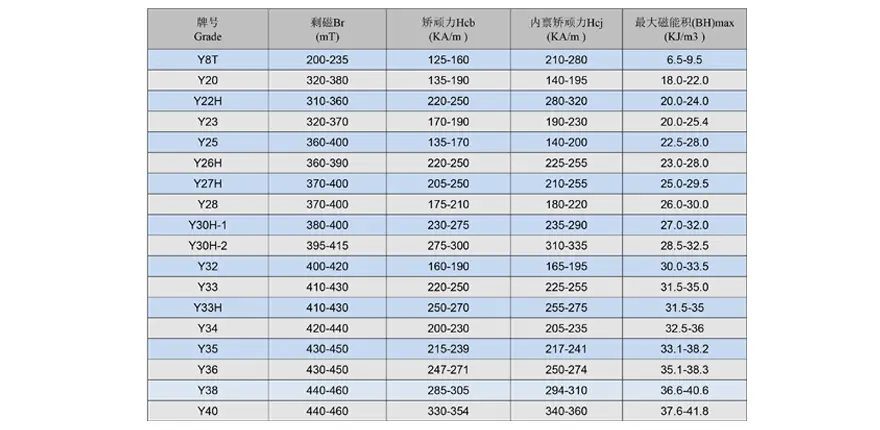
Our ferrite magnets comply with Chinese standard requirements, and our products are classified using the Y Series ferrite magnet grades.
Chinese Standard (GB/T 12796)
The Chinese ferrite magnet grade system is one of the most widely used ferrite magnet classification systems.
US Industrial Standards
US industrial ferrite magnet standards are mainly used in the North American market and are still widely applied in some traditional applications.
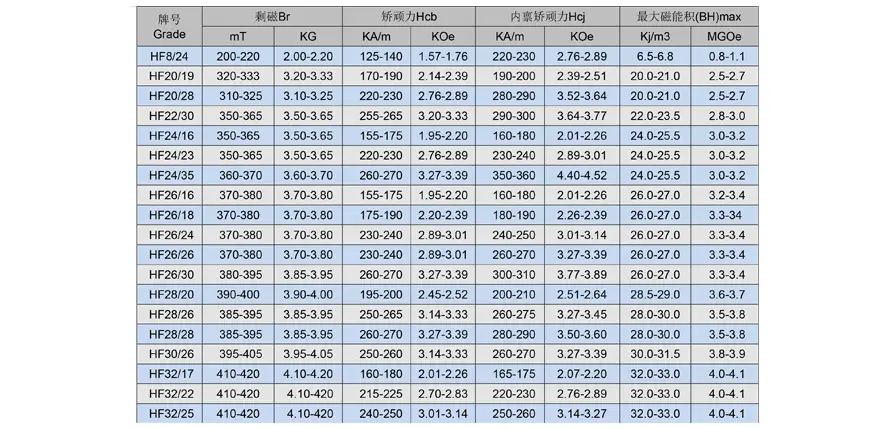
IEC Standard(DIN IEC 60404-8-1)
The International Electrotechnical Commission (IEC) ferrite magnet grade system is mainly used in European markets.
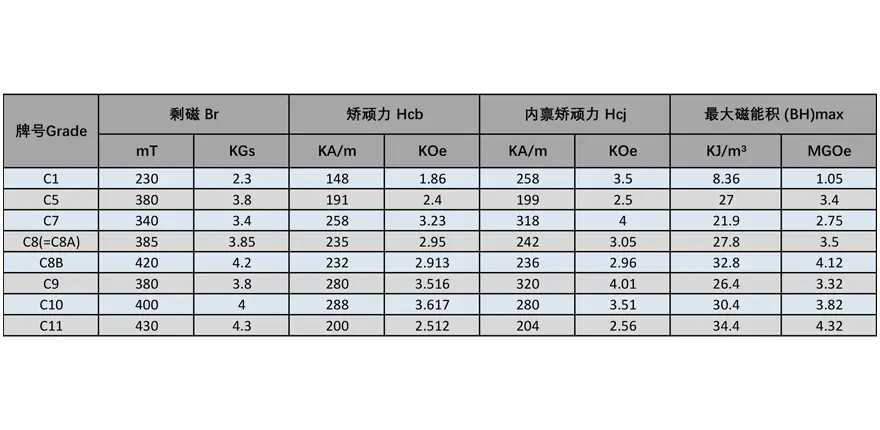
Bonded Ferrite Magnet Grades
Unlike sintered ferrite magnets with specific standard grade systems, bonded ferrite magnets currently do not have a unified international grade classification.
The following are the bonded ferrite magnet grade data provided by TOPMAG:
How to Choose the Right Ferrite Magnet Grade
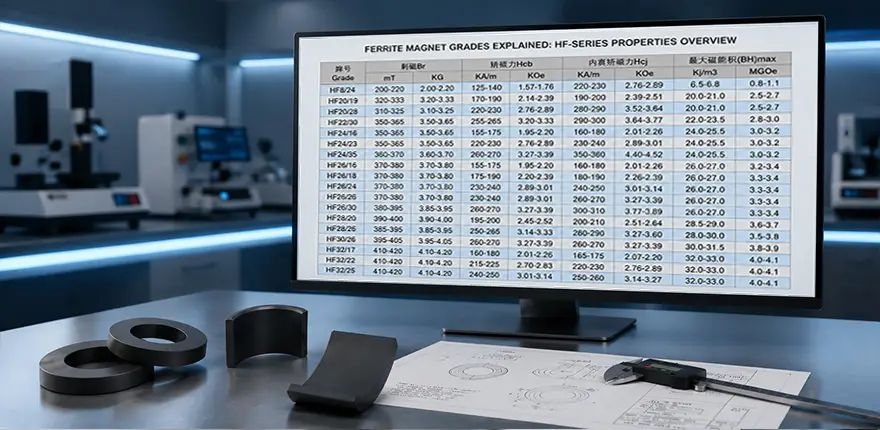
Regardless of which ferrite magnet grade is selected, the key is to find the best balance between performance, size, and cost according to actual application requirements.
Proper ferrite magnet grade selection not only meets the magnetic requirements of a product but also ensures optimal performance and long-term reliability during actual operation.
Taking Y Series sintered ferrite magnets as an example, the following factors can be used as references.
Does the Operating Environment Involve High Temperature or Strong Reverse Magnetic Fields?
If the application environment involves high temperatures or strong reverse magnetic fields, priority should be given to intrinsic coercive force (Hcj).
Ferrite magnet grades with stronger demagnetization resistance, such as Y30H-1 and Y33H, should be selected for high-temperature applications.
If the operating environment is stable, standard ferrite magnet grades are usually sufficient.
Does the Application Have Specific Magnetic Performance Requirements?
If the product has clear requirements for magnetic force, attraction force, or magnetic field strength, greater attention should be paid to Br and BHmax.
High-performance ferrite magnet grades such as Y35, Y38, and Y40 can better meet these requirements.
If the application only requires basic magnetic functions, selecting higher-performance grades is usually unnecessary.
Does the Product Require Complex Structures or Integrated Molding?
If the product contains complex structures or requires fewer assembly steps, bonded ferrite magnets are usually more suitable.
Simple structures typically use sintered ferrite magnets, which are suitable for mass production.
Is Product Cost a Critical Factor?
For large-volume consumer products such as household appliances and speakers, grades such as Y20, Y25, and Y30 ferrite magnets are usually preferred.
For industrial equipment or performance-oriented applications, grades such as Y30H-1, Y35, Y38, and Y40 can be selected.
Conclusion
Ferrite magnet grades represent not only different material classifications but also different magnetic properties, manufacturing processes, and application directions.
By understanding ferrite magnet grade systems, engineers and purchasing professionals can find the best balance between magnetic performance, cost, processing requirements, and reliability according to product requirements.
TOPMAG provides various ferrite magnet solutions with competitive pricing. With professional experience in magnetic materials and manufacturing capabilities, we help customers select ferrite magnet solutions that better match their product designs and operating environments.
Some FAQs
Are Higher Ferrite Magnet Grades Always Better?
Not necessarily.
A higher BHmax value (for example, Y33 compared with Y23) indicates higher magnetic energy density. However, if the design requires high-temperature stability, a grade with lower BHmax but higher Hcj, such as Y30H or Y10T, may be more suitable.
Can C Series Ferrite Grades Directly Replace Y Series Ferrite Grades?
C Series and Y Series ferrite magnet grades cannot be directly replaced one-to-one.the actual replacement relationship should be confirmed according to magnetic properties and application requirements.
What Is the Most Common Ferrite Magnet Grade?
Y30 ferrite magnets (equivalent to US C5 and IEC HF26/18 in similar performance ranges) are among the most widely used ferrite magnet grades because they provide an excellent balance between cost and magnetic performance.
What Is the Difference Between Anisotropic and Isotropic Ferrite Magnets?
Anisotropic ferrite magnets have a preferred magnetization direction and provide higher magnetic performance.
Most Y Series ferrite magnet grades are anisotropic.
Isotropic ferrite magnets can be magnetized in any direction but have lower magnetic performance.
What Is the Difference Between Y30 and Y35 Ferrite Magnets?
Compared with Y30 ferrite magnets, Y35 ferrite magnets have:
- Higher residual induction (Br)
- Higher maximum energy product (BHmax)
Therefore, Y35 provides stronger magnetic output capability, but the cost is usually higher.
For more insights, check these related blogs:
Ferrite Magnet Bulk Purchasing Solution
Neodymium Magnets for Industrial Automation
Rare Earth Magnets vs Ferrite Magnets: Key Differences
Rare Earth Magnets vs Ferrite Magnets: Key Differences
2026 Magnet Report: Rare Earths & Supply Chain Truths
Ready to upgrade your project? Browse our full product line at TOPMAG!🧲

I'm dedicated to popular science writing about magnets. My articles mainly focus on their principles, applications, and industry anecdotes. Our goal is to provide readers with valuable information, helping everyone better understand the charm and significance of magnets. At the same time, we're eager to hear your opinions on magnet-related needs. Feel free to follow and engage with us as we explore the endless possibilities of magnets together!