
Why Are Ferrite Ring Magnets Widely Used in BLDC Ceiling Fan Motors?
- Ethan
- Base de conhecimento
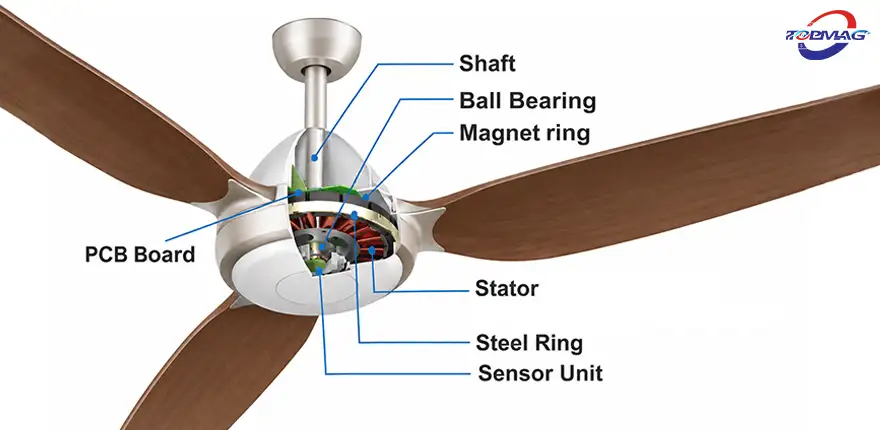
BLDC ceiling fans are gaining popularity due to their high energy efficiency, quiet operation, and precise stepless speed control.The permanent magnets in the rotor play a key role in determining motor performance and manufacturing cost.
Ferrite magnets are widely used in cost-sensitive motor applications, including many ceiling fan designs. Depending on the rotor structure and manufacturing process, the magnetic assembly may use injection-molded ferrite ring magnet or multiple sintered ferrite arc magnets arranged in a ring. Rare-earth magnets, such as ímãs de neodímio, offer higher magnetic performance. However, ferrite ring magnets provide a cost-effective alternative for many motor applications.
Why do motor manufacturers continue to choose ferrite magnets over high-performance rare-earth magnets? This article explores the engineering, economic, and practical reasons behind this choice.
Conteúdo
Principais conclusões
Ímãs de ferrite offer a cost-effective solution for BLDC ceiling fan motors.
Proper magnetic circuit design enables ferrite magnets to meet many ceiling fan performance requirements.
Ferrite magnets provide good thermal stability e excellent corrosion resistance.
Injection-molded ferrite ring magnets can simplify rotor assembly and reduce assembly-related vibration and noise risks.
The right magnet choice depends on motor design, magnetic performance, production costs, and reliability requirements.
Balancing High Efficiency and Low Cost
For household appliances produced in large volumes, material cost is an important factor in motor design.
Abundant Raw Materials and Relatively Stable Costs
Ímãs de ferrite are mainly made from iron oxide and compounds containing strontium or barium. They generally have a lower material cost and do not depend on rare-earth elements. In comparison, neodymium magnets require rare-earth elements such as neodymium or praseodymium. Some high-temperature grades also contain dysprosium or terbium. Their costs may be affected by raw material supply and market price fluctuations.
Supporting the Wider Adoption of Energy-Efficient Fans
Many regions are promoting energy-efficient fan technologies. For example, India’s BEE operates a star-rating program for ceiling fans. BLDC ceiling fans can reduce energy consumption through efficient motor design, but the total product cost still affects market competitiveness. Ímãs de anel de ferrite help manufacturers control material costs while meeting motor performance requirements. This supports the wider adoption of energy-efficient ceiling fans.
Suitable for Low-Speed, High-Torque Applications
Magnet selection must match the actual operating conditions of the motor. Ceiling fans are typical large-diameter, low-speed applications. Their operating speeds commonly range from 200 to 400 RPM, depending on the motor design and speed setting.
Supporting Smooth and Stable Operation
Ceiling fans require stable startup, smooth continuous operation, and reliable speed control rather than extremely high rotational speeds. With a properly designed magnetic circuit, ferrite ring magnets can provide the magnetic flux required for these applications.
Providing Sufficient Air-Gap Flux Density
With optimized stator slot and pole configurations and an appropriate electromagnetic design, ferrite magnets can provide sufficient air-gap flux density for many ceiling fan motors. The required magnetic performance depends on the overall motor design, not just the magnet material.
Good Thermal Stability
Ceiling fans may operate for long periods in relatively warm environments. Therefore, the operating temperature and demagnetization resistance of the magnets are important considerations.
Strong Resistance to Thermal Demagnetization
Ferrite ring magnets have favorable thermal characteristics. Within their suitable operating range, ferrite magnets generally offer good resistance to demagnetization. Their coercivity typically increases as temperature rises. However, their remanence decreases with temperature, so actual magnetic performance depends on the magnet grade, operating temperature, and working point.
Reliable Long-Term Performance
Some standard or lower-temperature grades of neodymium magnets may experience irreversible demagnetization under sustained high-temperature conditions. Ferrite magnets can offer an advantage in certain operating environments. With the right magnet grade and proper motor thermal design, they can support reliable long-term ceiling fan operation.
Excellent Corrosion Resistance
Although ceiling fans are usually installed indoors, moisture can still affect motor components in humid or coastal environments.
Ferrite is a ceramic oxide material with excellent corrosion resistance. Unlike sintered neodymium magnets, ferrite magnets generally do not require protective coatings to prevent corrosion of the magnet material itself.
In suitable applications, ferrite ring magnets can reduce the risk of corrosion-related performance changes. This makes them a reliable option for ceiling fan motors operating in humid environments.
Manufacturing Advantages of Integrated Multipole Ring Magnets
Ferrite magnets for ceiling fan rotors are available in two main forms: sintered ferrite arc segments (assembled into a ring) and one-piece injection-molded multipole ferrite rings. For rotor designs that support a one-piece ring structure, injection-molded ferrite ring magnets offer several manufacturing and assembly advantages.
Reduced Assembly-Related Noise
A one-piece ferrite ring magnet can reduce the bonding, positioning, and assembly steps required for multiple individual magnet segments. This may reduce assembly variations that contribute to rotor imbalance, vibration, and noise. However, overall motor noise also depends on magnetic field distribution, rotor balance, bearings, structural resonance, and motor control.
Improved Component Consistency
With proper mold design and process control, injection molding can help maintain consistent component dimensions and geometry across production batches. This improves assembly consistency between the magnet and other rotor components.
Simplified Rotor Structure
For designs suited to a one-piece ring magnet, the number of individual magnet segments and related bonding steps can be reduced. This simplifies rotor assembly and may improve manufacturing efficiency.
Conclusão
The continued use of ferrite ring magnets in BLDC ceiling fan motors reflects a combination of cost efficiency, application suitability, material stability, and manufacturing advantages. Ferrite magnets can meet the performance requirements of many ceiling fan designs while helping manufacturers control costs. For suitable rotor structures, injection-molded ferrite ring magnets can also simplify assembly and reduce the risk of vibration and noise caused by assembly variations.
Looking for customized ferrite ring magnets? TOPMAG provides one-stop magnetic solutions, including ferrite ring magnets for motor applications. Send us your product drawings or technical specifications, and our engineering team will respond to your requirements within 24 horas.
Algumas perguntas frequentes
How Can You Verify the Quality of a Ferrite Ring Magnet?
Ferrite ring magnet quality can be verified through dimensional inspection, magnetic performance testing, pole distribution testing, and visual inspection. For mass production, dimensional tolerances, magnetization consistency, and batch stability should also be checked.
Do Ferrite Ring Magnets Require Special Storage Conditions?
Ferrite ring magnets generally do not require special storage conditions. Store them in a clean, dry environment. Avoid impacts, drops, and excessive pressure to prevent chipping or cracking.
Is a Higher Surface Magnetic Field Always Better for a BLDC Ceiling Fan Motor?
Not necessarily. Surface magnetic field strength is only one indicator of magnet performance. The right magnetic properties and magnetic circuit design are more important than simply achieving a higher surface field reading.
Will Ferrite Magnets Be Replaced by New Motor Technologies?
Ferrite magnets are expected to remain important in cost-sensitive ceiling fan motor applications. Rare-earth magnets, such as neodymium magnets, are more suitable for designs that require higher magnetic performance and power density. Different magnet materials are more likely to complement each other according to application requirements than for one material to replace all others.
What Environmental Advantages Do Ferrite Magnets Offer Compared with Rare-Earth Magnets?
Ferrite magnets do not depend on rare-earth elements. This helps reduce reliance on rare-earth mining and separation supply chains. However, their overall environmental impact should also be evaluated based on raw material sourcing, manufacturing energy consumption, product lifespan, and recycling methods.
Para obter mais informações, consulte estes blogs relacionados:
How to Measure Surface Magnetic Field with a Gaussmete?
Injection Molded Ferrite Ring Magnets for Fan Motors | TOPMAG
Guia de economia de eletricidade do ventilador de teto BLDC
O guia definitivo sobre o ruído do ventilador de teto
Causas comuns de oscilação do ventilador de teto
Pronto para atualizar seu projeto? Navegue por nossa linha completa de produtos em TOPMAG!🧲

Dedico-me a escrever artigos científicos populares sobre ímãs. Meus artigos se concentram principalmente em seus princípios, aplicações e anedotas do setor. Nosso objetivo é fornecer aos leitores informações valiosas, ajudando todos a entender melhor o encanto e a importância dos ímãs. Ao mesmo tempo, estamos ansiosos para ouvir suas opiniões sobre as necessidades relacionadas aos ímãs. Fique à vontade para nos seguir e interagir conosco enquanto exploramos juntos as infinitas possibilidades dos ímãs!