
Is Titanium Magnetic?
- Ethan
- Base de conhecimento
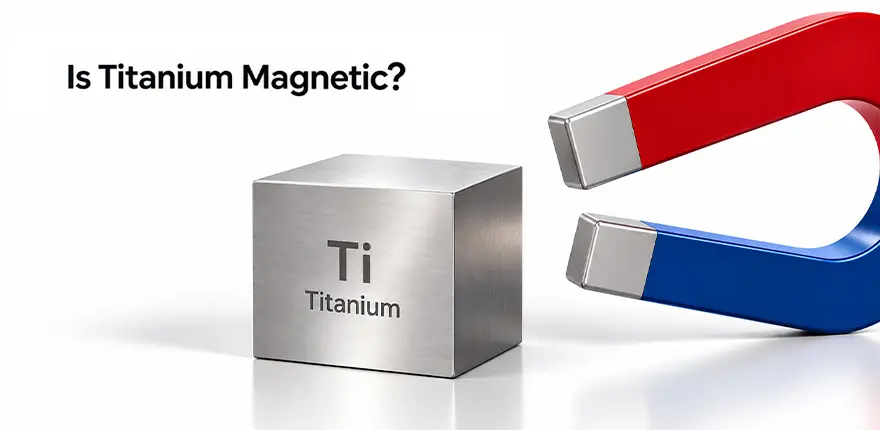
Titanium is generally considered a non-magnetic metal. Strictly speaking, titanium is paramagnético, which means it responds very weakly to an external magnetic field. This response is usually too weak to notice in everyday use. Titanium is therefore not noticeably attracted to ordinary permanent magnets. This property offers advantages in applications where low magnetic response is important.
Conteúdo
Principais conclusões
Titanium is weakly paramagnetic and is not noticeably attracted to ordinary magnets.
Most titanium alloys have similarly weak magnetic responses.
Titanium does not effectively shield magnetic fields.
Titanium offers excellent corrosion resistance, low weight, and good biocompatibility.
Magnet assemblies require proper magnet placement and corrosion protection.
What Are the Different Types of Magnetic Metals?
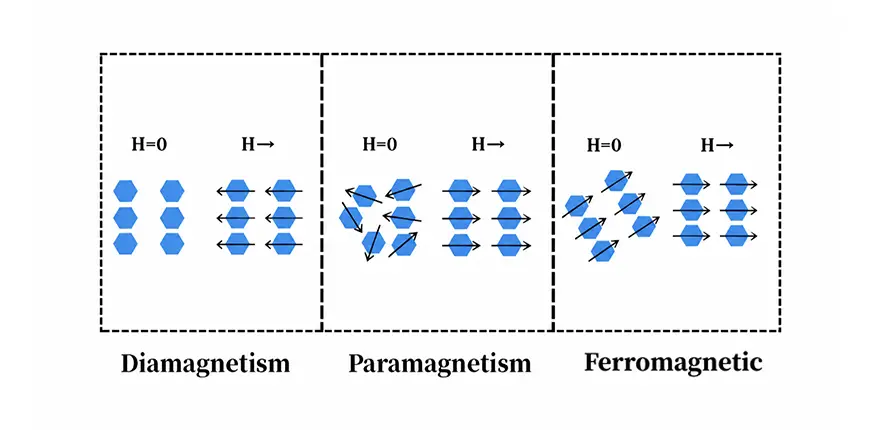
Metals generally fall into three categories based on how they respond to magnetic fields:
Ferromagnetic: Strongly attracted to magnets and can be magnetized, such as iron, cobalt, and nickel.
Paramagnético: Attracted very weakly by a magnetic field. This effect is usually unnoticeable in daily use. Examples include titanium, aluminum, and platinum.
Diamagnetic: Weakly repelled by a magnetic field. This effect is also difficult to notice in daily use. Examples include copper, gold, and silver.
| Metal | Tipo magnético | Can a Magnet Attract It? |
|---|---|---|
| Ferro | Ferromagnético | Yes, strongly |
| Nickel | Ferromagnético | Yes |
| Titanium | Paramagnético | No noticeable attraction |
| Alumínio | Paramagnético | No noticeable attraction |
| Cobre | Diamagnético | No noticeable attraction |
In everyday language, when people say a metal is “magnetic,” they usually mean it is ferromagnetic. Titanium does not belong to this category.
Why Is Titanium Not Magnetic?
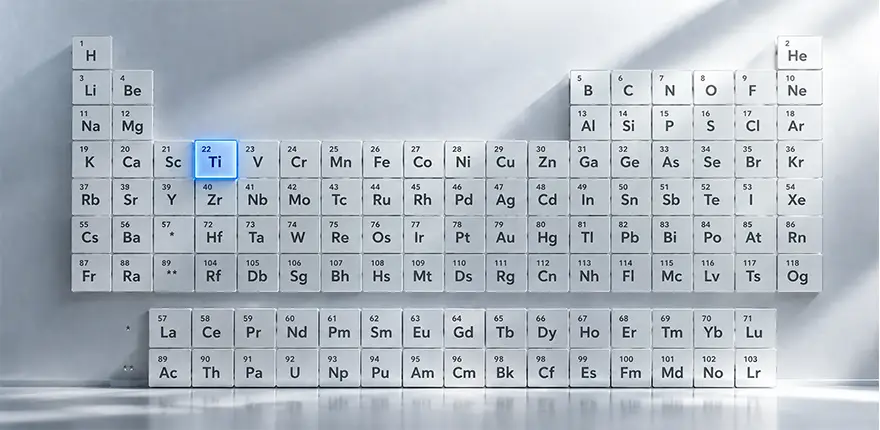
Titanium has an atomic number of 22 and an electron configuration of [Ar]3d²4s². In metallic titanium, electrons interact throughout the metal. Unlike iron, titanium does not exhibit the strong spontaneous magnetic ordering associated with ferromagnetism.
However, titanium can still respond very weakly to an external magnetic field. This is why it is classified as a paramagnetic material. Its magnetic susceptibility is on the order of 10⁻⁴ in SI units, while the magnetic response of ferromagnetic materials can be thousands of times stronger or more.
Are Titanium Alloys Magnetic?
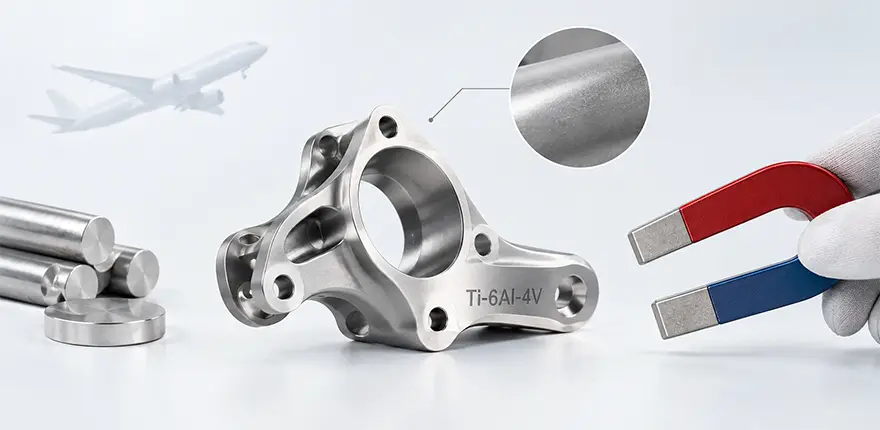
Most common titanium alloys are also considered essentially non-magnetic under ordinary conditions.
For example, Ti-6Al-4V is widely used in aerospace, medical devices, and industrial equipment. It is generally regarded as non-magnetic and is not noticeably attracted by ordinary magnets.
However, the magnetic response of a titanium alloy may vary with its composition, material condition, and processing history. If a component labeled as titanium is strongly attracted to a magnet, it may contain steel fasteners, ferromagnetic impurities, or other magnetic components.
Key Considerations When Combining Titanium and Magnets
Titanium has a very weak magnetic response. When designing magnetic products and assemblies, the connection method should be selected based on the actual structure and application.
- Titanium parts cannot provide strong magnetic attraction on their own. If you need a magnetic titanium housing, titanium accessory, or magnetic connection, you can embed permanent magnets in the assembly. Depending on the design, you can also use a steel armature, a magnetic component, or a magnet-to-magnet connection to achieve the required holding force.
- Titanium does not effectively shield magnetic fields. It is largely transparent to magnetic fields, so a magnet can work through a thin titanium sheet. This can be useful in magnetic clasps, magnetic sensors, and waterproof sealing structures.
- Consider corrosion protection when combining titanium with neodymium magnets. Titanium has excellent corrosion resistance, but neodymium magnets can corrode easily. When embedding magnets in titanium products, select a suitable coating or use effective encapsulation.
- Evaluate the complete assembly when using magnetic-sensitive equipment. Titanium is often selected for components in precision instruments and laboratory equipment where low magnetic response is important. However, the placement of any magnets in the assembly must also be considered to avoid interference.
Practical Benefits of Titanium's Non-Ferromagnetic Properties
Titanium combines its lack of ferromagnetism with low weight, high strength, corrosion resistance, and good biocompatibility. These properties make it useful in many applications.
Medical implants: Titanium is used in artificial joints, dental implants, and bone plates. Its lack of ferromagnetism means it is not strongly attracted by the static magnetic field of an MRI scanner. It may also produce less image distortion than some other materials. However, MRI safety depends on the specific device or implant.
Eyeglass frames, watches, and jewelry: Titanium is lightweight and corrosion-resistant. It is also often a good choice for people with metal sensitivities.
Aerospace and precision instruments: Titanium can help reduce unwanted magnetic interactions in equipment that requires low-magnetic-response components.
Electronic housings and structural parts: Titanium is not ferromagnetic, so it does not create the same magnetic attraction as iron-based materials. However, the effect on a compass or magnetic sensor depends on the complete assembly and any nearby magnets.
Conclusão
Understanding the magnetic differences between titanium and other metals helps with material selection. For magnetic assembly design, magnet performance, structure, and operating environment must also be considered.
Looking for magnets or a custom magnetic solution? We supply Neodymium, Ferritee Ímãs de alnico. Custom options are available for dimensions, coatings, and magnetization directions. Contact TOPMAG with your application requirements, and we can help you find a suitable solution.
Algumas perguntas frequentes
Can Titanium Be Used for Magnetic Shielding?
Titanium is generally not an ideal material for magnetic shielding because its relative magnetic permeability is close to 1. Magnetic shielding usually requires high-permeability materials, such as permalloy.
What Is the Difference Between Pure Titanium and Commercially Pure Titanium in Terms of Magnetism?
The main differences relate to purity and impurity content. Their magnetic responses may vary slightly, but both are generally weakly paramagnetic and are not noticeably attracted by ordinary magnets.
Does Titanium Rust?
Titanium naturally forms a dense oxide film on its surface. This gives it excellent corrosion resistance. In air, fresh water, and seawater, it generally does not rust like ordinary steel.
Why Are Some Stainless Steels Magnetic While Others Are Not?
This depends on their microstructure. Austenitic stainless steels, such as 304 and 316, are usually weakly magnetic or nearly non-magnetic in the annealed condition. Ferritic and martensitic stainless steels, such as 430 and 410, are generally magnetic.
Can You Wear Titanium Jewelry During an MRI Scan?
Titanium jewelry is generally not strongly attracted by magnetic fields. However, all metal jewelry should be removed before an MRI scan, and you should follow the hospital staff’s instructions.
Para obter mais informações, consulte estes blogs relacionados:
Magnetic Yoke vs. Keeper vs. Magnetic Shielding
Ciência e aplicação do ferromagnetismo, paramagnetismo e diamagnetismo
Motores de ímã permanente montados na superfície ou no interior
Metais magnéticos e não magnéticos: Propriedades e aplicações
How Does Air Gap Affect Permanent Magnet Motor Performance?
Pronto para atualizar seu projeto? Navegue por nossa linha completa de produtos em TOPMAG!🧲

Dedico-me a escrever artigos científicos populares sobre ímãs. Meus artigos se concentram principalmente em seus princípios, aplicações e anedotas do setor. Nosso objetivo é fornecer aos leitores informações valiosas, ajudando todos a entender melhor o encanto e a importância dos ímãs. Ao mesmo tempo, estamos ansiosos para ouvir suas opiniões sobre as necessidades relacionadas aos ímãs. Fique à vontade para nos seguir e interagir conosco enquanto exploramos juntos as infinitas possibilidades dos ímãs!