
Neodymium Magnets for Industrial Automation
- Ethan
- Base de conocimientos
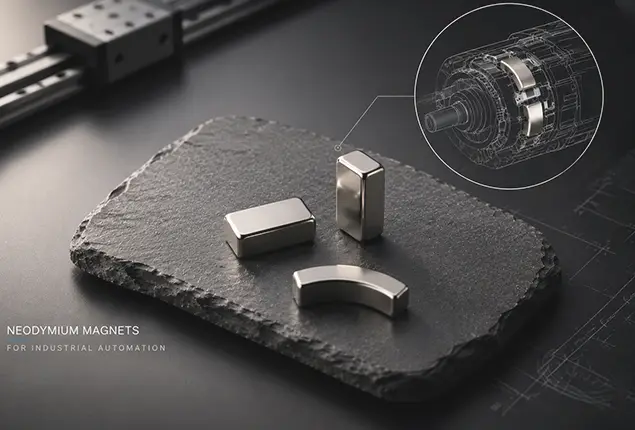
As industrial automation continues to evolve toward higher precision, speed, and efficiency, neodymium-iron-boron magnets have become indispensable core components in various types of automated equipment.
Thanks to their excellent magnetic properties, compact size, and stable, reliable performance, NdFeB magnets are widely used in motion control systems, smart manufacturing equipment, and various automated production lines.
Contenido
Principales conclusiones
- Imanes de neodimio are the preferred permanent magnets for industrial automation due to their exceptional magnetic strength and compact size.
- High-performance Imanes de NdFeB improve torque density, positioning accuracy, and energy efficiency in automated equipment.
- Industrial automation applications include servo motors, robotics, linear motors, magnetic sensors, AGVs, and magnetic assemblies.
- Choosing the proper magnet grade, coating, shape, and manufacturing precision ensures reliable long-term performance.
- Future demand is driving the development of high-performance, HRE-Free, and customized magnetic solutions for next-generation automation systems.
Why Industrial Automation Relies on Neodymium Magnets?
NdFeB vs. Ferrite, SmCo, Alnico
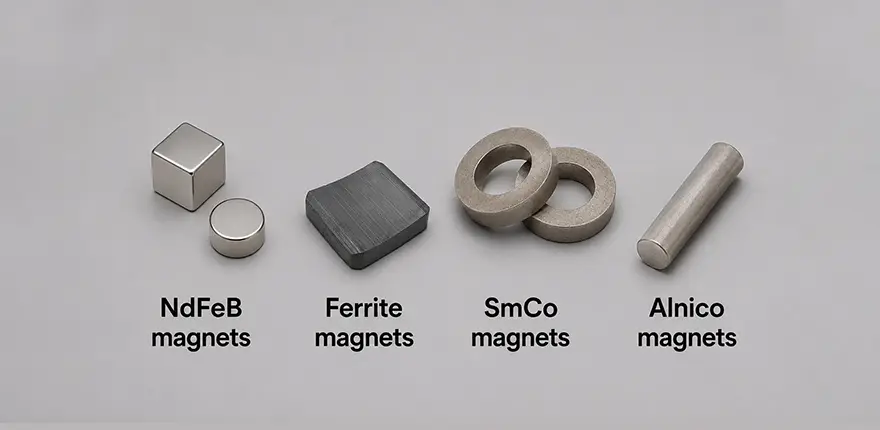
Ferrite magntes have a low price and excellent corrosion resistance, but their magnetic energy product is only about one-tenth that of NdFeB magnets. This means that achieving magnetic performance comparable to that of NdFeB magnets would require larger dimensions. In compact automated equipment, the cost of space is often far higher than the cost of materials.
SmCo magntes offer better temperature resistance and corrosion resistance than NdFeB magnets, but they have a lower magnetic energy product and are more expensive. They are a viable alternative in extreme environments.
AlNiCo magntes have excellent temperature stability and can operate at temperatures above 500°C, but they have low coercivity, meaning they demagnetizes easily when exposed to a reverse magnetic field. At the same time, their energy product is also low, which runs counter to the requirements of compact industrial automation equipment.
Neodymium magntes provide the best balance of overall performance: they have the highest energy product among currently available commercial magnets, are reasonably priced, and offer sufficient flexibility in grade and coating selection to adapt to nearly all automation environments.
| Magnet Material | Maximum Energy Product (BH)max | Temperatura máxima de funcionamiento | Resistencia a la corrosión | Relative Cost |
|---|---|---|---|---|
| NdFeB | 30–55 MGOe | 80–230°C (depending on grade) | Poor (coating required) | Alta |
| SmCo | 20-32 MGOe | 300–350°C | Excelente | Muy alta |
| AlNiCo | 5–9 MGOe | 450–550°C | Excelente | Medio |
| Ferrita | 3–5 MGOe | 250°C | Excelente | Bajo |
Key Advantages of Neodymium Magnets in Industrial Automation
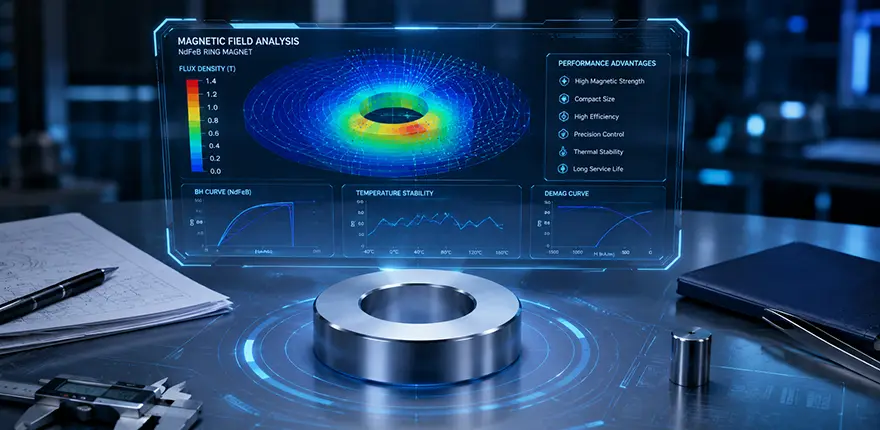
Higher Magnetic Strength in a Smaller Size
One of the greatest advantages of neodymium magnets is their extremely high magnetic energy product.Compared to other types of magnets, they can produce smaller magnets with the same magnetic strength. This allows for the design of more compact motors, robotic joints, and automation modules, effectively reducing the overall weight of the equipment.
Higher Energy Efficiency
NdFeB magnets can generate higher densidad de flujo magnético, enabling motors to produce greater torque at lower current levels. This reduces energy loss and heat generation, thereby improving overall operational efficiency.
Higher Positioning Accuracy
NdFeB magnets generate a stable and uniform magnetic field, effectively improving positioning accuracy while reducing vibration and torque fluctuations, thereby enabling precise control.
Greater Design Flexibility
Neodymium magnets can be customized to different shapes, sizes, surface treatments, and magnetization methods as needed, allowing for flexible adaptation to various automation equipment designs. This high level of customization enables engineers to further optimize magnetic circuit designs and achieve higher system performance.
Applications of Neodymium Magnets in Industrial Automation
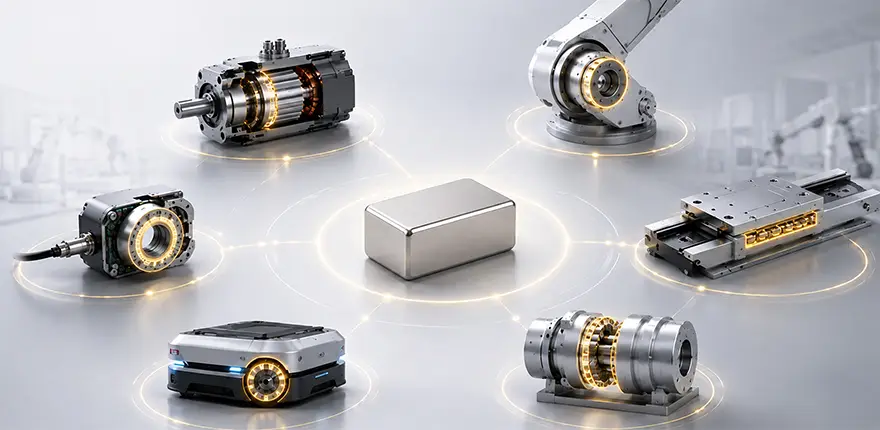
With their excellent magnetic performance and reliability, neodymium magnets are widely used in various types of industrial automation equipment, including the following applications:
Servo Motors
Servo motors are one of the most common applications in modern industrial automation. The powerful magnetic properties of NdFeB magnets help improve the motor’s torque density, positioning accuracy, and overall operational efficiency.
Robotic Actuators
Neodymium magnets provide high torque output while enabling compact designs, meeting the requirements for precise and stable motion in industrial robots.
Linear Motors
Linear motors utilize NdFeB magnets to achieve high-speed, smooth, and high-precision linear motion, and are widely used in various types of precision automation equipment.
Magnetic Sensors and Encoders
Precisely magnetized neodymium magnets generate stable magnetic field, enabling accurate detection of position, speed, and angle.
Automated Guided Vehicles (AGVs) and Autonomous Mobile Robots (AMRs)
Neodymium magnets are widely used in the drive motors, steering systems, and navigation modules of AGVs and AMRs, providing efficient and reliable power support for smart logistics.
Magnetic Couplings and Magnetic Clamping Systems
NdFeB magnets can be used in magnetic couplings and magnetic clamping systems to achieve contactless torque transmission and stable workpiece positioning.
How to Choose the Right NdFeB Magnet for Industrial Automation
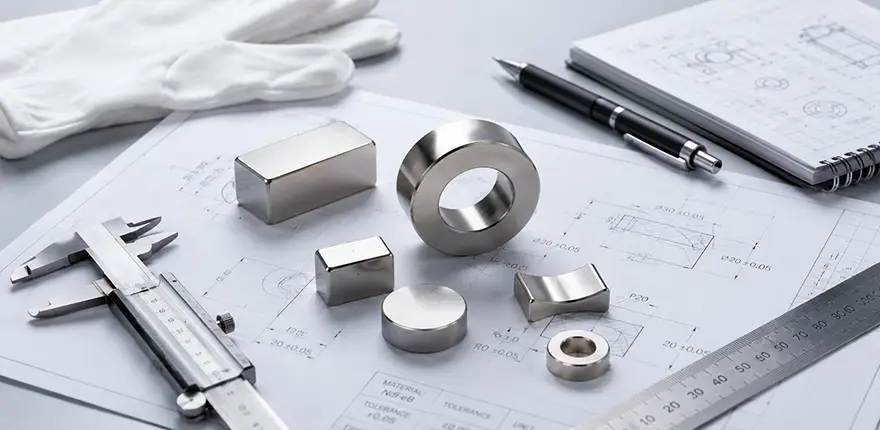
To select the right NdFeB magnet, you need to match the magnet’s grade, coating, and shape to the actual operating conditions of your equipment. The following key factors can help you choose the most suitable solution.
Grado magnético
The magnet grade determines the magnetic properties and temperature resistance of a neodymium magnet.
Based on the equipment’s performance requirements and operating temperature, you should select standard grades such as N35–N52 or high-temperature grades such as N, M, H, SH, UH, EH, TH, or AH to balance performance, reliability, and cost.
Magnet Shape
Magnet shape affects the magnetic circuit design and installation method. Selecting the appropriate cube, disc, ring, tile, or custom magnet based on the equipment’s structure can further enhance overall performance.
Equipment Operating Environment
The equipment’s operating temperature, humidity, vibration, and corrosive environments all affect the magnet’s performance. Assessing actual operating conditions in advance helps prevent issues such as demagnetization and corrosion, ensuring long-term stable operation.
Surface Treatment
Neodymium magnets typically require surface treatment to improve corrosion resistance. Selecting the appropriate coating based on the operating environment can effectively extend the magnet’s service life.
Precision Requirements
For high-precision applications such as servo systems and robots, special attention should be paid to dimensional tolerances, magnetization direction, and magnetic performance consistency to ensure the stability and accuracy of equipment operation.
Future Trends in Industrial Automation Magnets

As industrial automation continues to advance, higher demands will be placed on the performance, reliability, and sustainability of neodymium magnets. Future trends will primarily manifest in the following areas:
Higher-Performance Magnetic Materials
The next generation of neodymium magnets will evolve toward higher magnetic energy products and higher temperature resistance to meet the demands of high-efficiency motors and precision automation equipment.
Rare Earth Supply Chain and Sustainability
Reducing the use of heavy rare earth elements, developing HER-free technologies, and promoting rare earth recycling will become key drivers of sustainable development in the magnet industry, as well as solutions for mitigating cost volatility and supply chain risks.
Smart and Automated Applications
With the advancement of AI and smart manufacturing, neodymium-iron-boron magnets will play an increasingly important role in high-performance motors, magnetic sensors, and smart control systems.
Customized Magnetic Components
The growing demand for integrated and modular designs in automated equipment is driving the development of customized magnet and magnetic component solutions as a key industry trend.
Why Choose TOPMAG as Your Magnet Supplier
Choosing the right magnet supplier is just as important as choosing the right magnet.
With 24 years of experience in permanent magnet manufacturing, TOPMAG provides reliable Imanes de NdFeB y conjuntos magnéticos for industrial automation at highly competitive prices.
We offer one-stop custom magnet services and have accumulated extensive project experience in industrial automation fields such as servo motors, robots, and automation equipment, providing reliable magnetic solutions to customers worldwide.Contact us today for free technical consultation and sample support.
Algunas preguntas frecuentes
What type of magnet is best for industrial automation?
Neodymium magnets are the preferred choice for most industrial automation applications due to their high magnetic strength, compact size, and excellent energy efficiency.
Can magnets be customized for automation equipment?
Yes. Magnets can be customized in terms of grade, size, shape, coating, magnetization direction, and magnetic assemblies.
What coatings are available?
Common coatings include Nickel (Ni-Cu-Ni), Epoxi, Zincy Phosphate. The appropriate coating should be selected according to the operating environment.
Do you provide samples before mass production?
Yes. Sample production is available before mass production, allowing customers to verify product performance and compatibility.
How can I ensure the long-term reliability of neodymium magnets?
Selecting the right grado magnético y coating for the operating environment helps ensure reliable performance and a longer service life.
Para más información, consulte estos blogs relacionados:
HRE-Free Magnets Explained: Technology and Manufacturing Innovations
How to Customize High-Quality Neodymium Magnets
Rare Earth Magnets vs Ferrite Magnets: Key Differences
2026 Magnet Report: Rare Earths & Supply Chain Truths
¿Listo para mejorar tu proyecto? Consulte nuestra gama completa de productos en TOPMAG!🧲

Estoy dedicado a la divulgación científica sobre imanes. Mis artículos se centran principalmente en sus principios, aplicaciones y anécdotas industriales. Nuestro objetivo es proporcionar a los lectores información valiosa, ayudándoles a comprender mejor la fascinación y la importancia de los imanes. Al mismo tiempo, estamos ansiosos por conocer tus opiniones y necesidades relacionadas con los imanes. ¡Síguenos y participa activamente mientras exploramos juntos las infinitas posibilidades de los imanes!