
Bonded vs Sintered NdFeB Magnets: Which One Should You Choose?
- Ethan
- 지식 기반
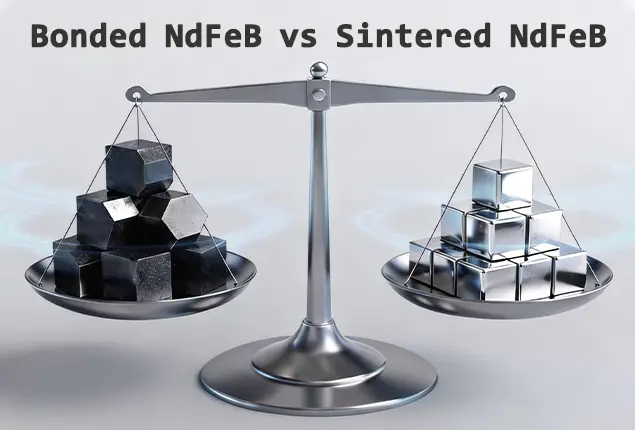
Sintered NdFeB magnets 그리고 bonded NdFeB magnets are the two dominant types of NdFeB 영구 자석 on the market. Though both belong to the 네오디뮴 magnet family, they differ drastically in manufacturing processes, magnetic performance, and application scenarios.
If you are sourcing NdFeB 자석 for industrial applications, you may wonder: what are the differences between sintered NdFeB vs bonded NdFeB magnets? Which option delivers the best cost-performance ratio for your budget?
Clarifying these distinctions enables precise product selection, preventing insufficient performance and unnecessary cost waste.
콘텐츠
주요 내용
- 소결 NdFeB: Superior 자력 그리고 고온 안정성, ideal for heavy-load and harsh environments (EV motors, MRI equipment).
- 보세 NdFeB: Flexible, customizable into complex shapes and cost-effective, perfect for mass-produced precision components (mobile phone motors, sensors).
- Stronger magnetism does not equal better performance: Properly matched performance cuts costs on machining and anti-corrosion treatment.
- Continuous technical upgrading: focus on high-performance NdFeB magnets, sustainability, and rare earth reduction.
Core Differences Between Sintered & Bonded NdFeB
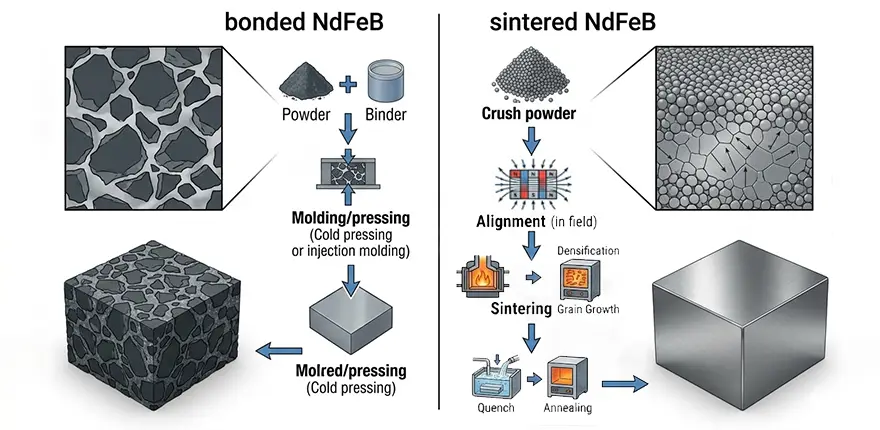
Manufacturing Process of Sintered NdFeB:Powder Metallurgy
- Melting & Pulverization: Raw materials (neodymium, iron, boron) are smelted into alloy ingots, then crushed and jet-milled into micron-scale powder.
- Magnetic Field Orientation & Compaction: Compressed under a strong magnetic field to align crystal grains in the easy magnetization direction.
- Sintering & Tempering: High-temperature sintering at 1000–1100℃ plus two-stage aging heat treatment to optimize magnetic properties 그리고 강압성.
- Post-processing: Precision machining (wire cutting, grinding) for dimensional accuracy, surface anti-corrosion coating, and final magnetization.
Manufacturing Process of Bonded NdFeB: Molding Process
- Material Mixing: Rapid-quenched NdFeB powder is evenly blended with binders and functional additives.
- Forming: Injection molding for thin-walled complex parts, or compression molding for regular shapes.
- Curing: Heating to harden binders and fix magnet shapes.
- 자화: Multi-pole or single-pole magnetization based on application demands.
How Manufacturing Processes Shape Performance
- Density Gap: Sintered NdFeB reaches a density of 7.5 g/cm³ with minimal internal voids; bonded NdFeB contains 20%–30% resin by volume, with a density of only 6.0 g/cm³ — the key reason for its weaker magnetism.
- Mechanical Toughness: Sintered magnets have a rigid, brittle crystal structure; the plastic matrix of bonded magnets delivers outstanding toughness against chipping and cracking.
Performance Comparison
The performance differences between the two types of magnets can be clearly distinguished through key parameters. The table below presents the critical performance indicators, making it easy to quickly compare and select the right option:
| Performance Index | 소결 NdFeB | 보세 NdFeB | Better Option |
|---|---|---|---|
| Magnetic Strength (BH)max | 25–55+ MGOe | 5–15 MGOe | Sintered (5–10 times stronger) |
| Max Working Temperature | 80–250℃ (by grade) | 80–150℃ (binder-limited) | Sintered (high-temperature resistance) |
| 내식성 | Coating required (prone to rust) | Naturally corrosion-resistant | Bonded (lower maintenance cost) |
| Shape Flexibility | Limited to simple shapes | Complex profiles, thin walls, multi-pole structures | Bonded (no secondary machining) |
| Unit Cost | Higher (extra machining & material loss) | Lower (mass production, no post-processing) | Bonded (budget-friendly) |
자기 강도
- Sintered NdFeB: Mainstream grades exceed 50 MGOe, with high-end versions over 55+ MGOe, ranking as the strongest commercial permanent magnet.
- Bonded NdFeB: Restricted by non-magnetic resin fillers, its (BH)max is generally below 10 MGOe.
온도 안정성
- Sintered NdFeB: Maintains stable magnetic properties at 80℃ to 250℃, adapting to harsh industrial high-temperature conditions.
- Bonded NdFeB: Continuous working temperature capped at 150℃. High heat softens and decomposes polymer binders, causing structural failure and irreversible demagnetization under reverse magnetic fields.
Tip: Select sintered NdFeB or SmCo magnets if equipment internal temperature regularly exceeds 120℃.
내식성
- Bonded NdFeB: Polymer binders fully wrap magnetic powder to form a protective barrier, requiring no extra coating for most indoor applications.
- Sintered NdFeB: High chemical activity leads to rapid oxidation and rust in humid environments. Professional 표면 처리 (nickel plating, zinc plating, epoxy coating) is mandatory to prevent pulverization and failure.
Mechanical Durability
Sintered NdFeB features high hardness but fragility, vulnerable to fracture under impact or stress; it boasts high compression resistance for heavy-load scenarios but lacks flexibility.
Bonded NdFeB gains shock resistance and bending tolerance from flexible binders, preventing cracks and edge chipping — ideal for precision equipment assembly.
Influence of Shape, Cost & Sustainability on Selection
Shape Flexibility & Dimensional Accuracy
Bonded NdFeB dominates in complex customized shapes. Mold integrated forming delivers precise dimensional tolerances without secondary processing, and supports in-mold multi-pole orientation, critical for precision sensors and miniature motors.
Sintered NdFeB is limited by brittleness. Complex structures demand costly post-sintering precision machining, resulting in substantial material waste and prolonged production cycles.
Cost-Effectiveness
- Bonded NdFeB: Low-energy molding process, no secondary machining or complex anti-corrosion treatment, reducing overall production costs — the top choice for mass consumer electronics.
- Sintered NdFeB: High energy consumption from high-temperature sintering, plus cutting, grinding and electroplating procedures, leading to higher manufacturing costs and material loss.
Environmental Impact
Traditionally, bonded NdFeB is more eco-friendly with low energy consumption, less waste and recyclable magnetic powder.
Sintered NdFeB is upgrading sustainably: manufacturers adopt renewable energy for sintering, recycle processing waste and promote eco-friendly epoxy coatings, greatly cutting carbon emissions and narrowing the environmental gap.
Application Scenario Selection
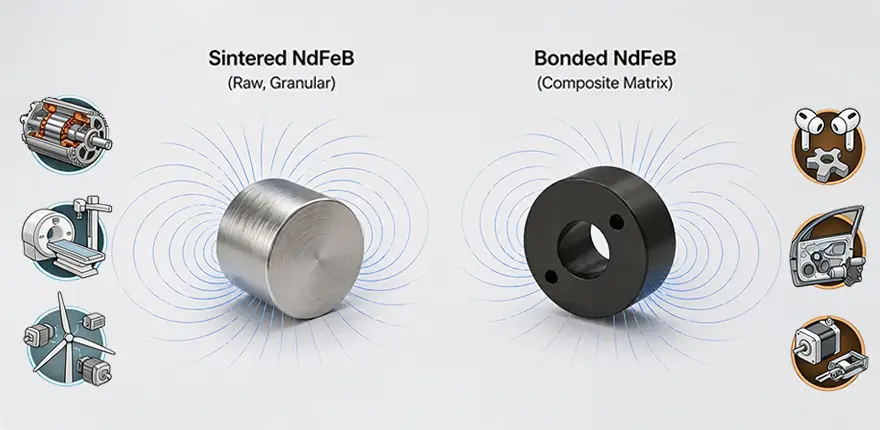
The core principle of selection is “matching the application requirements.” Below, we clearly differentiate the suitable application ranges of the two types of magnets based on specific use cases, along with a selection comparison table to enable quick and effective decision-making:
| Application Scenario | Recommended Magnet Type | Core Requirements |
|---|---|---|
| Mobile phone vibration motors, wireless earbuds, smart watches | 보세 NdFeB | Small size, complex shapes, low cost, mass production |
| Printer stepper motors, copier magnetic rollers | 보세 NdFeB | Complex magnetic structure, high precision, low noise |
| Automotive ABS wheel speed sensors, window lift motors | 보세 NdFeB | Multi-pole thin walls, corrosion resistance, low cost |
| Micro-robotics, medical wearable devices | 보세 NdFeB | Ultra-miniaturization, flexibility, integrated molding |
| EV main drive motors, powertrain motors | 소결 NdFeB | High (BH)max, high-temperature stability, high power density |
| MRI machines, surgical instruments | 소결 NdFeB | Strong magnetic field, high stability, high reliability |
| Satellite attitude actuators, missile gyroscopes | 소결 NdFeB | Extreme environment adaptability, high coercivity, demagnetization resistance |
| Wind turbines, industrial magnetic separators | 소결 NdFeB | High (BH)max, high durability, heavy-load adaptation |
| Flywheel energy storage, eVTOL electric aviation | 소결 NdFeB | Lightweight, high power density, compact size |
Bonded NdFeB Applications
- 소비자 가전: Vibration motors, hard drives, wireless earbuds and smartwatches; meets requirements of mini size, thin walls, complex shapes and mass supply.
- Office Automation: Printer stepper motors, copier magnetic rollers; features high-precision magnetic structures and low-noise operation.
- Automotive Components: ABS wheel speed sensors window lift motors and wiper motors; supports multi-pole thin-walled design and long-term corrosion resistance.
- Emerging Fields: Micro-robots and medical wearables; realizes millimeter-level miniaturization and integrated molding with plastic parts.
Sintered NdFeB Applications
- 새로운 에너지 차량: EV traction motor and powertrain systems; balances high power density, torque output and long-term high-temperature operation.
- 의료 장비: MRI scanners and surgical magnetic devices; provides ultra-stable strong magnetic fields for accurate imaging and treatment.
- Aerospace & Defense: Satellite attitude actuators and missile gyroscopes; adapts to extreme temperature differences, vacuum and severe vibration with excellent anti-demagnetization performance.
- Industrial Machinery: Wind turbines, industrial magnetic separators and high-power servo motors; delivers high durability and heavy-load adaptability.
- Cutting-Edge Industries: Flywheel energy storage and eVTOL aviation; realizes lightweight design with high energy density.
Future Technology Trends (2026–2030)
- Upgraded Bonded NdFeB: Magnetic strength to 15–18 MGOe, new high-temperature resistant binders raising working temperature above 200℃; recycled magnetic powder cuts costs by 30%–50% and carbon footprint by 60%.
- Optimized Sintered NdFeB: Grain boundary diffusion technology reduces 70% rare earth consumption (Dysprosium, Terbium) without performance loss; hot pressing technology achieves near-net shaping for complex parts, cutting processing waste by 80%.
- Hybrid Magnets: Combine sintered NdFeB’s strong magnetism and bonded NdFeB’s flexible shaping; widely applied in high-end 센서 and special motors, becoming an independent mainstream category by 2030.
전환식 자석은 중소형 휴대용 애플리케이션에 적합합니다. 전자석은 매우 강력하고 지속적으로 조절 가능한 유지력이 필요한 고강도 산업용 용도에 더 적합합니다. 어떤 것을 사용할지 결정할 때는 항상 다음을 기준으로 평가하세요. 로드 무게, 얼마나 자주 켜고 끌 것인지및 주요 안전 요소.
결론
- Choose 결합된 NdFeB for complex shapes, mass production and tight budgets.
- Choose sintered NdFeB for strong magnetism, high-temperature resistance and harsh working conditions.
몇 가지 자주 묻는 질문
Is bonded NdFeB a low-cost substitute for sintered NdFeB?
They are complementary rather than alternative. Bonded NdFeB has irreplaceable advantages in complex shaping, multi-pole magnetization and mass production, instead of being a downgraded version.
Is sintered NdFeB always more expensive?
Sintered materials cost more per kilogram, yet excessive machining loss may raise the final part price. Always compare finished component unit prices.
Can bonded NdFeB be used in automobiles due to low heat resistance?
Yes. It is widely used in automotive window motors and seat regulators, with working temperatures below 120℃, fully meeting vehicle internal operating standards.
Can sintered NdFeB be made into arbitrary shapes?
Limited by brittleness, it cannot produce thin-walled tubes, slender rods and toothed structures — classic strengths of bonded NdFeB.
Is higher magnetic performance always better?
Excessive magnetism leads to higher costs, difficult processing and increased corrosion risks. The core selection principle is “adequate performance for actual use”.
더 자세한 내용은 관련 블로그에서 확인하세요:
Ultimate Guide to Coating Selection for NdFeB Magnets 2026
How to Separate Strong Magnets
프로젝트를 업그레이드할 준비가 되셨나요? TOPMAG에서 전체 제품군을 살펴보세요!🧲

저는 자석에 관한 대중 과학 글을 쓰고 있습니다. 제 기사는 주로 자석의 원리, 응용 분야, 업계 일화에 초점을 맞추고 있습니다. 제 목표는 독자들에게 유용한 정보를 제공하여 모든 사람이 자석의 매력과 중요성을 더 잘 이해할 수 있도록 돕는 것입니다. 동시에 자석과 관련된 여러분의 의견을 듣고 싶습니다. 자석의 무한한 가능성을 함께 탐구하는 동안 자유롭게 팔로우하고 참여해 주세요!