
FERRITE ARC MAGNETICS
Cost-Effective Ferrite Arc Magnets for Electric Motors
Ferrite arc magnets are also known as Ferrite Arc Segments or Ferrite Motor Magnets. They are one of the core magnetic components used in permanent magnet motors. Their unique curved structure provides a stable and uniform magnetic field during motor operation. Ferrite Arc Magnets also offer excellent cost efficiency,making them the economical choice for many mass motor production.
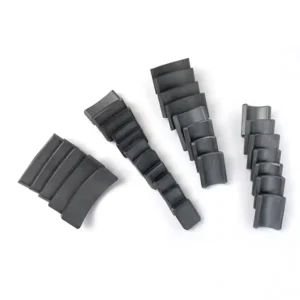
Ferrite Arc Magnet Manufacturing Process
According to the manufacturing process, Ferrite Arc Magnets are mainly divided into wet-pressed ferrite arc magnets and dry-pressed ferrite arc magnets.Wet-pressed ferrite magnets provide higher magnetic performance. They are also the most widely used type in the industry. Dry-pressed ferrite magnets offer higher production efficiency and lower manufacturing costs. They are better suited for small motors and applications with lower magnetic performance requirements.
| Process Type | Vantaggi | Applicazioni tipiche |
|---|---|---|
| Wet-Pressed Ferrite Arc Magnets | High magnetic performance, high density, excellent dimensional consistency, suitable for various sizes | Medium- and high-performance motors, automotive motors, household appliance motors, etc. |
| Dry-Pressed Ferrite Arc Magnets | Short production cycle, high production efficiency, lower manufacturing cost | Small motors, toy motors, and general industrial applications |
Ferrite Arc Magnet Installation Methods
The installation method affects the surface magnetic flux distribution requirements. Therefore, the installation position should be confirmed during product selection. Ferrite Arc Magnets can be installed on either the stator or the rotor.
- Stator Type
Curved ferrite magnet is fixed inside the motor housing with clips or adhesive. The inner arc serves as the working surface. Therefore, the magnetic flux density on the inner arc should be higher than that on the outer arc. - Rotor Type
Curved ferrite magnet is bonded or overmolded onto the rotor core. The outer arc serves as the working surface. Hence, the magnetic flux density on the outer arc should be higher than that on the inner arc.
Ferrite Arc Magnet Dimensional Tolerances
Different applications require different machining accuracies. We typically determine specific tolerance dimensions based on the drawings provided by customers. If no tolerance requirements are provided, we can also recommend suitable tolerance standards according to the application. The table below shows the reference tolerances commonly used in industrial applications.
| Dimension | General Tolerance (As-Sintered) | Ground (Precision Tolerance) |
|---|---|---|
| Chord Length W | ±1.5% | ±0.2 mm |
| Axial Length L | ±1.5% | ±0.2 mm |
| Thickness T | ±1.0 mm | ±0.1 mm |
| Outer Radius R | — | ±0.1 mm |
| Inner Radius r | — | ±0.1 mm |
| Arc Height H | — | ±0.3 mm |
As-sintered products use percentage tolerances for chord length and axial length. Thickness uses a fixed tolerance. As-sintered products generally do not specify separate tolerances for the outer radius, inner radius, or arc height.
Magnetization Methods and Directions
Ferrite arc magnets can be magnetized in several ways, and the right choice depends on the motor’s design and performance requirements.
Radial Magnetization
This is the most common magnetization method for ferrite arc magnets. The magnetic field passes radially through the arcFor example, if the inner arc is the S pole, the outer arc becomes the N pole.Radial magnetization produces a more uniform magnetic field and better performance, so it’s typically used in mid-to-high-end motors.
Diametrical Magnetization
The entire magnet is magnetized in one fixed direction rather than following the arc radius.This method is simpler and lower-cost, and is commonly used in toy motors and other low-cost applications.
Multipole Magnetization
Some motors require multiple alternating N and S poles on a single arc surface. This is typically used in motors with more specialized structural designs.
Not sure which method is more suitable for your product? Contact us for a free personalized technical assessment and expert selection guidance.
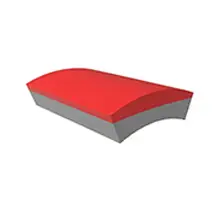
Diametrical Magnetization
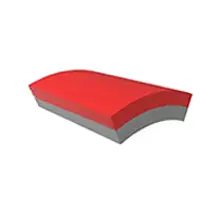
Radial Magnetization
Ferrite Arc Magnet Applications
Ferrite Arc Magnets are commonly used as stator magnets in electric motors. They are widely used in automotive motors, motorcycle motors, household appliances, power tools, fitness equipment, and many other motor-driven products. The automotive, motorcycle, and inverter home appliance industries are the largest application markets.
Ferrite Curved Magnets FAQ
- What are Ferrite Arc Magnets?Ferrite Arc Magnets are curved permanent magnets made from strontium ferrite or barium ferrite powders and then sintering. The industry also refers to them as ferrite arc segments. Their arc shape matches circular stator and rotor assemblies. They serve as the main magnetic material in permanent magnet DC motors.
- What ferrite arc magnet grades are available?Common grades include Y10T, Y25, Y30, Y33, Y35,ect. Higher-performance grades provide stronger magnetic properties and support a wider range of applications.
- How to distinguish the N/S poles of a Ferrite Arc Magnet?Manufacturers usually mark matched magnet sets with ink to identify polarity. You can also use a Gauss meter to measure the polarity of the inner and outer arcs.
- How to properly store and use the arc ferrite magnets?When storing, we should stack the magnets with opposite polarities isolated. Keep them away from strong alternating magnetic fields and avoid bumps and fractures. During assembly,we must handle with care and avoid reversing the magnetic poles.
- What is the operating temperature range of ferrite curved magnet?The Curie temperature of ferrite is approximately 450℃, and the recommended maximum long-term working temperature is about 250℃.
- Are Ferrite Arc Magnets suitable for humid or outdoor environments?Yes. Ferrite materials have excellent corrosion resistance and do not require protective coatings. They can be used for a long time in humid environments such as water pumps and other outdoor equipment.
More Options For Arc Magnets
In addition to Ferrite Arc Magnets designs below, we also present some arc magnet designs for particular application fields:
Magneti ad arco al neodimio
NdFeB Arc Magnets have the highest magnetic performance. They are ideal for high-performance motors, servo systems, and other applications that require strong magnetic force and compact dimensions.
Alnico Arc Magnets
Alnico Arc Magnets offer excellent temperature stability and strong resistance to demagnetization. They also produce a highly uniform magnetic field. And these magnets are suitable for precision equipment and high-temperature applications.
Magneti ad arco SmCo
SmCo Arc Magnets have slightly inferior performance than neodymium magnets. However, they offer better high-temperature resistance and corrosion resistance. They are often used in demanding industrial and high-end technical applications.