
Magnetic Separator Magnets: Types and Applications
- Ethan
- Base de conocimientos
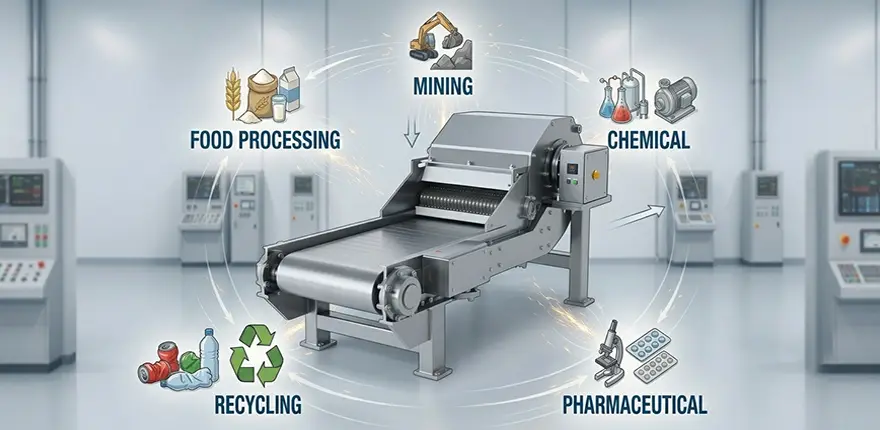
Magnetic separation technology removes unwanted ferromagnetic contaminants from material streams and is widely used in mining, food processing, recycling, pharmaceutical manufacturing, and chemical processing industries. It plays a critical role in ensuring product quality, protecting valuable equipment, and meeting regulatory requirements.
The performance of a Separador magnético largely depends on the type of magnet used, magnetic field strength, and magnetic circuit design. Selecting the right magnetic separator magnets for a specific application not only improves separation efficiency but also enhances product purity and ensures long-term operational reliability.
As a professional magnet manufacturer, TOPMAG provides customized magnets for magnetic separators to meet a wide range of industrial requirements.
Contenido
Principales conclusiones
- Magnetic Separator Magnets determine separation efficiency through magnet type y magnetic field design.
- Ferrita magnets, NdFeB magnets, and electroimanes are used for different industrial applications.
- Application requirements such as food-grade purity or mining capacity are more important than magnet cost.
- Magnetic field gradient, capture depthy operating temperature affect long-term performance.
- Proper magnet selection improves eficacia, reduces downtime, and increases ROI.
What Is Magnetic Separation?
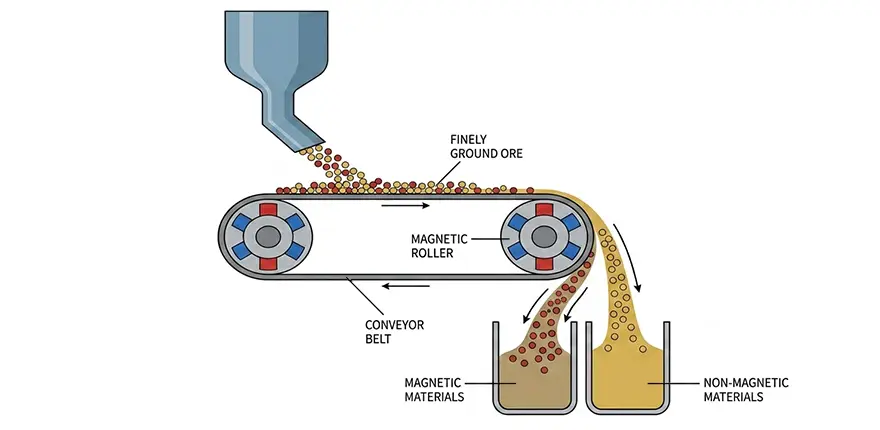
Magnetic separation is a process that uses magnetic force to separate magnetic materials from non-magnetic materials. All magnets have a north pole and a south pole and generate a Campo magnético around them. When a mixture of magnetic and non-magnetic materials passes through the magnetic field region, magnetic particles are attracted by the magnet and separated from the non-magnetic materials.
The effectiveness of magnetic separation is mainly influenced by the following factors:
- Intensidad del campo magnético
- Magnetic field gradient
- Magnetic penetration depth
- Particle size
- Material flow rate
In general, stronger magnetic fields provide better capture capability for weakly magnetic contaminants and fine particles. However, higher magnetic field strength often requires more expensive magnetic materials and more complex magnetic circuit designs. Therefore, magnetic separator system design must balance performance and cost.
Types of Magnets Used in Magnetic Separators
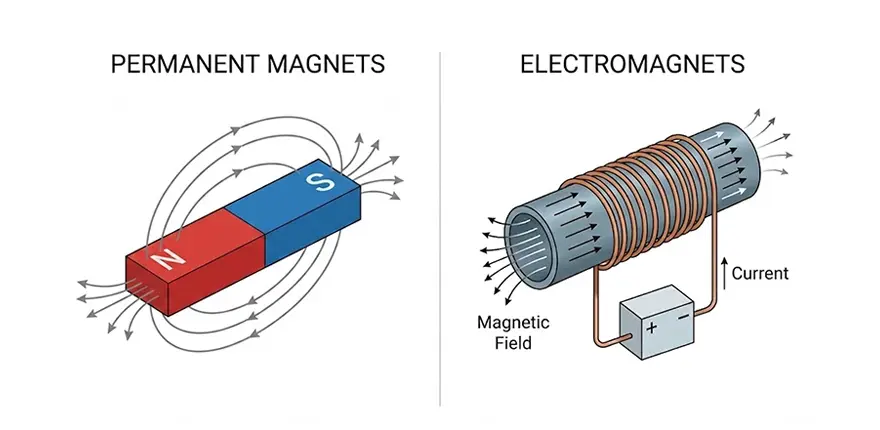
Imanes permanentes
Permanent magnets retain their magnetism without requiring an external power source. Due to their low operating cost and minimal maintenance requirements, most industrial magnetic separator systems utilize permanent magnets.
The two most common permanent magnets used in magnetic separators are ferrite magnets and neodymium iron boron magnets.
- Ferrite Magnets:
Ferrite magnets are the most widely used magnetic material in conventional magnetic separator equipment. They are particularly suitable for applications requiring magnetic force over a greater distance. - NdFeB Magnets:
NdFeB magnets, also known as imanes de tierras raras, are the core material used in high-performance magnetic separators. They are widely used in applications requiring precise contaminant removal, such as food processing, pharmaceutical manufacturing, and specialty chemical production.
Electroimanes
However, electromagnets require substantial electrical power and often need cooling systems to prevent coil overheating.
As a result, electromagnetic separators are commonly used in large-scale mining operations y heavy industrial processing lines.
Permanent Magnets vs Electromagnets
| Tipo de imán | Surface Magnetic Field | Operating Cost | Maintenance Requirement | Aplicaciones típicas |
|---|---|---|---|---|
| Imanes de Ferrita | 1,500–4,000 Gs | Bajo | Bajo | Mining, Recycling |
| Imanes de NdFeB | 8,000–15,000 Gs | Bajo | Bajo | Food, Pharmaceutical, Chemical |
| Electroimanes | Ajustable | Alta | Medio-Alto | Large Mining Operations, Heavy Industry |
For applications requiring the removal of micron-sized metal contaminants, NdFeB magnets are generally the preferred solution.
Magnets Used in Different Types of Magnetic Separators
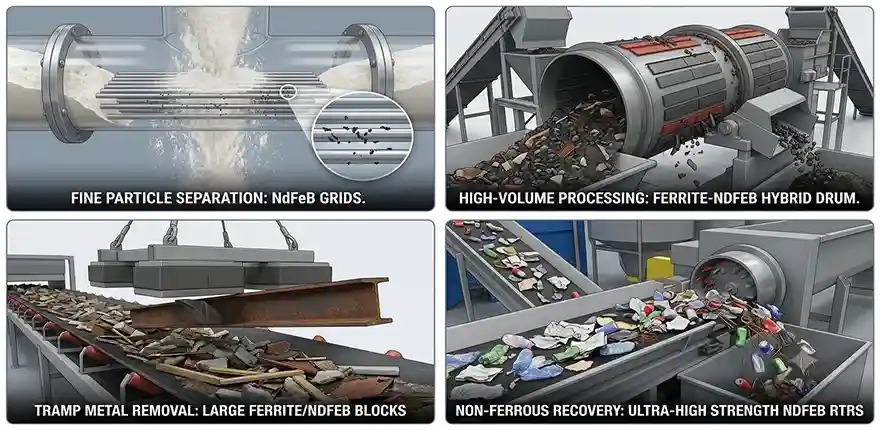
Magnetic Grid Separators and Drawer Magnets
- Recommended Magnet: High-performance Imanes de NdFeB
- Application Logic: These magnetic separator magnets are designed for powders, granules, and liquid materials where the goal is to capture extremely fine metallic contaminants. NdFeB magnets can provide magnetic field strengths of 8,000–12,000 Gauss within compact spaces, ensuring maximum contaminant capture efficiency.
Magnetic Drum Separators
- Recommended Magnet: Ferrite magnets or Ferrite-NdFeB hybrid magnetic systems
- Application Logic: Magnetic drum separators are commonly used for high-volume ore processing and recycling operations. Ferrite magnets offer low cost and broad magnetic coverage, while hybrid systems use NdFeB magnets to enhance surface attraction. Together, they provide optimal capture depth and processing capacity.
Overband Magnetic Separators and Cross Belt Separators
- Recommended Magnet: Ferrite magnets or custom NdFeB blocks
- Application Logic: These magnetic separator systems are installed above conveyor belts and are designed to remove large ferrous contaminants from bulk material streams. This prevents tramp metal from entering downstream crushers and other processing equipment, reducing maintenance costs and equipment damage.
Eddy Current Separators
- Recommended Magnet: Ultra-high-strength Imanes de NdFeB
- Application Logic: Widely used in recycling facilities, eddy current separators utilize rapidly changing magnetic fields to generate repulsive forces that separate non-ferrous metals such as aluminum and copper from mixed waste streams.
Typical Applications of Magnetic Separator Magnets
- Mining Industry
Magnetic separator magnets are used to remove tramp iron from ore streams and protect downstream processing equipment. - Food Processing Industry
Used to remove metallic contaminants from flour, sugar, spices, grains, and dairy products to ensure product safety and quality. - Recycling Industry
Used for separating ferrous and non-ferrous metals from mixed waste streams. - Pharmaceutical Industry
Ensures product purity and helps manufacturers comply with strict regulatory standards. - Chemical Industry
Protects pumps, mixers, and downstream processing systems while improving final product quality.
How to Select the Right Magnet for a Magnetic Separator
Material Characteristics
- Particle Size and Flow Rate: Fine powders typically require high-gradient magnetic grid separators, while large bulk materials often require magnetic drum separators with deeper magnetic penetration.
- Material Condition: Is the material dry or wet? Wet processing environments may require enhanced sealing and corrosion protection to prevent magnet degradation.
Contaminant Type and Separation Requirements
If the objective is to remove micron-sized contaminants, such as in food processing applications, NdFeB magnets are usually required. For removing large ferrous objects, ferrite magnets may be a more economical solution.
Temperatura de funcionamiento
Operating temperature is one of the most frequently overlooked factors in magnet selection. If the production line involves heating or cooling processes, the maximum operating temperature must be clearly specified to avoid performance loss caused by demagnetization.
Maintenance and Operating Costs
- Permanent Magnets: Low operating cost and minimal maintenance requirements.
- Electromagnets: Greater flexibility but require continuous power consumption and additional maintenance.
Conclusión
Imanes are the core component of every magnetic separator. From powerful rare earth magnets used for high-gradient separation to adjustable electromagnets designed for heavy industrial systems, selecting the right magnet technology is essential for achieving optimal separation performance.
If you are facing challenges in magnet selection, TOPMAG’s engineering team can recommend the most solución magnética adecuada based on your material characteristics, separation requirements, and operating conditions.
Algunas preguntas frecuentes
Why does a magnetic separator lose performance over time?
Common reasons include high temperature exposure, surface contamination buildup, o internal corrosion due to sealing failure.
How often should magnetic separators be cleaned?
Cleaning frequency depends on contamination levels. For continuous operation, self-cleaning systems are recommended.
Is higher magnetic field always better?
Not necessarily. Excessively high magnetic fields may cause particle buildup and reduce separation efficiency due to shielding effects.
Does magnet shape affect performance?
Yes. Magnet geometry influences field distribution and gradient, which directly impacts separation efficiency.
Why are magnetic separators polished?
Mirror polishing reduces material adhesion, improves hygiene, and enhances separation performance, especially in food and pharmaceutical applications.
Para más información, consulte estos blogs relacionados:
Why Do Neodymium Magnets Need Edge Treatment?
What is Passivation for NdFeB Magnets?
How Segmented Magnets Reduce Eddy Current Loss
Arc Magnet vs Block Magnet: Key Differences in Motor Applications
¿Listo para mejorar tu proyecto? Consulte nuestra gama completa de productos en TOPMAG!🧲

Estoy dedicado a la divulgación científica sobre imanes. Mis artículos se centran principalmente en sus principios, aplicaciones y anécdotas industriales. Nuestro objetivo es proporcionar a los lectores información valiosa, ayudándoles a comprender mejor la fascinación y la importancia de los imanes. Al mismo tiempo, estamos ansiosos por conocer tus opiniones y necesidades relacionadas con los imanes. ¡Síguenos y participa activamente mientras exploramos juntos las infinitas posibilidades de los imanes!