
Ferrite Beads: How They Work and How to Choose the Right One
- Ethan
- Base de conocimientos
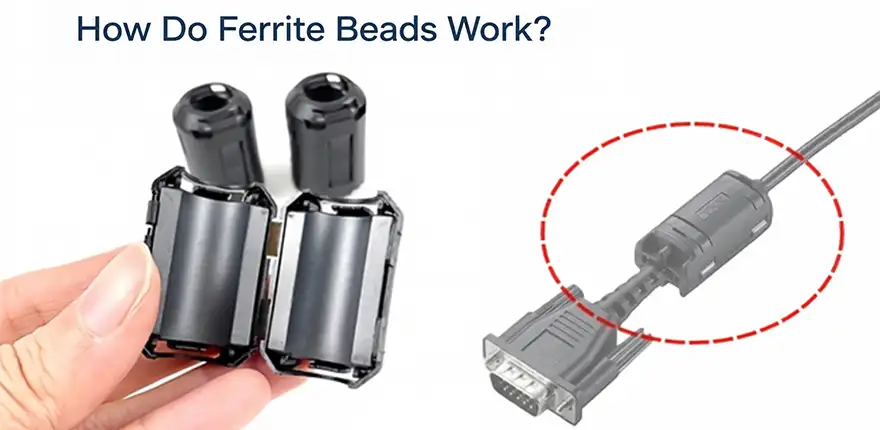
In modern electronic circuit design, ferrite beads are common yet essential passive components. They are widely used in computer motherboards, smartphones, power adapters, and communication equipment. Their main function is to suppress high-frequency electromagnetic interference (EMI).
Contenido
Principales conclusiones
Ferrite beads suppress high-frequency EMI through their frequency-dependent impedance.
Their resistive impedance converts part of the noise energy into heat.
Different ferrite bead types suit different installation methods and applications.
Proper selection requires considering impedance, rated current, DC resistance, and package size.
Effective noise suppression depends on matching the bead’s impedance to the target noise frequency and circuit conditions.
What Is a Ferrite Bead?
A ferrite bead is a passive component used to suppress high-frequency electromagnetic interference (EMI). It converts some high-frequency noise energy into heat while minimizing its impact on useful signals. Unlike ordinary capacitors or inductors, which mainly store energy or provide filtering through reactive impedance, ferrite beads use their frequency-dependent impedance and material losses to attenuate noise.
In appearance, a ferrite bead resembles a small inductor. Its internal structure typically consists of a conductive path surrounded by a ferrite magnetic core.
How Do Ferrite Beads Work?
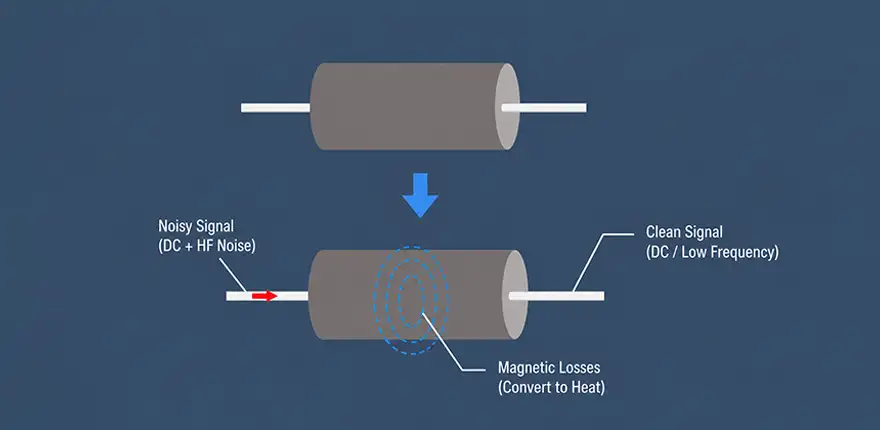
The working principle of ferrite beads is mainly related to their frequency-dependent impedance and magnetic core losses.
When current flows through a conductor, it generates a magnetic field around the conductor. According to the principle of electromagnetic induction, a changing magnetic field produces an electric field. Under an alternating magnetic field, the ferrite material responds magnetically and generates energy losses.
At low frequencies, the induced electric field in the ferrite material is relatively weak, resulting in lower losses. As the frequency increases, the losses generally become more significant within the bead’s effective operating range. This allows ferrite beads to absorb or impede high-frequency noise, making them effective components for EMI suppression.
To understand the actual filtering performance of a ferrite bead, it is important to examine its impedance-frequency characteristics.
Equivalent Circuit Model:
At low frequencies, a ferrite bead can be represented by a low-value resistance and an inductance. At higher frequencies, its resistive component may become dominant, allowing it to behave more like a resistor.
Three Frequency Regions:
Low-Frequency Region: The impedance is relatively low, and the reactive component is dominant. At this stage, the ferrite bead has little effect on DC or low-frequency useful signals, allowing them to pass with relatively little attenuation.
Mid-Frequency Region: The reactive components interact with parasitic capacitance. The ferrite bead may exhibit high resistive impedance, creating greater opposition to high-frequency noise.
High-Frequency Region: Parasitic capacitance and other high-frequency effects may change the impedance characteristics. As a result, the impedance may level off or decrease.
Different ferrite beads have different impedance curves. Therefore, you should select a product that matches the target noise frequency based on the manufacturer’s impedance-frequency curve. Actual performance should also be verified through testing in the application circuit.
Types of Ferrite Beads
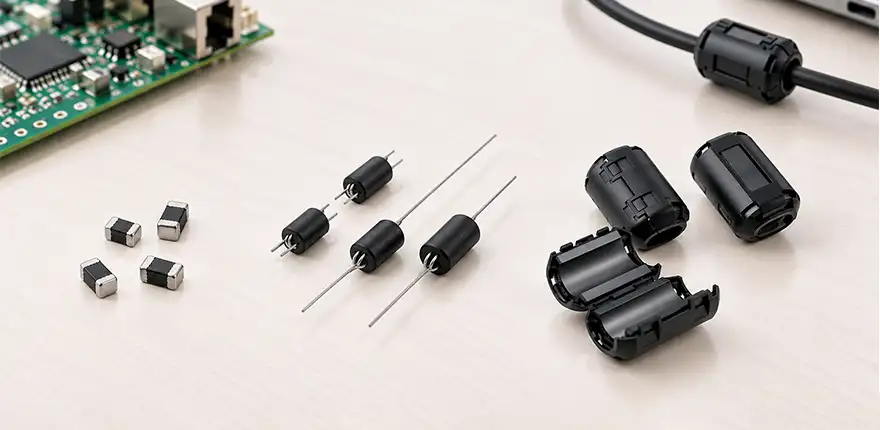
Based on their common structures and installation methods, ferrite beads can be divided into the following types:
Surface-Mount Ferrite Beads: These are widely used on PCB power lines and signal lines. Common package sizes range from 0201 to 1812. They are suitable for automated, high-speed SMT assembly.
Axial Ferrite Beads: These beads have lead wires and are installed on circuit boards through through-hole mounting. They are suitable for electronic designs that use through-hole components.
Clamp-On Ferrite Cores: These have a detachable structure, usually with a plastic housing. They can be clipped directly onto external cables, such as laptop power cables. They have a different structure and installation method from ferrite beads soldered onto PCBs.
How to Choose the Right Ferrite Bead
Suitable Rated Current: When DC current flows through a ferrite bead, excessive current may cause overheating or affect its magnetic performance. The selected bead should have a rated current that meets or exceeds the circuit’s maximum operating current. Temperature rise and actual operating conditions should also be considered.
Appropriate DC Resistance (DCR): The DC resistance of a ferrite bead affects voltage drop and power loss in the circuit. In high-current applications, excessive DC resistance may cause voltage drops and additional heat. This can reduce power efficiency and affect circuit performance.
Impedance at the Target Frequency: Check the impedance-frequency curve provided by the manufacturer. Make sure the bead provides sufficient impedance at the noise frequency you need to suppress. Do not focus only on its maximum impedance peak.
Suitable Package Size: Choose a package size that matches the PCB layout and assembly process while meeting the required electrical performance. Even if a ferrite bead has suitable impedance characteristics, poor PCB layout may prevent it from achieving the expected noise suppression performance.
Conclusión
Ferrite beads are simple, cost-effective, and widely used EMI suppression components in electronic circuit design. They help protect sensitive digital and analog circuits from electromagnetic interference by converting part of the high-frequency noise energy into heat.
With proper ferrite bead selection and practical testing, designers can improve noise suppression and enhance the electromagnetic compatibility (EMC) of electronic devices.
Work with TOPMAG to Explore the Right Magnetic Solutions
At TOPMAG, we believe that the right magnetic solution starts with a clear understanding of application requirements. From material selection and design optimization to custom magnetic components, we work with customers to develop solutions that meet their project needs.
Whether you are developing a new product or optimizing an existing design, we welcome the opportunity to discuss your requirements and explore suitable magnetic solutions together.
Algunas preguntas frecuentes
Do Ferrite Beads Affect Signal Quality?
Yes. Ferrite beads introduce frequency-dependent impedance. If this impedance affects the useful signal frequency range, it may cause signal attenuation or waveform distortion. For high-speed signal applications, their impact on signal integrity should be carefully evaluated.
Where Should Ferrite Beads Be Placed on a PCB?
Ferrite beads are usually connected in series with the power or signal lines that require filtering. For power supply filtering, their placement should be considered together with decoupling capacitors, grounding paths, and PCB layout. Keeping critical current loops as short as possible helps improve filtering performance.
Do Ferrite Beads Have Polarity?
No. Standard ferrite beads are non-polarized components and can generally be installed in either direction. However, the specific circuit design and manufacturer’s installation requirements should always be followed.
Can a Ferrite Bead Replace an Inductor?
Not necessarily. Ferrite beads are mainly used to suppress noise within specific high-frequency ranges. Inductors are commonly used for energy storage, filtering, and power conversion. Their electrical characteristics and functions are different. The choice depends on the circuit’s function and frequency requirements.
Why Is EMI Not Improved After Installing a Ferrite Bead?
This may happen because the impedance characteristics of the ferrite bead do not match the target noise frequency. Other factors may also affect the results, including PCB layout, grounding, DC bias, and resonance. Check the noise spectrum, ferrite bead specifications, and overall filtering network. Practical testing is also necessary to verify the actual performance.
Para más información, consulte estos blogs relacionados:
How to Measure Surface Magnetic Field with a Gaussmete?
Injection Molded Ferrite Ring Magnets for Fan Motors | TOPMAG
Guía de ahorro de electricidad del ventilador de techo BLDC
Guía definitiva sobre el ruido de los ventiladores de techo
Causas comunes del bamboleo del ventilador de techo
¿Listo para mejorar tu proyecto? Consulte nuestra gama completa de productos en TOPMAG!🧲

Estoy dedicado a la divulgación científica sobre imanes. Mis artículos se centran principalmente en sus principios, aplicaciones y anécdotas industriales. Nuestro objetivo es proporcionar a los lectores información valiosa, ayudándoles a comprender mejor la fascinación y la importancia de los imanes. Al mismo tiempo, estamos ansiosos por conocer tus opiniones y necesidades relacionadas con los imanes. ¡Síguenos y participa activamente mientras exploramos juntos las infinitas posibilidades de los imanes!