COMPRESSION BONDED MAGNETS
What Are Compression Bonded Magnets?
Compression bonded magnets are permanent magnets made by mixing magnetic powder with a polymer binder. The mixture is compressed under high pressure at room temperature and then cured. Compression bonded NdFeB magnets are the most common type of compression bonded magnets. Compared with injection molding, compression molding can usually achieve a higher magnetic powder content. Therefore, compression bonded NdFeB magnets generally offer higher magnetic performance while retaining the good dimensional consistency and design flexibility of bonded magnets.

Classification of Compression Bonded NdFeB Magnets
Based on the arrangement of the magnetic powder particles, compression bonded magnets can be divided into:
- Isotropic Magnets: The magnetic powder particles have no fixed orientation. The magnet can be magnetized in different directions after compression. This provides high flexibility in product design.
- Anisotropic Magnets: The magnetic powder is aligned by a magnetic field before compression. The magnetic performance is significantly improved along the orientation direction. However, the magnetization direction must be consistent with the orientation direction.
Anisotropic magnets provide significantly higher performance in the orientation direction than isotropic magnets. However, they are limited to magnetization along the orientation direction. The choice depends on the required magnetic performance and magnetization flexibility of the product.
Compression Bonded Magnets Manufacturing Process
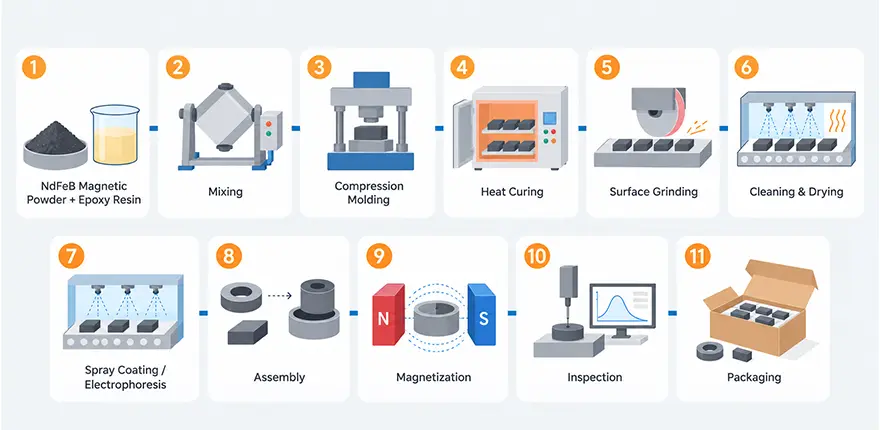
Compression bonded magnets are produced by compressing magnetic powder and binder to form the required magnet structure. For compression bonded NdFeB magnets, the main manufacturing process includes:
NdFeB Magnetic Powder + Epoxy Resin → Mixing → Compression Molding → Heat Curing → Surface Grinding → Cleaning & Drying → Spray Coating / Electrophoresis → Assembly → Magnetization → Inspection → Packaging
Compression molding and heat curing are used to form a stable magnet structure. Subsequent grinding and surface treatment are carried out according to the product dimensions, surface condition, and operating environment requirements. After these processes, the products can be further assembled and packaged.
Magnetic Properties of Compression Bonded Magnets
The magnetic properties of compression bonded magnets are affected by the magnetic material, powder formulation, magnetic powder orientation, and other factors. The following are reference magnetic properties for compression bonded NdFeB magnets:
| Propiedad | AMP-3 | AMP-4 | AMP-5L | AMP-6 | AMP-8 | AMP-8H | AMP-9 | AMP-10 | AMP-12L | AMP-13 |
|---|---|---|---|---|---|---|---|---|---|---|
| Residual Induction Br (mT) | 350–500 | 450–550 | 490–600 | 550–650 | 600–680 | 650–750 | 620–720 | 650–750 | 700–800 | 750–850 |
| Residual Induction Br (kGs) | 3.5–5.0 | 4.5–5.5 | 4.9–6.0 | 5.5–6.5 | 6.0–7.0 | 6.5–7.5 | 6.2–7.2 | 6.5–7.5 | 7.0–8.0 | 7.5–8.5 |
| Coercive Force Hcb (kA/m) | 200–280 | 240–336 | 280–360 | 304–440 | 320–440 | 416–520 | 400–480 | 400–520 | 360–480 | 440–520 |
| Coercive Force Hcb (kOe) | 2.5–3.5 | 3.0–4.2 | 3.5–4.5 | 3.8–5.5 | 4.0–5.5 | 5.2–6.5 | 5.0–6.0 | 5.0–6.5 | 4.5–6.0 | 5.5–6.5 |
| Intrinsic Coercive Force Hcj (kA/m) | 320–560 | 360–704 | 352–600 | 360–640 | 560–680 | 840–1040 | 600–760 | 640–800 | 520–640 | 640–800 |
| Intrinsic Coercive Force Hcj (kOe) | 4.0–7.0 | 4.5–8.8 | 4.4–7.5 | 4.5–8.0 | 7.0–8.5 | 10.5–13.0 | 7.5–9.5 | 8.0–10.0 | 6.5–8.0 | 8.0–10.0 |
| Maximum Magnetic Energy Product (BH)max (kJ/m³) | 16-32 | 28–44 | 37–48 | 44–60 | 60–76 | 72–88 | 68–80 | 70–88 | 80–96 | 88–108 |
| Maximum Magnetic Energy Product (BH)max (MGOe) | 2.0–4.0 | 3.5–5.5 | 4.7–6.0 | 5.5–7.5 | 7.5–9.5 | 9.0–11.0 | 8.5–10 | 8.8–11.0 | 10.0–12.0 | 11.0–13.5 |
| Saturated Magnetic Field Hs | ≥1300 | ≥1600 | ≥1300 | ≥1300 | ≥1600 | ≥2000 | ≥1600 | ≥1600 | ≥1600 | ≥1600 |
| Saturated Magnetic Field (kOe) | ≥16 | ≥20 | ≥16 | ≥16 | ≥20 | ≥25 | ≥20 | ≥20 | ≥20 | ≥20 |
| Recoil Permeability (μrec) | 1.2 | 1.2 | 1.2 | 1.2 | 1.2 | 1.2 | 1.2 | 1.2 | 1.2 | 1.2 |
| Average Reversible Temperature Coefficient α (Br) | -0.12 | -0.12 | -0.12 | -0.12 | -0.12 | -0.12 | -0.12 | -0.12 | -0.12 | -0.12 |
| Curie Temperature (°C) | 305 | 305 | 305 | 305 | 305 | 305 | 305 | 305 | 305 | 305 |
| Temperatura máxima de funcionamiento (°C) | 120 | 120 | 120 | 150 | 160 | 180 | 160 | 160 | 160 | 160 |
| Density (Uncoated) (g/cm³) | 5.8–6.2 | 5.8–6.2 | 5.8–6.2 | 5.8–6.2 | 5.9–6.2 | 5.9–6.2 | 6.0–6.3 | 6.0–6.3 | 6.0–6.3 | 6.0–6.3 |
Magnetization Options
Compression bonded magnets support various magnetization options. The available options depend on whether the magnetic powder is isotropic or anisotropic.
| Magnetization Method | Descripción | Applicable Type |
|---|---|---|
| Axial Magnetization | Magnetized along the axial direction of the magnet. Commonly used for disc and cylindrical magnets. | Isotropic, Anisotropic |
| Radial Magnetization | Magnetized along the radial direction. Commonly used for ring magnets and rotors. | Isotropic, Anisotropic* |
| Multi-Pole Magnetization | Multiple alternating magnetic poles are created on the magnet. Multi-pole patterns can be arranged in the axial or radial direction according to the magnet structure and application. | Mainly Isotropic |
| Magnetización sesgada | The magnetization direction or magnetic pole boundaries are arranged at an angle. It can be used to create a skewed magnetic field pattern. | Mainly Isotropic |
| Other Customized Magnetization | Special magnetization patterns can be produced according to the product design and application requirements. | Subject to product structure |
* For anisotropic magnets, the magnetization direction must match the magnetic orientation direction.
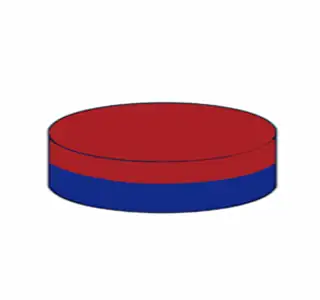
Axial Magnetization

Radial Magnetization

Multi-Pole Magnetization

Magnetización sesgada
Engineering Support & Simulation Capabilities
Beyond standard bonded magnet supply, we offer field measurement and motor simulation services. These help customers validate magnet design before mass production. This reduces trial-and-error costs.
Field Measurement: We use 3D magnetic field scanning equipment. It maps the surface field distribution of bonded magnets with high precision. Output includes 2D, polar plot, and 3D views. This verifies magnetization quality and multi-pole consistency. It can also detect internal cracks through field anomalies.
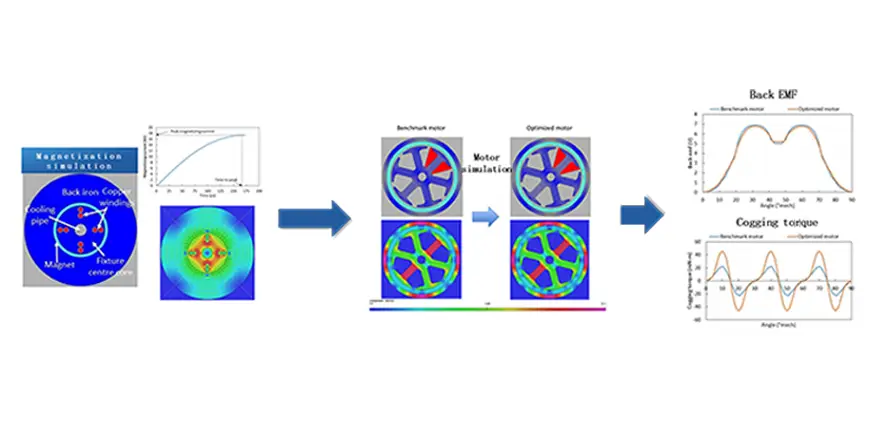
Motor Simulation: We simulate the magnetization fixture and magnetizing current curve. This confirms whether the magnet reaches full saturation. We also run motor-level simulations using your magnet design. This compares back EMF and cogging torque across different pole designs. It helps optimize motor performance before tooling begins.